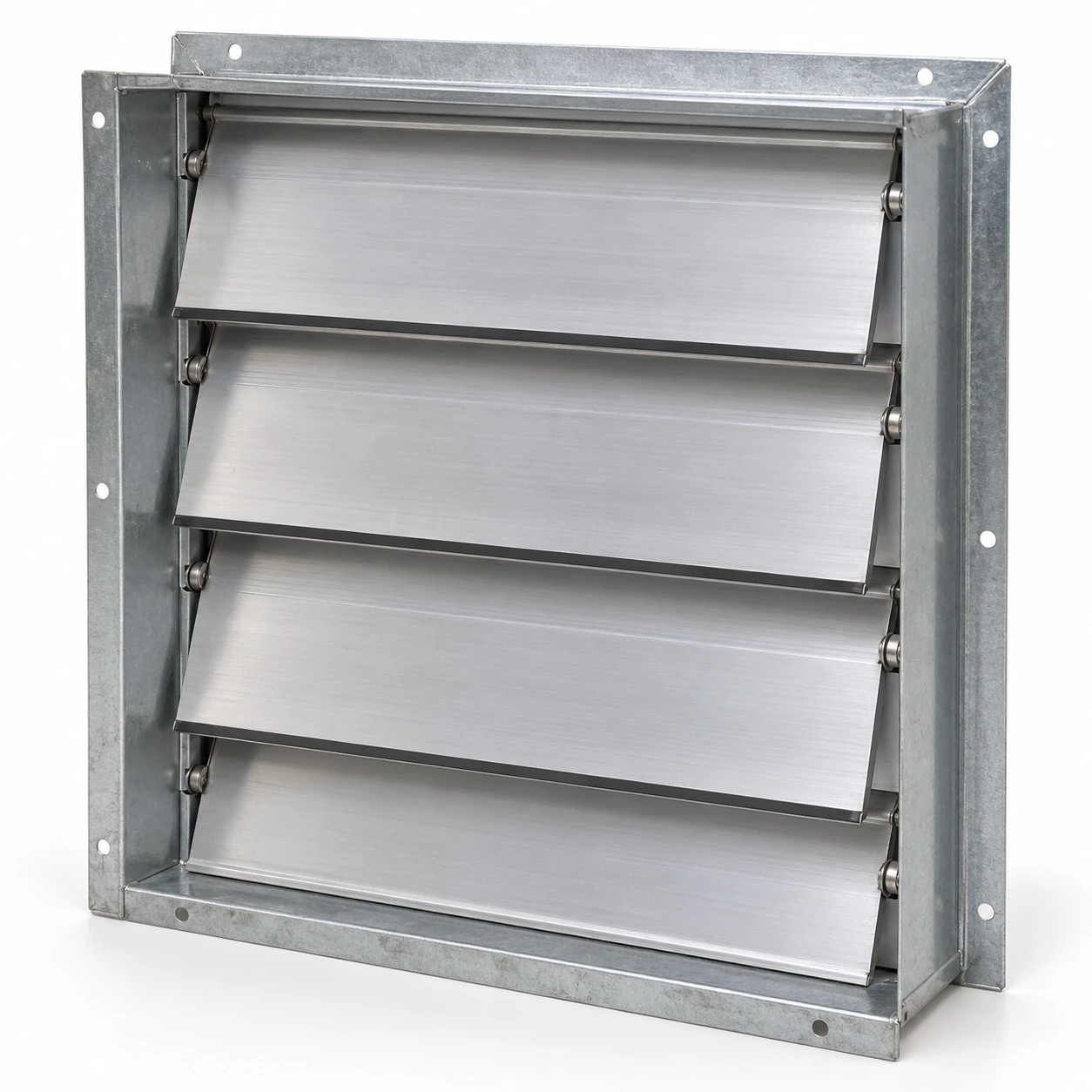
Air Volume Control Dampers
backdraft dampers
| Nominal rectangular W × H | 254 × 254 mm; 305 × 305 mm; 457 × 457 mm |
|---|---|
| Compact frame depth | 98 mm for the selected rectangular construction; flange and blade projection specified separately |
| Frame / blades | Galvanized steel frame with aluminum blades; alternative materials selected for the air stream |
| Operation | Pressure-open, gravity-close; spring or counterbalance assistance according to type |
| Installation | Vertical frame for horizontal flow, or a separate construction for vertical upflow or downflow |
| Connection | Duct insert, intake flange or discharge flange |
| Performance selection | Start-open pressure, operating pressure loss and reverse leakage assessed at the required duty |
W × H identifies the nominal duct opening, not the outside flange or unobstructed free area. Inch-based nominal dimensions are rounded to millimetres. The final drawing defines frame clearance and the full blade travel envelope.
Backdraft damper size, connection, blade assistance and materials can be customized to the airflow direction and installation conditions.
Backdraft dampers open for airflow in the intended direction and close when that driving force falls away or reverses. They help limit unwanted airflow through inactive ventilation paths, with the blade arrangement selected for the duct position and operating conditions.
Opening the blades is only the first step
A passive damper responds to the pressure difference across its blades. Forward pressure produces an opening force; blade weight, a spring or the selected balancing arrangement provides a closing force. The blades settle at a position determined by those forces and the airflow. They do not necessarily move directly from fully closed to fully open when a fan starts.
Start-open pressure
This is the pressure needed to begin moving the blades. It does not describe the pressure required for full opening or the resistance at the intended airflow.
Operating pressure loss
Air passing through the frame and blade bank uses part of the available fan pressure. Include the relevant loss in the system calculation, especially at a reduced fan speed.
Reverse leakage
A closed blade bank can still pass air through blade edges, pivots and frame joints. Compare leakage at a stated pressure and direction rather than assuming closed means airtight.
These three characteristics answer different purchasing questions. A damper that opens easily may still have excessive resistance at the required volume flow. A unit with a good closed position may not meet a demanding isolation requirement. Select the complete operating range, including the lowest normal airflow and the expected reverse pressure.
Match gravity to the installation
Mounting orientation describes the plane of the damper frame as well as the direction of air travel. A frame installed vertically can serve horizontal airflow. A frame installed horizontally may serve upward or downward airflow, but those duties can require different blade and spring arrangements.
Rotating a gravity damper to fit a convenient opening can remove the force that should close it. Specify both the installed plane and the required airflow direction on the drawing. For circular duct connections, compare round backdraft dampers with the same orientation requirements.
Leave room for the moving parts
The flange outline, duct opening and clear air passage are separate dimensions. Blades may project beyond a shallow frame as they open. Nearby mesh, a duct joint or a fan inlet can interfere even when the frame fits correctly.
Fit the frame square without forcing it into a distorted opening. Tightening fixings against an uneven support can rack the frame and make a blade bind. Provide support at the frame and access to inspect movement; the blades should not carry installation loads.
What incomplete opening and rattling can mean
If the blades lift only slightly, first compare the actual fan duty with the resistance of the complete air path. A blocked screen, changed filter or restrictive terminal can reduce available airflow. An incorrectly oriented damper, a damaged pivot or a fixing that enters the blade path can produce a similar symptom. Changing the damper without identifying the cause may leave the same problem in place.
Repeated movement or chatter can occur where the operating point is close to the opening threshold or the incoming airflow is uneven. Review the location relative to elbows and fans, the selected blade assistance and the low-speed operating mode. Do not add improvised weights or remove springs to silence the assembly; those changes alter its closing behaviour.
Maintenance should keep the blade edges and pivots free of deposits that obstruct motion. Use a cleaning method compatible with the seals and bearings, and check the open and closed positions after service. A damaged seal or bent blade needs an appropriate repair rather than extra force from the fan.
Keep the function distinct
A backdraft damper is not a substitute for balancing a branch, regulating a room pressure or providing a fire and smoke barrier. Nor does it establish gas-tight isolation for a hazardous process. Where a positive isolation duty is required, review the appropriate Airtight Isolation Dampers configuration and its documented performance separately.
For a useful quotation, provide the duct connection, airflow range, reverse-pressure condition, installed orientation and air-stream temperature or contaminants. These inputs allow the frame, blade mechanism and seals to be selected together, without assigning one universal pressure or leakage rating to every available size.
Backdraft damper size, connection, blade assistance and materials can be customized to the airflow direction and installation conditions.