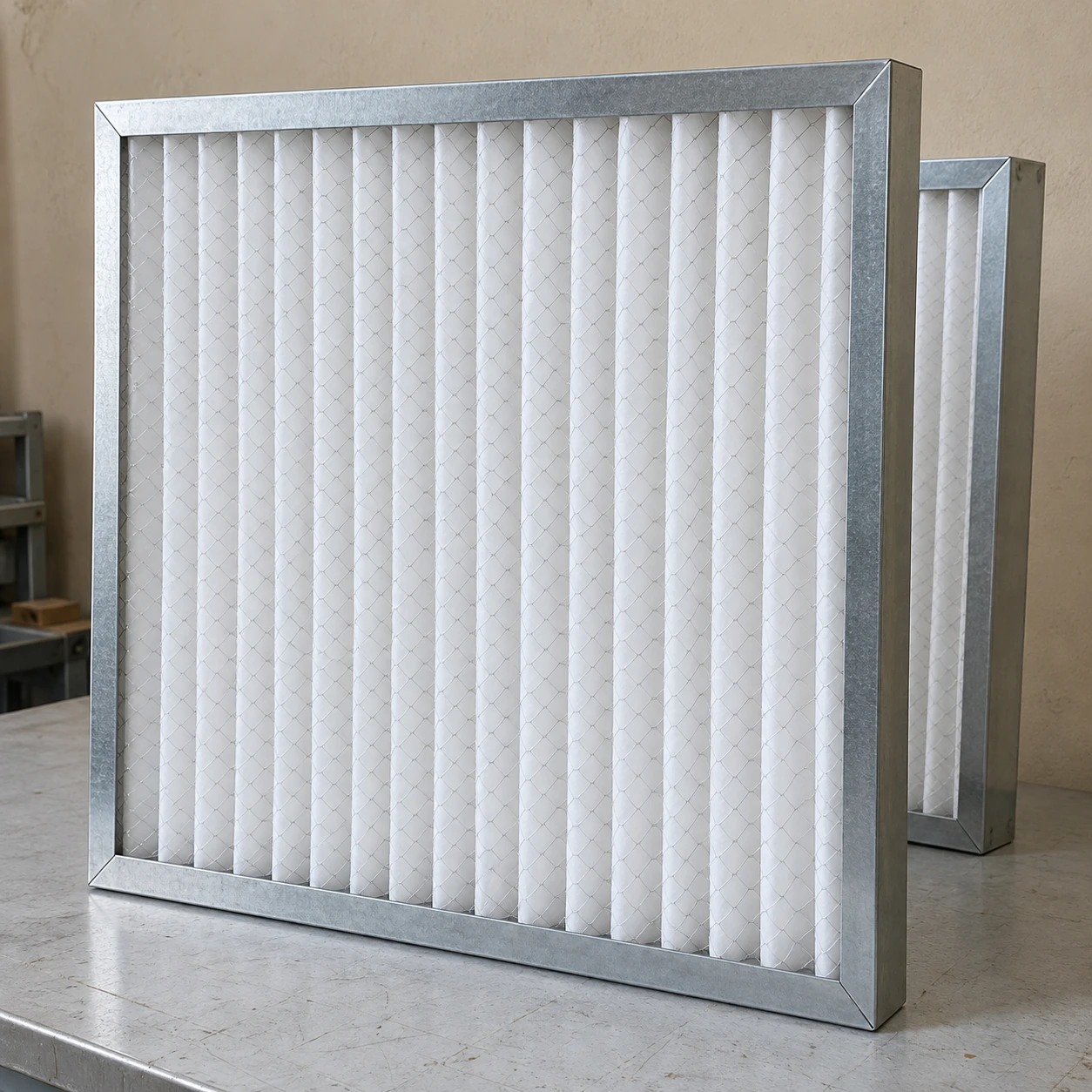
Air Filters
panel air filters
| Filter construction | Flat synthetic media or pleated particulate media |
|---|---|
| Outer face W × H (mm) | 287 × 592; 490 × 490; 592 × 592 |
| Frame depth D (mm) | 25; 48; 96, according to construction |
| Frame options | Cardboard, galvanized steel or aluminum |
| Media support | Face grid, wire backing or supported pleats |
| Sealing | Frame fit; optional perimeter gasket matched to holder |
| Performance selection | Particle class and pressure drop at the specified airflow |
Dimensions are actual outer-frame options. Nominal inch sizes and rack openings must be checked separately; media and depth combinations are selected together.
Panel dimensions, frame material, media and sealing can be customized for your equipment and operating conditions.
Panel air filters provide a replaceable filtration stage in a shallow frame. Their usefulness depends on more than the face size: the media must suit the dust, the frame must seal in its holder, and the air system must be able to move the required volume through it.
Start with the job the panel must do
A ventilation intake may need to intercept lint and coarse dust before these reach a coil. An air-handling unit may use a panel ahead of a more expensive fine filter. A machine enclosure may need a compact replaceable barrier in limited space. These uses place different demands on the same basic rectangular form.
Flat media offers a simple shallow arrangement. Pleating fits more filtering surface into the face opening, distributing the air over a larger media area when the pleats are properly supported and spaced. Tightly packed or distorted pleats can restrict that area, so appearance alone does not establish airflow performance.
Choose the particle grade for the equipment or downstream stage being protected. A coarse pre-filter should not be expected to deliver the same fine-particle control as a higher-efficiency filter. For an existing first stage, the Panel Pre-Filters range provides a related starting point.
Three replacement details that prevent avoidable trouble
Measure the frame, then inspect the holder
Record width, height and depth from the intact frame. Check the retaining channel, access opening and sealing face as well. A unit that slides into the slot but leaves a gap at its edge permits unfiltered air to pass around the media.
Check how the frame is supported
The holder must restrain the panel against airflow without crushing it. Wet or damaged cardboard, bowed rails and missing retaining clips can defeat an otherwise suitable replacement. Metal frames may be preferable where handling or moisture exposure makes a disposable card frame unsuitable.
Allow for resistance as dust accumulates
Clean-filter pressure drop is only the starting condition. As dust loads the media, resistance usually rises. Compare the proposed filter with the fan operating point and the system's change-out limit, rather than selecting a higher grade on its name alone.
More depth can help, but only where the cabinet accepts it
A deeper pleated panel can accommodate more media and may offer a useful resistance or loading advantage at a given duty. It also needs a compatible rail and enough space for installation. Extending a shallow rack with an improvised spacer may interfere with the access door or leave an unsealed joint.
If the replacement is intended to improve filtration, compare complete filter data at the same airflow and face size. A change in depth, pleat design or media can alter performance independently. Preserve the airflow required by the equipment; do not judge an upgrade solely by the cleanliness of the new media.
Dust capture and gas removal are different tasks
Standard fibrous panels collect airborne particles. Odor or a named gaseous contaminant calls for a suitable sorbent stage, such as carbon panel air filters or a chemically selected medium. Dark-colored media does not, by itself, demonstrate gas-removal capacity.
Where both duties exist, arranging particle protection ahead of a gas filter can reduce dust loading on the sorbent. The extra stage still needs space, sealing and an airflow check.
Make replacement part of normal maintenance
Record the clean pressure reading with the system at its normal flow. Inspect the media and gasket during service, and replace damaged panels even if their pressure reading appears acceptable. Do not wash a disposable fibrous or pleated panel unless the selected construction is expressly designed for cleaning.
For a quotation, send the frame dimensions, a photograph of the holder, the required particle grade and the operating airflow. These details let the replacement be matched to the installation rather than to a nominal size alone.
Panel dimensions, frame material, media and sealing can be customized for your equipment and operating conditions.