Air Filters
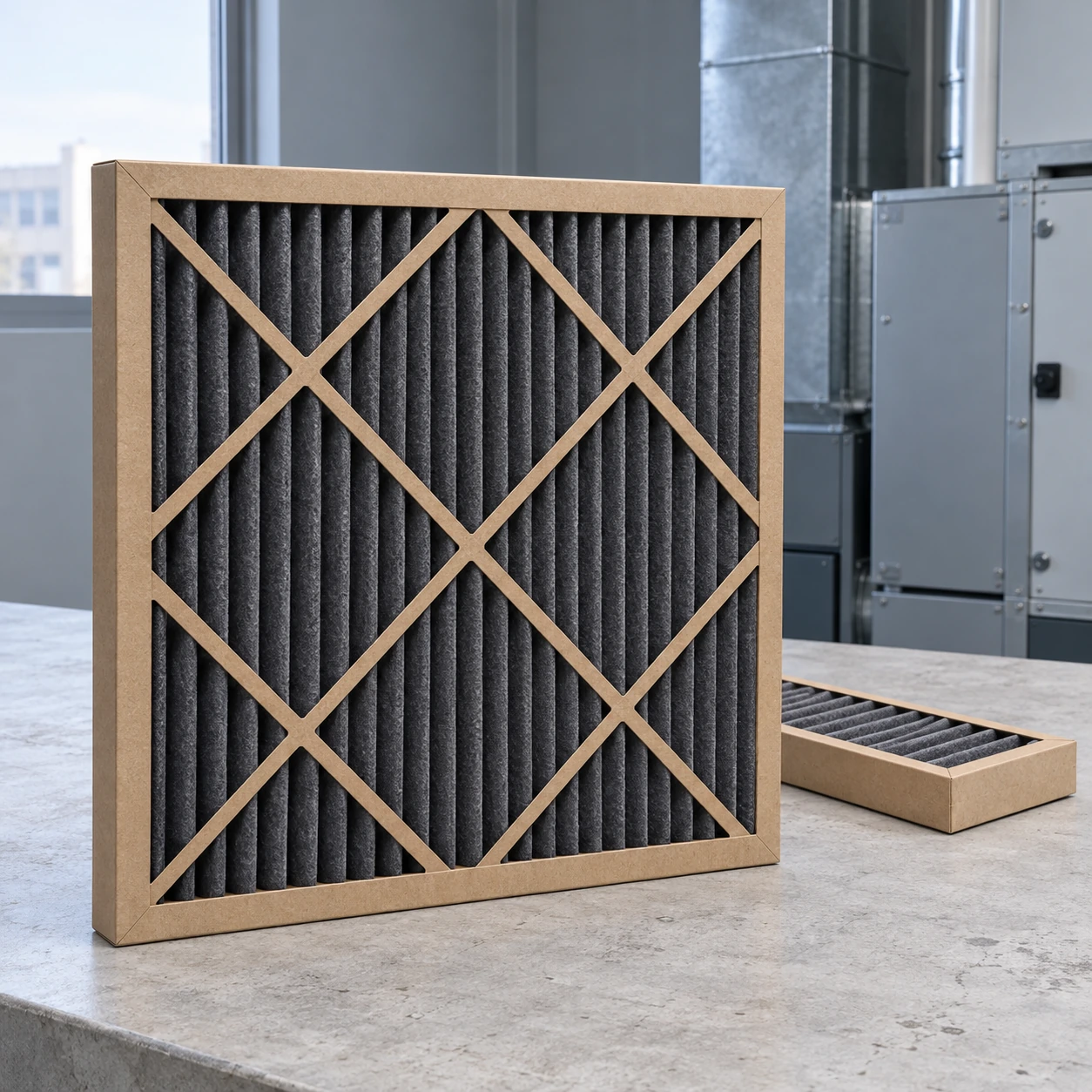
carbon panel air filters
| Primary duty | Selected odors and gas-phase organic contaminants |
|---|---|
| Pleated outer W × H × D (mm) | 594 × 594 × 44; 594 × 594 × 95 |
| Metal-panel outer W × H × D (mm) | 287 × 287 × 48; 287 × 592 × 48; 592 × 592 × 48 |
| Media forms | Carbon-loaded pleated media; bonded or retained carbon |
| Frame selection | Moisture-resistant cardboard or metal, by construction |
| Installation | Compatible front- or side-access holder; perimeter seal as required |
| Comparison data | Active media quantity, gas capacity and resistance at duty airflow |
| Replacement basis | Contaminant loading, operating history and gas-performance checks |
The pleated and metal-panel dimensions belong to different construction options. Their frames, seals and media are not automatically interchangeable.
Carbon panel dimensions, construction, frame and sealing can be customized for the available space and the contaminant duty.
Carbon panel air filters bring an adsorbent into a compact ventilation filter. The panel format is convenient for limited installation space, but the amount and arrangement of active carbon determine how much work the filter can perform before replacement.
A dark face can hide very different constructions
Carbon-loaded pleated media
Carbon is carried within or on a fibrous medium folded into pleats. This format can combine particle collection with some gas adsorption in a compact frame. Its large visible media area should not be confused with the carbon mass of a deeper sorbent bed.
Bonded carbon panels
Carbon is held in a stable porous structure. Retention and airflow paths are part of the construction, so comparisons should consider the finished panel. A statement about the raw carbon's activity does not describe every effect of forming it into a filter.
Retained granular media
Granules are enclosed within a supported panel or tray. The faces and internal retention must keep the charge in place during handling and operation. Gaps caused by poor filling, settling or damaged retainers can create paths with little useful contact.
Look beyond the color and face area
Adsorption occurs at the carbon's available surfaces and pores. Different compounds interact with that structure differently, and the air stream may contain competing gases or moisture. Ordinary activated carbon is not a universal treatment for every chemical contaminant.
The practical comparison is between complete filters under the intended conditions. Ask how much active material is present, how the air passes through it and what data exists for the target substance. A heavier panel is not necessarily better if the extra mass is mainly its frame or if the resulting resistance prevents the system from reaching its required airflow.
For contaminants needing a chemically selected medium, compare chemical panel air filters. This distinction matters when the purpose is control of a named gas rather than general odor reduction.
A thin replacement slot places a real limit on capacity
A shallow carbon panel can be useful for a modest gas load where the chosen medium has suitable affinity and the airflow is appropriate. It has limited space for active material. A high or continuous contaminant load may exhaust that material too quickly for a practical service interval.
Increasing depth or using a dedicated sorbent housing can provide more media and a different contact arrangement, but requires space and a revised airflow assessment. Adding another thin panel to an existing rack is not automatically equivalent: the system must tolerate the extra resistance, and every edge still needs to seal.
Two different reasons to change the filter
The air path becomes restricted
Particles can load a combined carbon panel or collect on its protective face. Rising differential pressure helps reveal this condition when readings are taken at comparable flow. Suitable upstream particle filtration can reduce avoidable loading on the carbon stage.
The carbon loses useful capacity
The adsorbent can approach breakthrough while the air path remains relatively open. A normal pressure reading therefore does not prove that gas removal is still adequate. Use the selected gas-performance or media-life assessment method alongside the airflow check.
Replacement timing depends on the contaminant concentration, operating hours and the acceptable downstream condition. A fixed calendar interval copied from another building may be inappropriate. Keep records that connect actual duty to the observed performance of the selected configuration.
Handle the unused panel as an active material
Keep protective packaging intact until the panel is ready to be installed. Avoid storage beside solvents, fuels or other strong emission sources. Inspect frame and media retention before fitting, then follow the specified direction and sealing arrangement.
Do not assume that washing, heating or drying an ordinary disposable carbon panel restores its adsorption capacity. Replacement and disposal should follow the selected product instructions and the contaminants it has collected. For the broader product family, see Activated Carbon Air Filters.
Carbon panel dimensions, construction, frame and sealing can be customized for the available space and the contaminant duty.