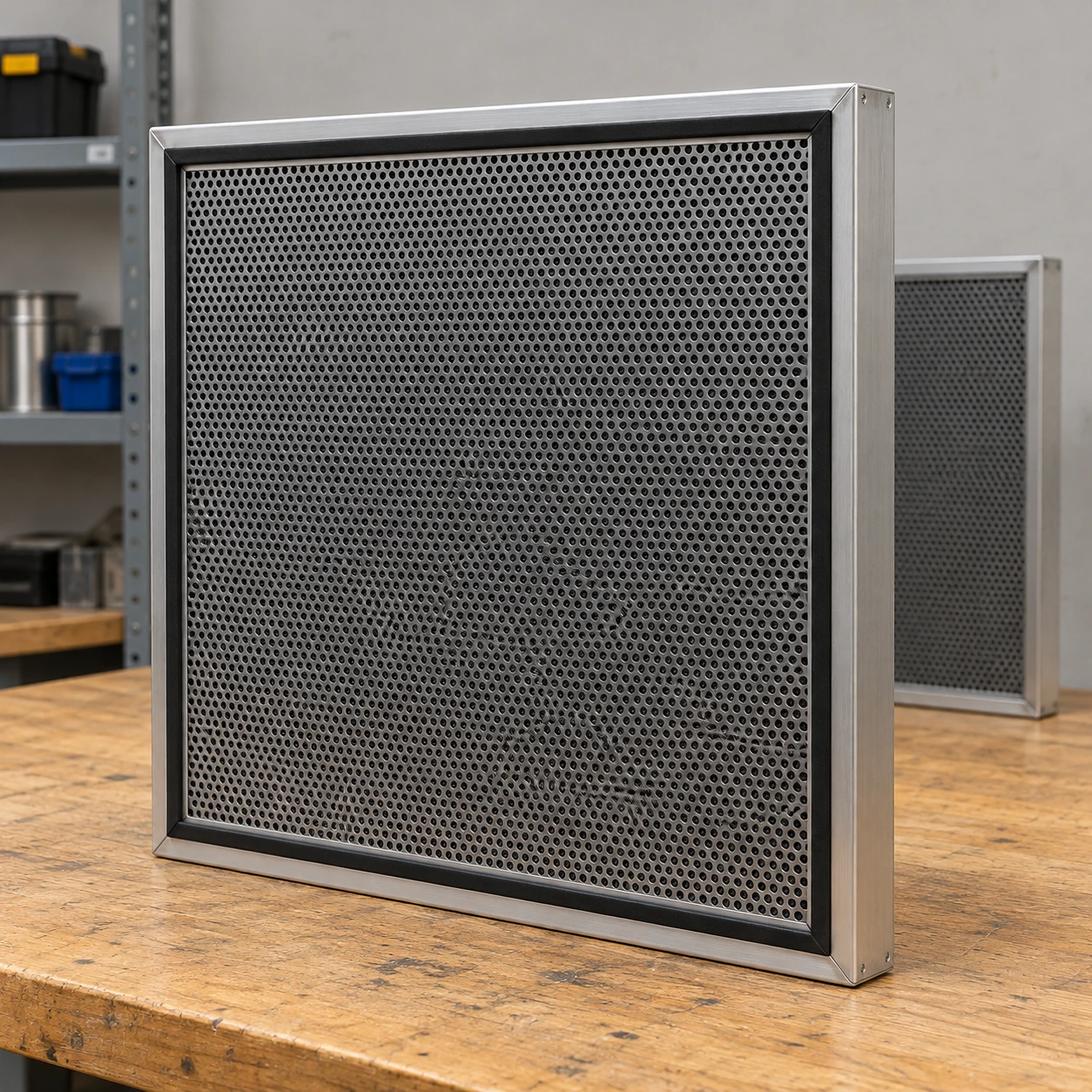
Air Filters
chemical panel air filters
| Filter duty | Targeted gas and vapor filtration |
|---|---|
| Outer W × H × D (mm) | 287 × 287 × 48; 287 × 592 × 48; 592 × 592 × 48 |
| Media selection | Activated carbon, treated carbon or other selected chemical sorbent |
| Panel structure | Supported sorbent sheet or retained / bonded media |
| Frame options | Galvanized steel or aluminum |
| Seal options | Perimeter gasket and seal face matched to housing |
| Operating inputs | Target gas, concentration, airflow, temperature and humidity |
| Performance evidence | Gas-specific efficiency and capacity under stated test conditions |
Frame sizes do not establish gas-removal performance. The selected medium, media quantity and airflow must be confirmed as one configuration.
Chemical panel size, sorbent selection, frame and sealing can be customized for the target contaminants and ventilation system.
Chemical panel air filters place a gas-removal medium in a shallow filter format. They are selected for the substances in the air, rather than simply for a dust grade, and work only on the air that actually passes through the active medium.
Name the contaminant before choosing the medium
An odor complaint describes an experience, not a complete filtration specification. The source may involve organic vapors, an acidic gas, an alkaline gas or a mixture. A medium effective for one substance can have limited usefulness for another, even when both are sold as chemical filters.
Activated carbon can be useful for many organic compounds. Treated carbon and other chemically active sorbents are selected for particular reactions or contaminant groups. Selection also depends on concentration, competing substances and moisture. A generic black panel should not be accepted as evidence that all chemical gases will be removed.
Connect the source, the airflow and the installation
Identify the incoming load
Distinguish outdoor pollution from a process source within the building. Record whether the release is continuous or intermittent, and identify peak conditions where available. A panel used in a supply-air system receives a different duty from one exposed directly to a concentrated process exhaust.
Match contact with the media
Air needs sufficient contact with the selected sorbent. A shallow panel can fit where a deeper bed cannot, but its available media volume is limited. Higher flow through the same face can reduce contact and increase resistance; increasing the amount of active material also has practical limits.
Close the bypass path
Air can follow a loose edge, an unsealed retaining channel or a gap between panels. The media chemistry cannot correct this path. Specify the sealing face and retainers, and check that the gasket is compressed evenly without distorting the frame.
Protect the sorbent from avoidable fouling
Coarse dust can accumulate on a gas filter without contributing useful gas capacity. An upstream particulate stage helps protect the sorbent where the incoming stream carries particles. Its own loading must be managed so that the air system continues to deliver the required volume.
A downstream particle-control stage may also be needed where the process is sensitive to media shedding. This depends on the complete filter construction and the cleanliness requirement; low-shedding language for one manufacturer's product should not be applied to all chemical panels.
Use evidence for the gas, not a borrowed particle rating
A particle classification describes particle capture under its test conditions. It does not quantify adsorption capacity or gas breakthrough. Ask for the challenge substance, inlet concentration, airflow, temperature, humidity and the point used to define the end of the test.
Initial removal and usable capacity answer different questions. A filter can perform well at the start yet reach breakthrough quickly under a heavy load. Comparisons are meaningful only when the conditions and the acceptance criterion are comparable.
Plan replacement around remaining function
Differential pressure helps reveal restriction. It is not a direct measurement of the sorbent's remaining chemical capacity: the medium can become exhausted without a corresponding large increase in resistance.
Use a maintenance plan based on the contaminant duty, operating history and appropriate upstream/downstream measurements or media analysis. An odor returning is a reason to investigate; absence of odor is not proof that an important contaminant is controlled.
For a straightforward carbon-based option, see carbon panel air filters. For a mixed or uncertain duty, send the available gas information and system layout with the enquiry. The decision may involve a different medium, a larger media bed or source-control work beyond a shallow panel.
Chemical panel size, sorbent selection, frame and sealing can be customized for the target contaminants and ventilation system.