Air Filters
high-efficiency particulate air filters
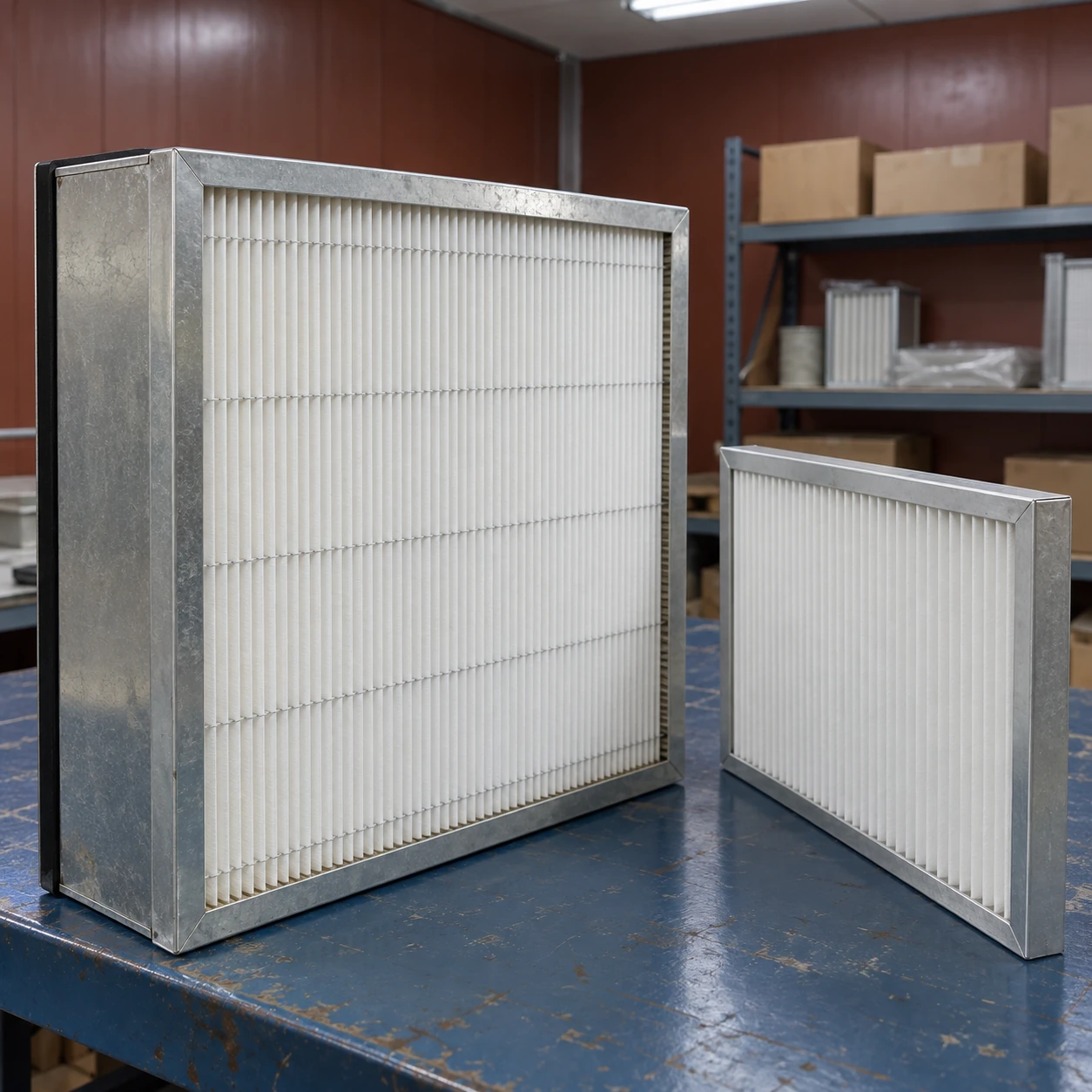
| Filter category | Rigid-frame high-efficiency particulate air element |
|---|---|
| Panel W × H × D (mm) | 305 × 610 × 66; 610 × 610 × 66; 914 × 610 × 66 |
| Deep-pack W × H × D (mm) | 610 × 610 × 292 |
| Classification | EN 1822 H13 or H14, with the required test basis stated in the order |
| Construction | Mini-pleat panel or deep separator/pleat pack |
| Frame selection | Aluminum, galvanized steel or specified stainless steel |
| Seal arrangement | Gasket compression or housing-compatible gel seal |
| Performance selection | Rated airflow, initial pressure drop and required individual test results |
| Installation acceptance | Housing seal and installed leakage verification where required by the process |
Dimensions are external frame W × H × D. Classification thresholds define a test requirement; acceptance of a supplied element depends on its corresponding identification and test documentation.
High-efficiency filter size, construction, seal and documentation requirements can be customized to the equipment and process specification.
High-efficiency particulate air filters retain particles in a dense fibrous medium. Selecting one requires a defined test basis as well as a suitable construction. The efficiency of an individual filter, leakage around its housing and the condition achieved in a room are different performance measures.
Read the efficiency number with its test conditions
A percentage without a particle size, airflow and test method is an incomplete comparison. Under EN 1822, the overall class threshold is assessed at the most penetrating particle size, or MPPS, for the filter under test. The local leakage requirement is a separate part of that assessment.
H13
The overall efficiency threshold is at least 99.95% at MPPS. Specify the class and accompanying test basis together so that an offered element can be evaluated against the intended requirement.
H14
The overall threshold rises to at least 99.995% at MPPS. The higher class still needs a compatible fan, intact media and a properly sealed installation.
The commonly quoted US HEPA description of 99.97% at 0.3 micrometres uses a different stated basis. Do not treat these descriptions as interchangeable labels or substitute a general high-efficiency HVAC rating for an explicitly specified HEPA class.
Particle capture is not a simple mesh-size cutoff
The filter uses a depth of fine fibres rather than a perforated sheet with one hole size. Particles interact with that fibre structure as the air passes through it. A stated test particle size therefore does not mean that every smaller particle travels straight through the filter.
The media pack must also remain mechanically sound. Damaged pleats or a weak bond between the pack and frame can affect performance even when the material originally met its specification. Protect the face during storage, handling and installation.
Compare resistance on equal terms
Ask for the pressure drop at the same working airflow when comparing alternatives. A lower figure at a lower flow is not evidence that one element will save energy at the required duty. Media area, construction and filter class all influence the selection.
Allow for loading over service life. The fan and controls need an agreed operating range, and the maintenance plan needs a measurable reason to replace the element before the equipment falls below its required delivery.
Keep a traceable selection
Include the filter drawing, sealing arrangement, duty point and required documentation in the purchase scope. Match the delivered identification to that record before installation. For construction choices, see HEPA filters; for a serviceable room system, see HEPA room air filtration.
High-efficiency filter size, construction, seal and documentation requirements can be customized to the equipment and process specification.