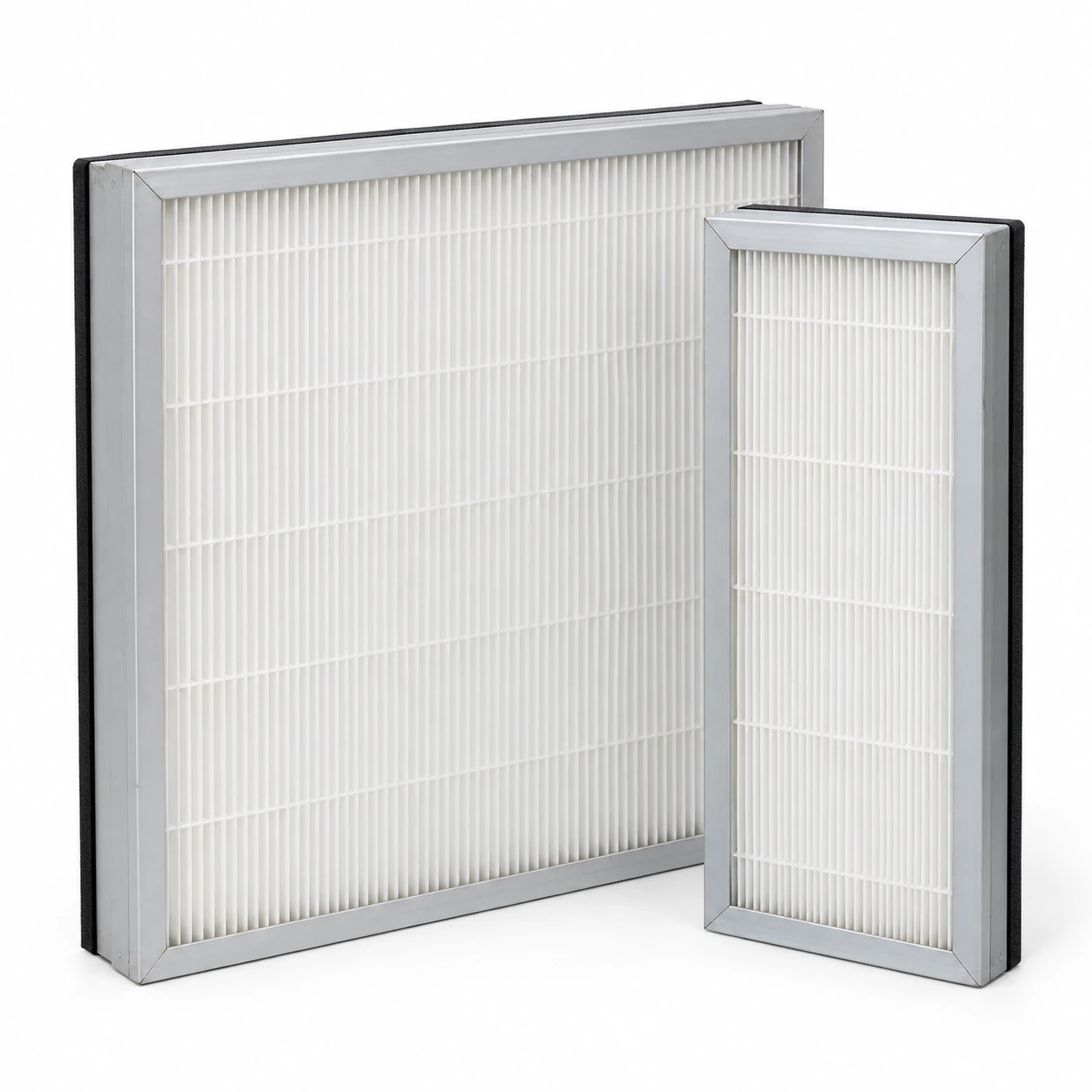
Air Filters
hepa filters
| Product format | Replaceable rigid-frame particle filter |
|---|---|
| Shallow panel W × H × D (mm) | 305 × 610 × 66; 610 × 610 × 66; 914 × 610 × 66 |
| Deep-box W × H × D (mm) | 610 × 610 × 292 |
| Filter class selection | H13 or H14 to EN 1822, specified for the selected element |
| Media construction | Mini-pleat or separator construction; media selected for the operating conditions |
| Frame | Aluminum or galvanized steel; stainless steel where required |
| Housing seal | Continuous gasket or matched gel-seal interface |
| Air duty | Airflow and initial resistance specified together for each selected size and grade |
| Supply documentation | Element identification, dimensions, flow/resistance data and required individual test record |
Dimensions refer to the outside of the filter frame, not the housing opening. Frame profile, gasket position and clamping clearance must match the receiving assembly.
HEPA filter dimensions, frame and sealing arrangements can be customized to suit the receiving equipment and operating conditions.
HEPA filters capture airborne particles in a finely structured media pack. The useful product is a complete element: media, frame, seal and a construction that fits the receiving housing. A high filter class cannot compensate for air passing around an unsealed frame.
Start with the housing and the air duty
A replacement needs to fit mechanically and allow the system to deliver its intended airflow. Record the clear opening, available depth, support ledge and location of the sealing surface. Measuring only the visible face leaves out the details that determine whether the element can be clamped correctly.
For a new installation, select the filter and fan together. More resistance can reduce delivery from an unchanged fan; increasing fan speed can change noise and power demand. Compare initial resistance at the same airflow, then allow a usable operating margin as the filter loads.
Shallow panels
Mini-pleat panels suit space-limited terminal equipment and local clean-air assemblies. The housing must support the frame evenly and leave the face protected during installation.
Deep elements
A deeper box accommodates a different media-pack arrangement and may suit an air cleaner or duct housing with sufficient service depth. Greater depth alone does not establish a higher efficiency class.
Sealing interfaces
A compressible gasket and a gel channel use different mating surfaces. Specify the complete interface instead of replacing one seal type with another because the outer dimensions appear similar.
Prevent a bypass around good media
A twisted frame, uneven clamping or debris on the sealing land can leave a path around the media. Keep the support surface clean and intact, use the correct retaining arrangement and avoid pressing on the pleated face while handling the element.
Where the process requires an installed leakage test, allow access for the agreed test method. A filter's factory result and the performance of its completed installation answer different questions.
Make future replacement straightforward
Keep the approved drawing and element identification with the equipment record. This avoids repeating the selection exercise when a visually similar product is offered later. The replacement scope should include the required gasket and test documents as well as the filter itself.
shengtongjh coordinates filter selections around the housing and duty. See HEPA filters for air cleaners for replacement fit, or high-efficiency particulate air filters for class and acceptance considerations.
HEPA filter dimensions, frame and sealing arrangements can be customized to suit the receiving equipment and operating conditions.