Air Filters
chemical panel air filters manufacturer
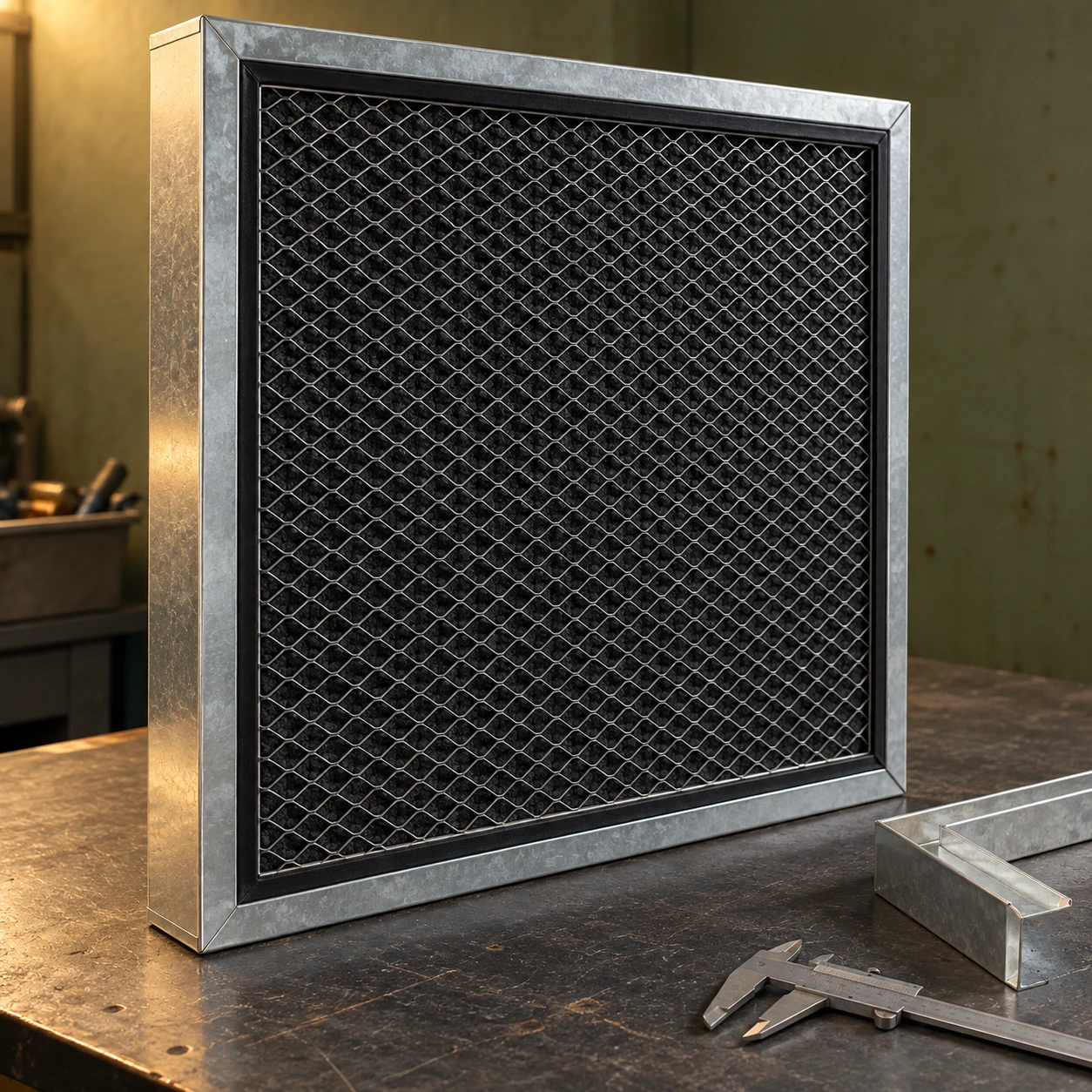
| Product form | Finished shallow sorbent panel |
|---|---|
| Outer W × H × D (mm) | 287 × 287 × 48; 287 × 592 × 48; 592 × 592 × 48 |
| Frame construction | Folded metal frame with supported media faces |
| Media options | Selected carbon or chemical sorbent; bonded or mechanically retained |
| Sealing interface | Specified face, gasket section and continuity |
| Drawing controls | Outer dimensions, tolerances, airflow direction and retention details |
| Acceptance scope | Dimensions, assembly condition, media identification and agreed performance evidence |
Manufacturing details and acceptance criteria are agreed for the selected configuration. Dimensions alone do not establish gas-removal efficiency or capacity.
Chemical panel construction, dimensions, media retention and sealing can be customized to meet the installation and procurement requirements.
A chemical panel air filter manufacturer must turn the selected sorbent into an assembly that fits, seals and survives normal handling. shengtongjh coordinates equipment and material supply; the frame, media and acceptance requirements are defined with the selected production source for the order.
The drawing starts at the air-handling unit
A well-made panel can still fail as a replacement if its frame is defined without the holder. The specification needs the actual outer envelope, insertion direction, sealing face and the way the retainer applies pressure.
Dimensions should be controlled at the points that determine fit. A projecting corner, a folded seam or a gasket on the wrong face can stop the panel seating even when its central frame measurements appear correct. Agree dimensional tolerances in relation to the available clearance and the required seal compression.
Where access is restricted, account for the path used to withdraw the old panel and insert the new one. Handles, added retaining tabs or a thicker gasket may be helpful in one housing and obstructive in another.
Construction details that influence the air path
- Frame joints
- The corner and seam arrangement must keep the panel square during transport and installation. Joint gaps need to be considered as potential bypass routes, not merely as cosmetic imperfections.
- Media retention
- The support faces and internal restraints hold the sorbent in its intended distribution. A loose granular fill, a bonded structure and a pleated carbon-loaded sheet require different retention methods; one assembly drawing cannot describe all three correctly.
- Perimeter sealing
- The gasket must suit the contact surface and compression available in the holder. A continuous sealing line is useful only when the frame reaches that surface and the retainer holds it consistently.
- Material compatibility
- Frame coating, adhesive, gasket and retaining layers need to suit the intended temperature, humidity and chemical exposure. For sensitive processes, materials that shed particles or introduce unwanted emissions can create a separate contamination problem.
The active medium must remain identifiable
Buying a filter solely by a generic term such as carbon makes repeatability difficult. Define the selected medium or controlled media specification, its quantity or loading where relevant, and the construction in which it is used. Changes to that specification should be reviewed against the target-gas duty.
Raw-media data is useful during selection, but the completed assembly adds air distribution, retention and sealing effects. A material's test result should not be presented as an unconditional removal guarantee for every panel made from it.
Agree acceptance before production
- Confirm the assembly definition. Approve the drawing, materials, media identification, direction and packaging scope. When replacing an existing part, resolve nominal and actual dimensions at this stage.
- Define the physical checks. Decide how outer dimensions, squareness, frame joints, gasket continuity and media retention will be checked. These checks address fit and construction; they do not substitute for gas testing.
- Define the required performance evidence. Identify the target gas, airflow and environmental conditions for the evidence being requested. Distinguish initial removal from capacity and the chosen breakthrough criterion.
- Keep the delivered configuration traceable. Connect the accepted construction to its batch identification and shipment documents. Record approved deviations so future replacements follow the same controlled requirement.
Change the design for a reason
A heavier support face may improve handling but obstruct more of the flow area. More sorbent may add useful capacity while increasing resistance or weight. A different gasket can change the force needed to close a retaining frame. Evaluate these effects together rather than optimizing a single component in isolation.
For operation in a shallow existing slot, manufacturing changes cannot create unlimited contact time. Some duties require a larger filtration arrangement instead of a more densely packed panel.
Prepare a manufacturing enquiry that can be acted on
Send the holder drawing or measured interface, the target-gas information, operating airflow, expected environmental conditions and quantities. Include the documentation required for acceptance and any material restrictions from the process.
The chemical panel supply page covers replacement schedules and packing. The chemical filtration page explains how the operating duty guides media selection before the construction is finalized.
Chemical panel construction, dimensions, media retention and sealing can be customized to meet the installation and procurement requirements.