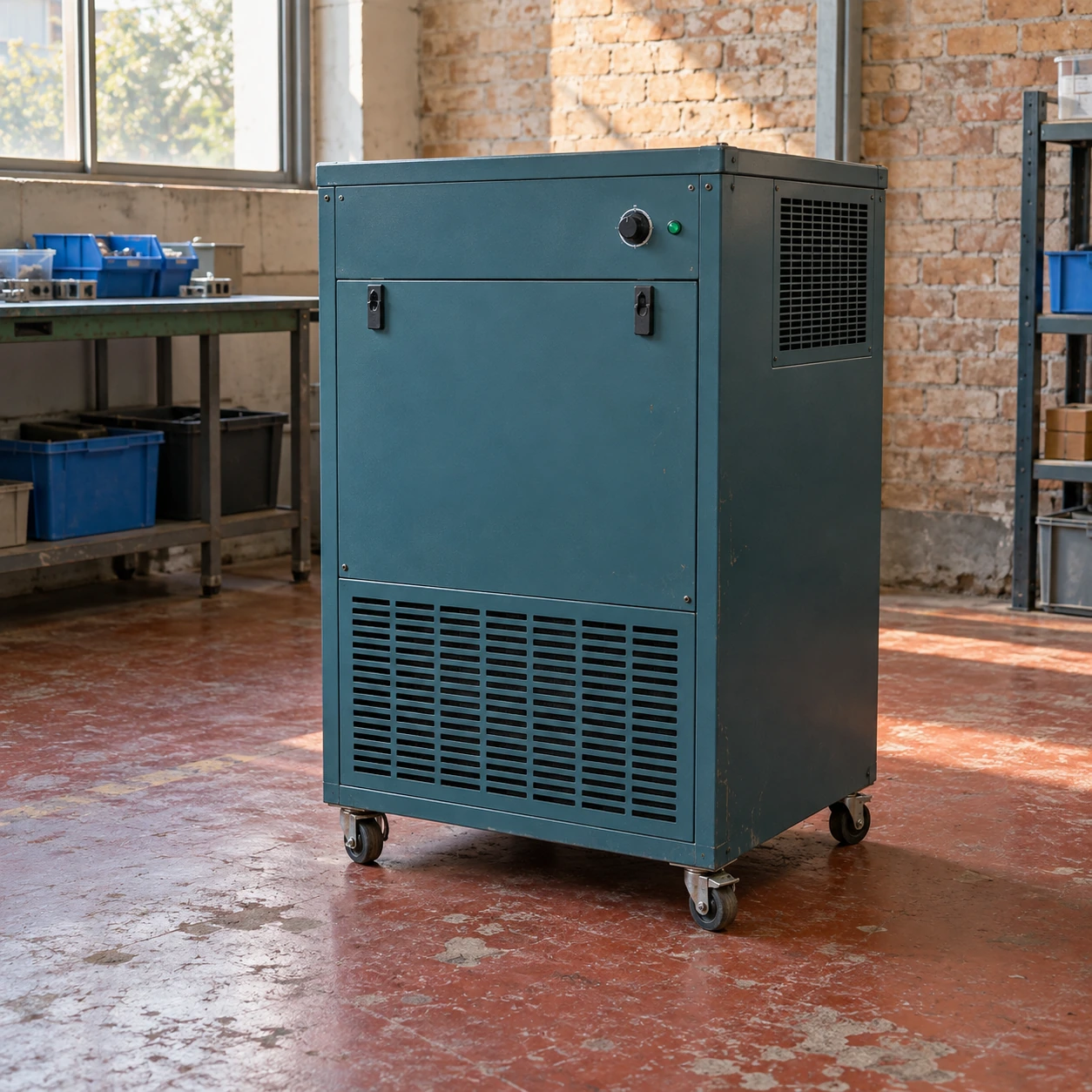
Air Cleaners & Room Filtration
air clean hepa
| Equipment | Mechanical recirculating air-cleaner cabinet |
|---|---|
| Compact case W × D × H (mm) | 550 × 263 × 638 |
| Floor cabinet W × D × H (mm) | 770 × 720 × 1628 |
| Airflow selections | Compact configuration up to 720 m³/h; larger floor configuration nominally 2000 m³/h |
| Particle stages | Replaceable prefilter followed by a selected H13 or H14 HEPA element |
| Enclosure | Coated sheet metal; stainless-steel options according to the environment |
| Electrical supply | 230 V, single phase, 50/60 Hz; electrical configuration matched to destination |
| Controls | Variable fan setting; filter-condition indication and remote-control options |
| Installation | Freestanding or mobile arrangement, with accessible filter-service side |
Select cabinet, fan and filtration stages as one package. Dimensions describe the case; airflow depends on the chosen assembly, filter condition and connected resistance. Service space and outlet fittings are additional.
The air-cleaner package can be customized for the workroom layout, particle load, available space and operating schedule.
A commercial HEPA air cleaner draws room air through filters and returns filtered air to the space. A self-contained cabinet can add particle filtration to an existing workroom without rebuilding its entire ventilation system. Its value depends on the air it actually processes in the occupied layout.
Put the intake where room air can reach it
A cabinet placed behind storage boxes may run continuously while processing only a small pocket of air. Keep the intake clear and direct the discharge into the working space without blowing loose material across a bench. Consider where partitions, racks and open doors interrupt circulation.
A mobile unit is useful when workstations move, but each new position changes the air path. Mark an unobstructed operating position and keep the service door accessible rather than treating the cabinet as spare storage space.
Choose a speed that can remain in use
Maximum airflow is useful only if the setting is acceptable during normal work. Fan noise, draughts and the direction of discharge influence whether staff leave the unit running. Agree the operating duty at the intended setting, with its actual filter stages fitted.
A higher-class element is not a free upgrade for every cabinet. Its resistance and media area must suit the fan. If delivery drops sharply, more efficient capture in the filter may be offset by less room air passing through the machine.
Moderate everyday particle loading
Inspection areas, component storage rooms and light-assembly support spaces may need a practical supplemental recirculation stage. Review occupancy and door opening as well as the room size.
A concentrated process source
Dust released at a machine should be considered at that source first. General room filtration is not a substitute for designed extraction of fumes, hazardous dust or explosive material.
Design the service routine into the purchase
A removable prefilter helps separate routine coarse-dust service from replacement of the fine element. Check how the door opens, where the used filter is placed and whether the replacement can pass through the available aisle. Avoid a layout that requires moving a heavy cabinet each time it is serviced.
shengtongjh can coordinate the cabinet, filters and controls with the site's operating conditions. For a fixed installation, see HEPA room air filtration. Replacement components are addressed separately under HEPA filters for air cleaners.
The air-cleaner package can be customized for the workroom layout, particle load, available space and operating schedule.