Weighing & Dispensing Booths
Sampling Booths
| Construction | 304 stainless steel; 316 stainless steel internal surfaces available to suit cleaning chemistry |
|---|---|
| External W × D × H (mm) | 1500 × 1500 × 2600; 1900 × 2400 × 2600 |
| Clear internal W × D × H (mm) | 1400 × 1000 × 2000; 1800 × 1800 × 2000, respectively |
| Air arrangement | Filtered recirculation for suitable powder duties; separately specified single-pass extraction for vapour duties |
| Downflow control | Adjustable fan; nominal 0.45 m/s setpoint, commissioned at the agreed measurement plane |
| Filtration | Prefilter and intermediate filter with H14 HEPA supply filtration; exhaust filtration selected for the duty |
| Controls | Filter differential-pressure indication; airflow monitoring and alarm options; LED lighting |
| Electrical supply | 230 V, single-phase, 50 Hz or 415 V, three-phase, 50 Hz, matched to the selected assembly |
| Handling and access | Open-front drum access; worktable, service access and overall dimensions selected for the process |
Dimensions describe paired configuration options. The confirmed working boundary, service clearances and electrical duty are established for the selected arrangement.
Booth dimensions, materials, controls and extraction arrangements can be customized to suit your sampling application.
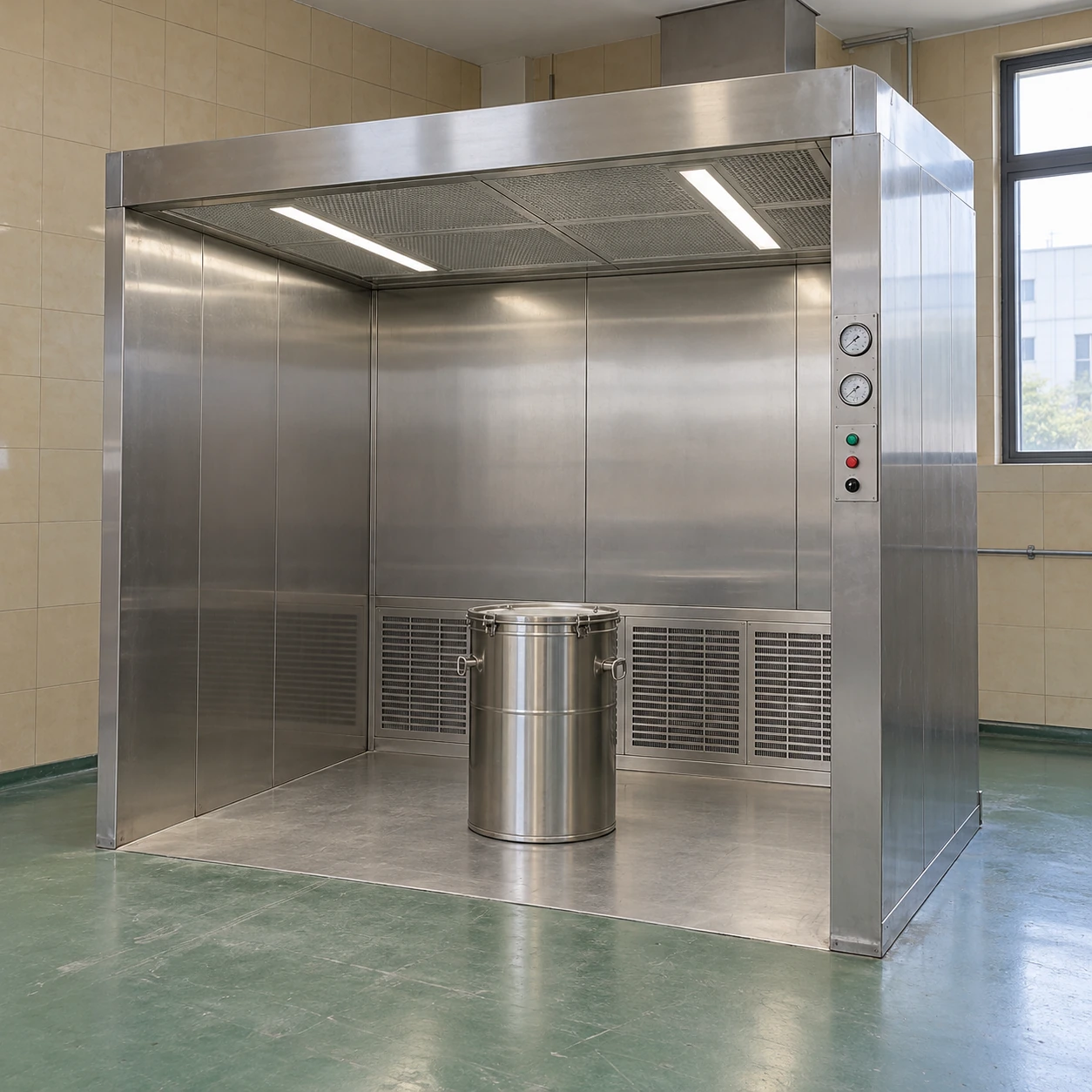
Sampling Booths provide a local ventilated workspace for opening raw-material containers and collecting samples. Filtered downflow and low-level extraction help control dust released at the sampling point, while the layout keeps containers, tools and the operator inside a defined working zone. shengtongjh coordinates booth sourcing around the material, handling method and available installation space.
Keep the dust release inside the sampling workspace
A sealed drum can travel through a warehouse with little dust release, yet opening its liner or withdrawing a sampling tool can expose loose powder. A booth places controlled air movement around this short, repeated task. Air supplied from above moves towards return grilles near floor level, carrying suspended particles into the filtration circuit. Controlled exhaust also draws replacement air through the open front.
This arrangement suits the assessment of pharmaceutical raw materials, food ingredients and other industrial powders when the material risk assessment supports an open-front booth. Product cleanliness and operator exposure are separate requirements: a clean-air classification or a HEPA filter rating alone does not establish containment performance.
Size the booth around the opened container
The usable sampling position is smaller than the enclosure footprint. Allow room for the container lid, sampling tool, operator movement and any sample trolley while keeping the dust-generating task within the commissioned working boundary. A wide booth with insufficient depth can still leave the operation too close to its open edge.
Drums and furniture must leave the low-level returns clear. Where small samples also need weighing, position the balance and its enclosure without interrupting capture; increasing fan speed is not a substitute for resolving an obstructed layout.
Allow space outside it as well
Check the drum route, doorway, ceiling height and filter-removal path before fixing the equipment location. Forklift traffic, an opening loading-bay door or a nearby supply diffuser can disturb the air entering the booth. A quieter sampling location can be more useful than extra nominal working width.
Incoming containers, clean tools and completed samples need distinct staging positions. These should support a straightforward material route without turning the booth into a storage area.
Plan the complete container-to-sample sequence
Container preparation
Provide a place for checking identification and cleaning the container exterior according to the site's procedure. Keep outer packaging and incoming surface dirt away from clean sampling tools.
Sample collection
Arrange the container, tool reach and sample vessel as one working position. Avoid layouts that require repeated movement across the open front while material remains exposed.
Closure and changeover
Provide space to close the container, seal and identify the sample, and remove used tools. A defined cleaning route between materials helps prevent carryover into the next sample.
Choose the air circuit for the material
Recirculating booths filter and reuse much of their airflow, reducing the amount of conditioned replacement air needed for suitable powder tasks. Single-pass arrangements discharge the extracted air through a separately designed exhaust system. They require coordination with room make-up air and the discharge location.
HEPA filtration captures particles; it does not remove solvent vapour. Vapour-producing duties therefore need a suitable extraction design. Combustible dusts and highly potent materials also require their own hazard assessment and may need specialist electrical arrangements, secondary containment or a closed isolator. An ordinary booth is not a universal solution for every powder.
Keep maintenance out of the material route
Smooth internal joints and accessible return grilles make routine cleaning easier. Select surfaces and seals for the actual cleaning agents. Filter access must also allow contaminated elements to be handled and removed appropriately without passing them over clean tools or open containers.
Filter pressure readings help track loading, while airflow monitoring checks the operating condition. Establish service limits for the selected assembly instead of relying on a fixed calendar alone.
Agree the operating evidence before supply
Specify the material properties, container sizes, sampling sequence and room layout with the enquiry. Agree how airflow, filter integrity, alarms and task-specific containment will be demonstrated with representative equipment and operator positions. The final working boundary should follow that assessment.
For work that also includes bulk dispensing, compare the Negative Pressure Weighing Booth. Use the quotation form to discuss the sampling layout and supply scope with shengtongjh.
Booth dimensions, materials, controls and extraction arrangements can be customized to suit your sampling application.