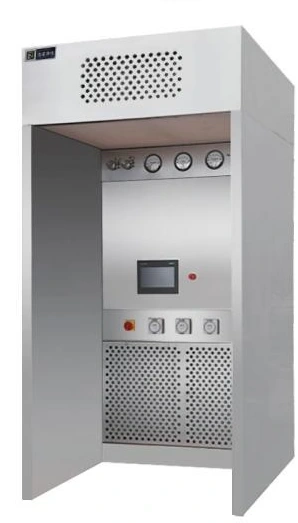
Weighing & Dispensing Booths
Negative Pressure Weighing Booth
| Specification | JN-NPWC |
|---|---|
| Working dimensions | Customized around equipment, containers and operator access |
| Construction | 304 stainless steel |
| Air distribution | Overhead supply with lower-level return |
| Air distribution face | Distribution membrane or diffuser plate |
| Air velocity setting | 0.45 m/s ±20% |
| Filtration | High-efficiency filtration with pressure monitoring |
| Power supply | 220 V, 50 Hz |
| Controls | PLC or push-button control options |
| Customization | Workspace, handling layout and controls to suit the process |
Dimensions and configurations can be customized for your application.
Control dust where containers are opened, powders are weighed and ingredients are transferred. The booth must be arranged around the release point, the operator and the handling sequence.
Start with the point where dust becomes airborne
Opening a sack, pouring powder into a vessel and brushing residue from a container produce different release patterns. A booth is most useful when these actions take place within a defined working zone, with air directed downwards and collected through the lower return arrangement.
The airflow is intended to move released material towards collection rather than allow it to drift through the surrounding room. The balance between supplied, recirculated and discharged air matters. A negative-pressure description alone does not demonstrate the containment achieved for a particular substance or task.
Put the operator on the correct side of the release
Arrange containers, scales and tools so the operator does not repeatedly lean through the dust-producing transfer. Keep the active pouring position within the controlled zone and avoid using a large drum or pallet to block the return path.
A practical layout gives incoming material, weighing, dispensing and outgoing containers distinct positions. It also allows an opened container to be closed without carrying it through an uncontrolled area.
Make weighing stable as well as contained
Air movement, vibration and repeated handling can disturb sensitive balances. Protect the weighing operation through the location of the scale, the design of its immediate working space and the agreed operating method. Simply reducing fan speed to obtain a steady reading can weaken dust control elsewhere in the booth.
Match the booth to the powder, not only the room
The material's dustiness, toxicity, tendency to cling to surfaces and cleaning requirements affect the arrangement. Potent ingredients require an exposure assessment and demonstrated containment appropriate to the process. Combustible powders also need a specific hazard assessment; ordinary filtration and stainless construction do not make equipment explosion protected.
Filters collect particles. They should not be assumed to remove hazardous gases or solvent vapours. Processes involving these substances may need another extraction or treatment strategy. Identify the complete material and process conditions before selecting the airflow and filtration arrangement.
Keep control effective between batches
Visible residue on the work surface is only part of the cleaning task. Include container bases, scale supports, return grilles and accessible joints in the cleaning method. Avoid disturbing deposits into the operator's breathing zone or forcing them into inaccessible cavities.
Filter loading changes resistance and can affect air balance. Use the monitoring arrangement to support planned service, and establish a safe filter-change method for the retained material. After changes to filters, equipment positions or operating methods, check the booth under representative working conditions.
The workspace, container access and controls can be customized for the actual weighing and dispensing sequence. Share the material, container sizes and handling steps to develop a suitable configuration.