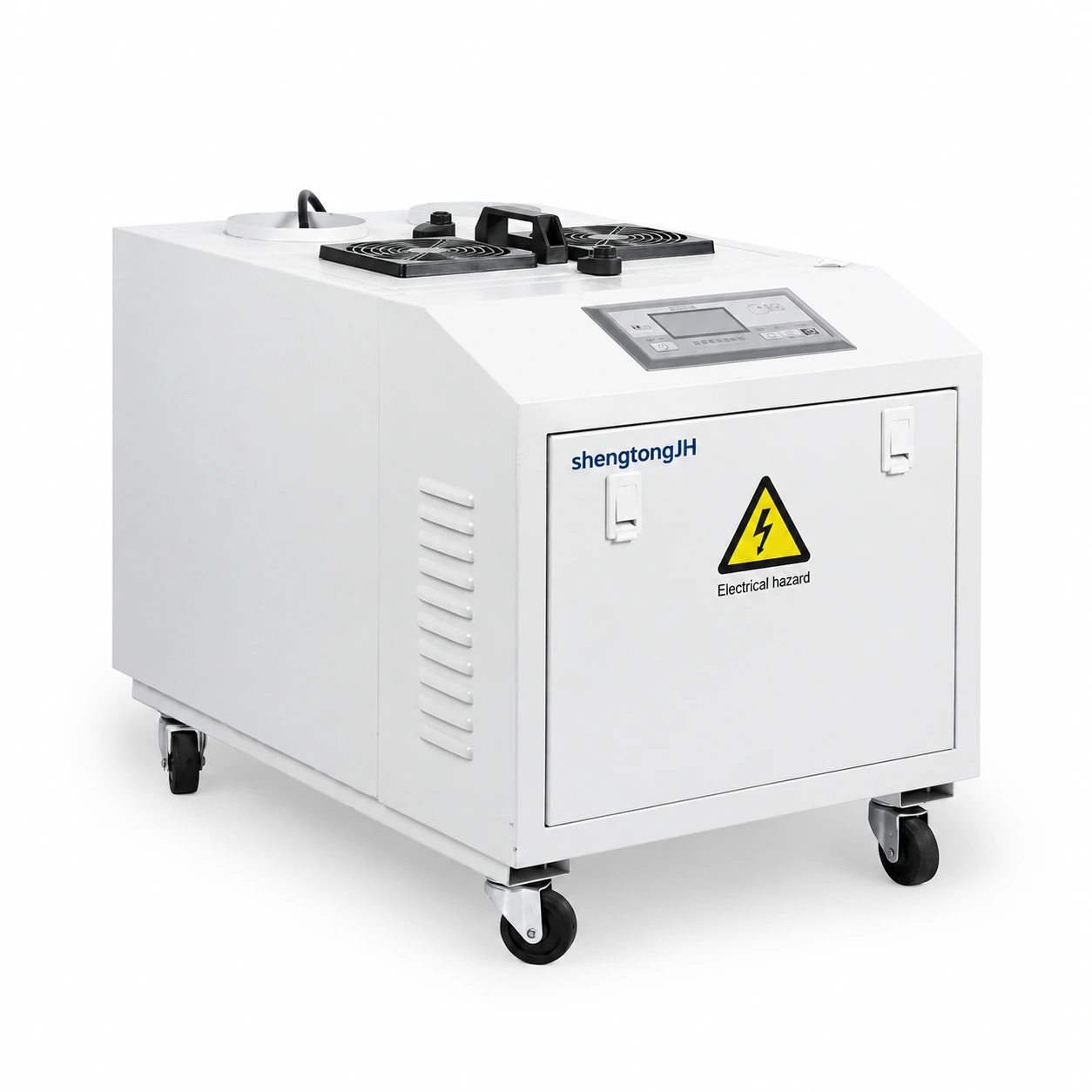
Cabinet appearance and connection layout vary with the selected capacity.
Ultrasonic Humidifiers
evaporative vs ultrasonic humidifier
| Specification | 3 kg/h | 6 kg/h |
|---|---|---|
| Brand | shengtongJH | |
| Humidification capacity | 3 kg/h | 6 kg/h |
| Rated input power | 0.3 kW | 0.6 kW |
| Power supply | 220 V AC, 50 Hz | |
| Cabinet dimensions (mm) | 530 × 360 × 470 | 510 × 360 × 465 |
| Net weight | 22 kg | 28 kg |
| Mist outlet arrangement | 1 × nominal 110 mm PVC | |
| Cabinet fan airflow | 180 m³/h | 350 m³/h |
| Humidity sensing | Electronic humidity sensor | |
| Positioning | Floor-standing cabinet with swivel casters | |
Capacity, connections and configuration can be selected for your application. Installation drawings define orientation and service clearances.
Evaporative and ultrasonic equipment both add moisture, but they deliver it differently. Compare the water path, the air path and the maintenance task before choosing which method belongs in your space.
Evaporative
Air passes over a wetted surface
A fan or ventilation system moves air across wet media, where water evaporates into the air. The rate depends on the entering air condition, the media and the airflow. As the air becomes more humid, the driving force for evaporation decreases; this does not remove the need for suitable controls.
Maintenance centres on the water distribution system, basin and media. Mineral accumulation can reduce wetting and airflow. Media condition and replacement access matter, especially where maintenance has to fit around production.
Ultrasonic
Water becomes a mist before it evaporates
Vibrating transducers create droplets that are carried into the air. Distribution must provide enough opportunity for those droplets to evaporate before contacting sensitive surfaces. An attractive visible plume is not evidence of uniform room humidity.
Maintenance centres on the reservoir, atomizing surfaces, air path and water preparation. Dissolved minerals can travel with droplets, making suitable water treatment particularly important where deposits are unacceptable.
Compare the practical differences
| Decision | Evaporative | Ultrasonic |
|---|---|---|
| Moisture delivery | Evaporation from wetted media into an air stream | Atomized droplets followed by evaporation |
| Water-related work | Manage mineral deposits, wetting and media condition | Manage dissolved minerals, reservoir hygiene and transducer deposits |
| Space requirement | Allow suitable airflow through the media and access for replacement | Allow discharge clearance, mist absorption space and cabinet access |
| Useful cost comparison | Include fan operation, water management and media replacement | Include atomization, fans, water treatment and cleaning |
Neither method is automatically the lower-maintenance or lower-total-cost choice. Compare a complete configuration at the same required moisture output and operating conditions. Product-family labels alone do not establish noise, control accuracy or hygiene performance.
Choose around the constraint you actually have
If the installation has an appropriate air-handling route and accessible media space, evaporative equipment may be worth evaluating. If a local cabinet arrangement is preferred and treated water plus an unobstructed discharge route are practical, ultrasonic equipment may fit the layout. Cold surfaces, high existing humidity or poor air mixing can limit the useful performance of either approach.
Water treatment and cleaning remain part of the decision. Demineralization is not sterilization, and a clean-looking tank is not a substitute for an operating maintenance procedure.
Use the comparison to specify the purchase
The cabinet and configurations above are ultrasonic equipment; this page does not present them as evaporative models. Record the required moisture load, air temperature, humidity target, water condition and available service space before selecting a method. Explore ultrasonic equipment operation for the next level of detail.
shengtongJH can help organize equipment options around your application. Capacity, water preparation and installation arrangements can be configured for the selected approach.