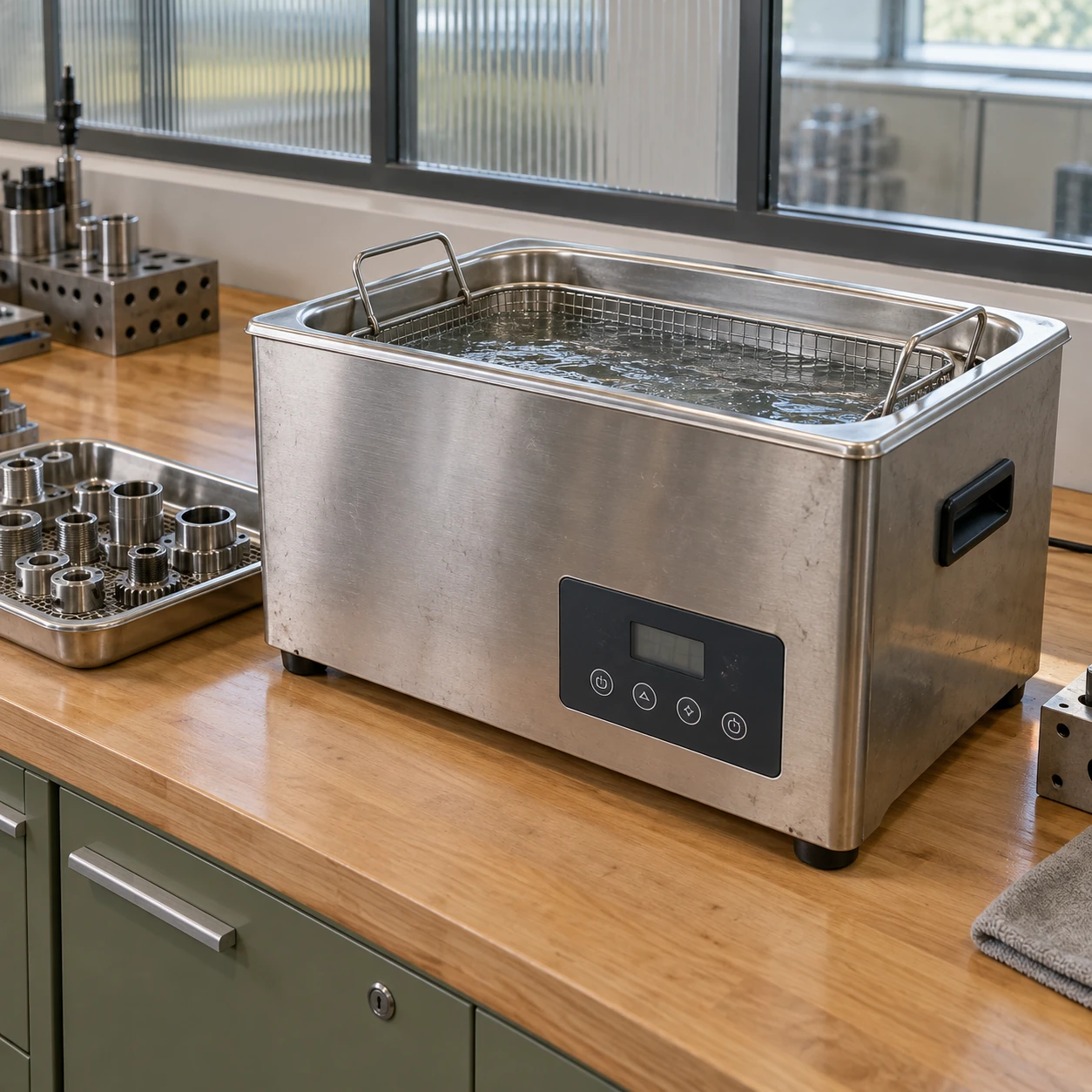
Ultrasonic Cleaners
ultrasonic cleaner
| Tank family | 10 / 15 / 30 L nominal capacity |
|---|---|
| Internal tank W × D × H (mm) | 300 × 240 × 150 / 330 × 300 × 150 / 500 × 300 × 200 |
| External W × D × H (mm) | 330 × 270 × 310 / 360 × 330 × 310 / 530 × 330 × 350, respectively |
| Ultrasonic frequency / power | 40 kHz; 240 / 360 / 600 W options by tank size |
| Heating | 200 / 300 / 500 W; adjustable up to 80 °C, subject to chemistry and material limits |
| Controls | Timer up to 30 minutes; rotary or digital controls; selectable degassing function |
| Construction / accessories | 304 stainless steel tank and case; suspended basket, lid and drain valve |
| Electrical supply | 220–240 V, 50/60 Hz; 100–120 V variants by configuration |
These compact configurations suit professional small-batch work. Larger floor units are selected separately; litres are nominal tank designations, not basket capacity.
Equipment size, controls and accessories can be configured for your professional cleaning application.
An ultrasonic cleaner uses sound energy in a liquid to help detach contamination from wetted surfaces. For industrial and laboratory work, the equipment is selected together with the cleaning solution, component material and required finish.
How the cleaning action reaches the part
The generator drives transducers attached to the tank. Pressure changes in the liquid create cavitation: small bubbles form and collapse, producing local activity that assists removal of attached soil.
This action depends on liquid access. A sealed cavity cannot be cleaned simply by immersing the outside, and an air pocket can prevent the solution from contacting a recessed surface. Orient the part and choose a basket that exposes the areas requiring treatment.
The solution also has a chemical job. It must wet the surface and deal with the particular oil, deposit or residue while remaining compatible with the substrate and the machine. Plain water or a stronger setting is not a universal answer to every soil.
Build a process around the bath
- Check compatibility. Assess all materials, coatings, seals and bonded joints in the component, along with the intended aqueous chemistry.
- Prepare the solution and load. Follow the selected machine's instructions for fill level, degassing and temperature. Suspend the parts in a suitable basket above the tank floor.
- Evaluate the cleaning cycle. Use representative parts and inspect difficult surfaces, adjusting the process within material and equipment limits.
- Rinse and finish. Remove carried-over solution as required, dry the work appropriately and protect it from contamination during handling.
Choose a useful equipment format
A benchtop ultrasonic cleaner suits manageable small loads near the workstation. A floor-standing unit offers more room for bulky parts and handling accessories, but needs more space and utility planning.
Keep the limits visible
Cleaning does not establish sterilization, and ultrasound is not suitable for every assembled product. Ordinary aqueous units must not be treated as flammable-solvent machines. The appropriate result is a verified cleaning process for the specific part.
What makes an enquiry useful
Provide the component size, material, contamination and next operation. Add the normal batch pattern and whether the work needs a separate rinse or drying stage. These facts determine a suitable configuration more directly than a requested litre capacity alone.
Equipment size, controls and accessories can be configured for your professional cleaning application.