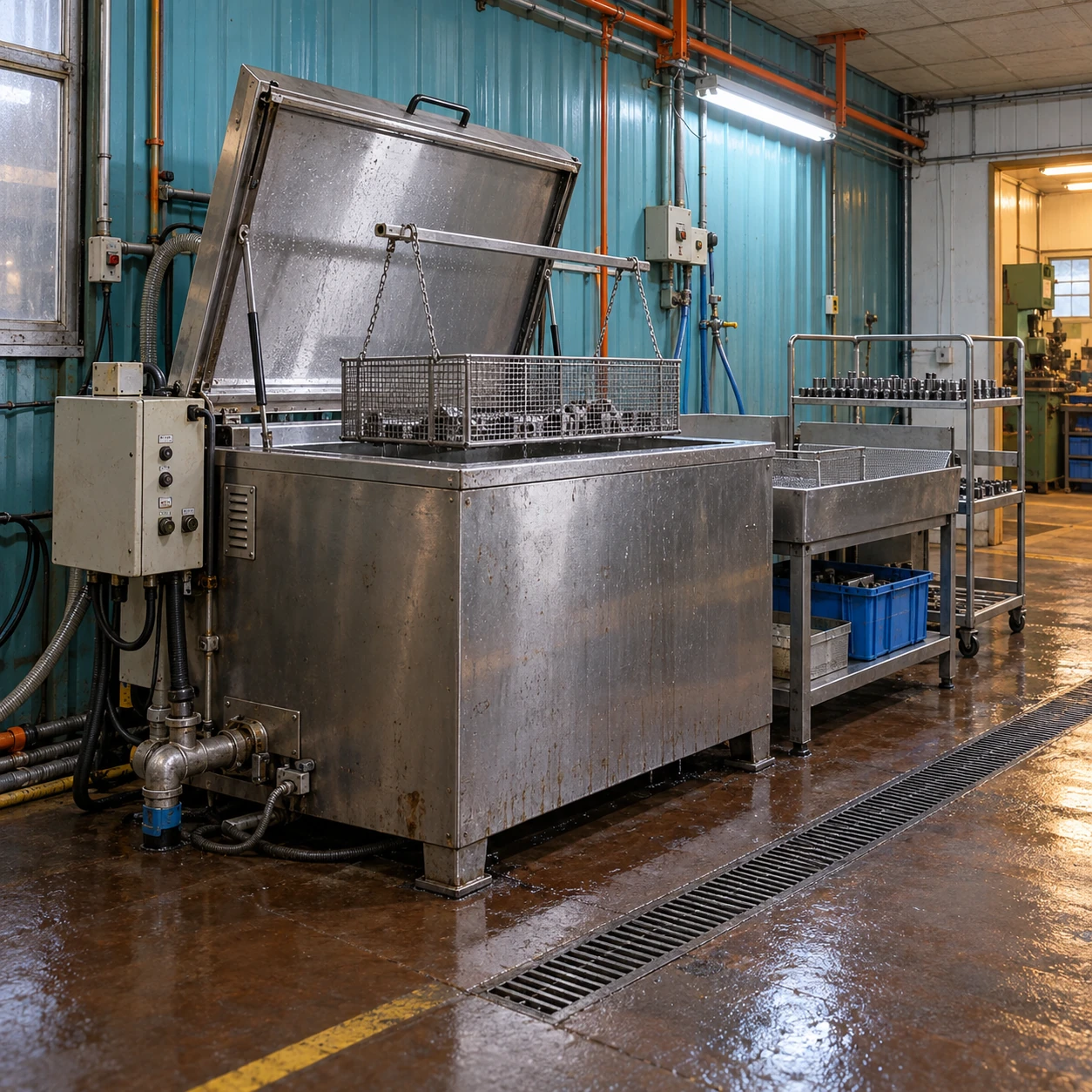
Ultrasonic Cleaners
ultrasonic cleaner industrial
| Internal tank W × D × H (mm) | 600 × 450 × 450 / 1000 × 500 × 400 / 750 × 650 × 500 |
|---|---|
| External W × D × H (mm) | 780 × 550 × 800 / 1180 × 600 × 800 / 930 × 750 × 800 options, respectively |
| Ultrasonic frequency | 25 or 40 kHz, selected for the cleaning task |
| Nominal ultrasonic power | 1–2 kW across the listed tank families; generator matched to transducers |
| Heating / control | 4.8–7.2 kW options; thermostatic control up to 80 °C |
| Tank / frame | Welded stainless tank; 304 or 316L wetted construction selected for the solution |
| Loading / bath care | Suspended basket and lid; optional basket lift, filtration, oil separation and rinse stage |
| Electrical / discharge | 400 V three-phase, 50/60 Hz configuration; drain and overflow connection by tank design |
These configurations provide options for replacement or expansion. Existing generators, tanks, services and baskets require compatibility review before reuse.
Replacement equipment, bath-care accessories and station interfaces can be configured around your existing industrial process.
An ultrasonic cleaner already in industrial use may need improvement because results vary, bath life is short or handling consumes too much time. The useful starting point is the behaviour of the current process, followed by a targeted equipment decision.
Trace the symptom before replacing the machine
- Some surfaces remain dirty
- Check trapped air, part orientation, overlapping loads and the basket itself. If the liquid cannot reach a surface, simply extending exposure may not help.
- The first batches clean better than later ones
- Review incoming soil, actual bath temperature, solution condition and carryover. A change through the shift may point to bath management rather than insufficient tank size.
- Parts leave the bath clean but fail inspection later
- Check rinsing, drying and the receiving carrier. Recontamination or retained residue can arise after the ultrasonic stage.
- The station cannot keep up
- Time loading, treatment, draining, rinsing and drying separately. The longest delay may be outside the cleaning bath.
Improve loading when access is the problem
A new basket, dividers or revised orientation may expose the required surfaces without increasing tank volume. Confirm that the altered arrangement still supports the wet load and fits the next stage.
If the component only just fits, a differently proportioned tank may be preferable to a deeper version of the same footprint. Preserve clearance around the work.
Improve liquid management when the bath is the problem
Remove bulk contamination before immersion and assess suitable filtration or oil separation. Match the accessory to the contaminant; a particle filter does not remove every dissolved substance.
Define when the solution is changed or replenished based on the process. A larger tank can delay visible contamination while leaving the same underlying issue unresolved.
Check the interfaces before a replacement arrives
A new cabinet may change drain height, electrical demand, lid movement or basket transfer. Compare the full installation drawing with the current station, including access to service panels. Do not reuse a generator with a replacement tank solely because the connectors appear to fit.
If the station is being extended with a rinse bath or dryer, agree the transfer heights and wet-load handling. A well-defined retrofit should remove the identified constraint without introducing a new one beside it.
Record the baseline that the change must improve
Document the current component, soil condition, loading pattern and inspection result. This provides a fair comparison after the alteration. For a new station designed from the outset, see industrial ultrasonic cleaner.
Replacement equipment, bath-care accessories and station interfaces can be configured around your existing industrial process.