Ultrasonic Cleaners
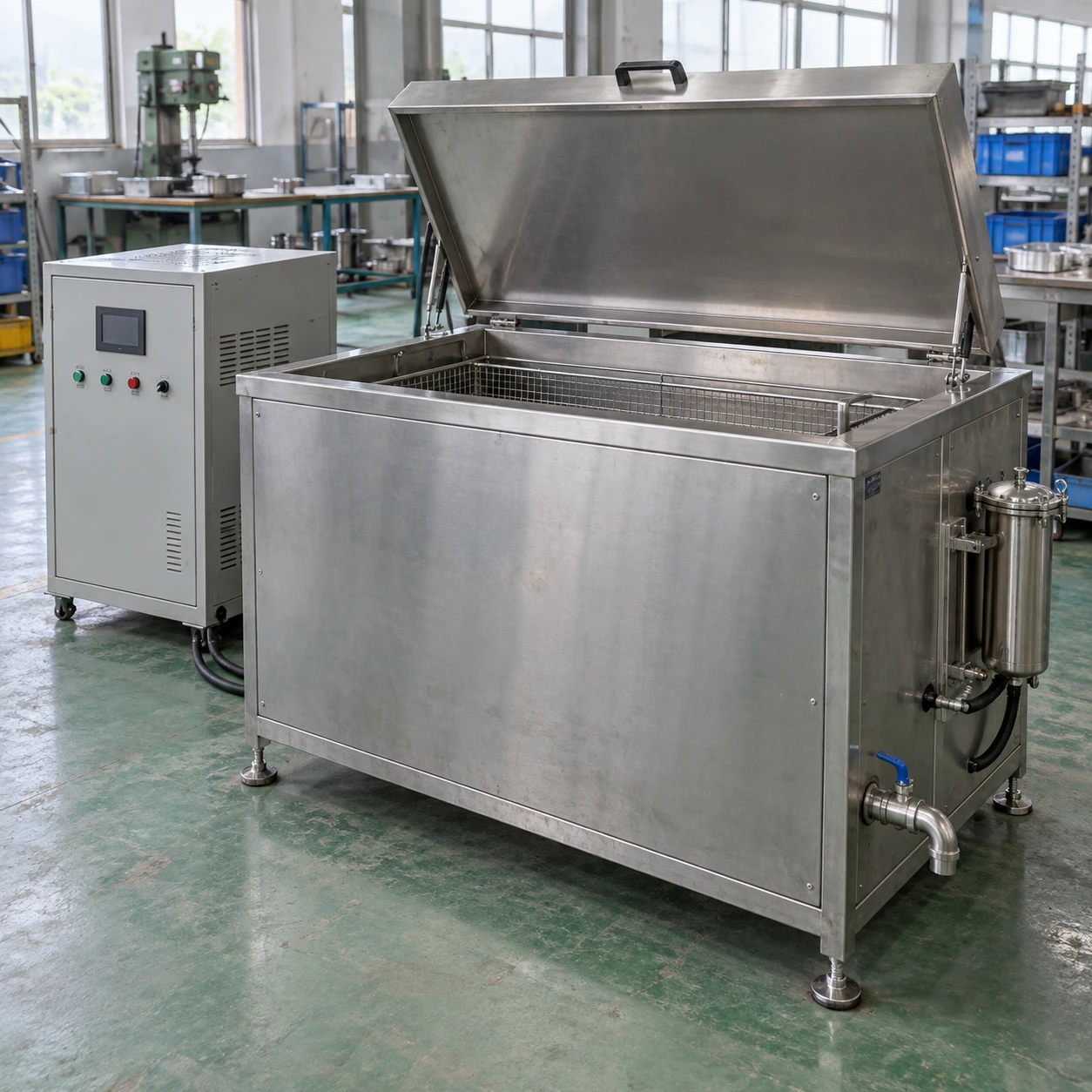
industrial ultrasonic cleaner
| Internal tank W × D × H (mm) | 600 × 450 × 450 / 1000 × 500 × 400 / 750 × 650 × 500 |
|---|---|
| External W × D × H (mm) | 780 × 550 × 800 / 1180 × 600 × 800 / 930 × 750 × 800 options, respectively |
| Ultrasonic frequency | 25 or 40 kHz, selected for the cleaning task |
| Nominal ultrasonic power | 1–2 kW across the listed tank families; generator matched to transducers |
| Heating / control | 4.8–7.2 kW options; thermostatic control up to 80 °C |
| Tank / frame | Welded stainless tank; 304 or 316L wetted construction selected for the solution |
| Loading / bath care | Suspended basket and lid; optional basket lift, filtration, oil separation and rinse stage |
| Electrical / discharge | 400 V three-phase, 50/60 Hz configuration; drain and overflow connection by tank design |
Select power, tank size and connected accessories as a matched configuration. Tank dimensions alone do not establish throughput or a continuous-duty rating.
The cleaner and its loading, liquid-management and finishing interfaces can be configured for your production process.
An industrial ultrasonic cleaner is one stage in a controlled parts-cleaning process. Tank geometry and acoustic power matter, but the station also has to accept the incoming load, maintain the bath and pass cleaned work to the next operation without recontamination.
Design for the normal production load
Begin with the load that the station will process most often. Include component spacing, fixtures and the way the basket arrives from the previous operation. An exceptionally large item may justify a separate arrangement if sizing every batch around it would create unnecessary heating and liquid demand.
Set a cleanliness criterion related to the next operation, such as assembly, coating or inspection. This gives equipment selection and process trials a common target instead of relying on visual brightness.
Input condition
Separate loose debris and control the amount of oil carried into the bath. Large variations in incoming soil make cycle results harder to reproduce.
Cleaning condition
Maintain the selected solution, fill level, temperature and basket pattern. Freshly prepared liquid may need degassing according to the operating instructions.
Output condition
Control drainage, rinse carryover and drying. Use clean carriers after processing so that the next operation receives the condition established by the trial.
Choose automation at the constraint
A basket lift can reduce the burden of handling a heavy wet load. Transfer equipment can assist movement between compatible tanks. Neither accessory makes an unsuitable cleaning recipe effective, so choose automation after the process and load are understood.
Additional controls can coordinate the cycle with a line, but the scope should define the signals, interlocks and responsibility for integration. A standalone timer and a production-control interface are different equipment requirements.
Keep maintenance outside the production path
Allow access to the generator, cooling openings, heaters, valves and filter housings without dismantling adjacent equipment. Plan how used liquid will be removed and how the tank will be inspected after draining.
For an existing station with uneven cleaning or repeated stoppages, the ultrasonic cleaner industrial page focuses on diagnosing and improving the current installation. New-equipment selection should include these service tasks from the beginning.
The cleaner and its loading, liquid-management and finishing interfaces can be configured for your production process.