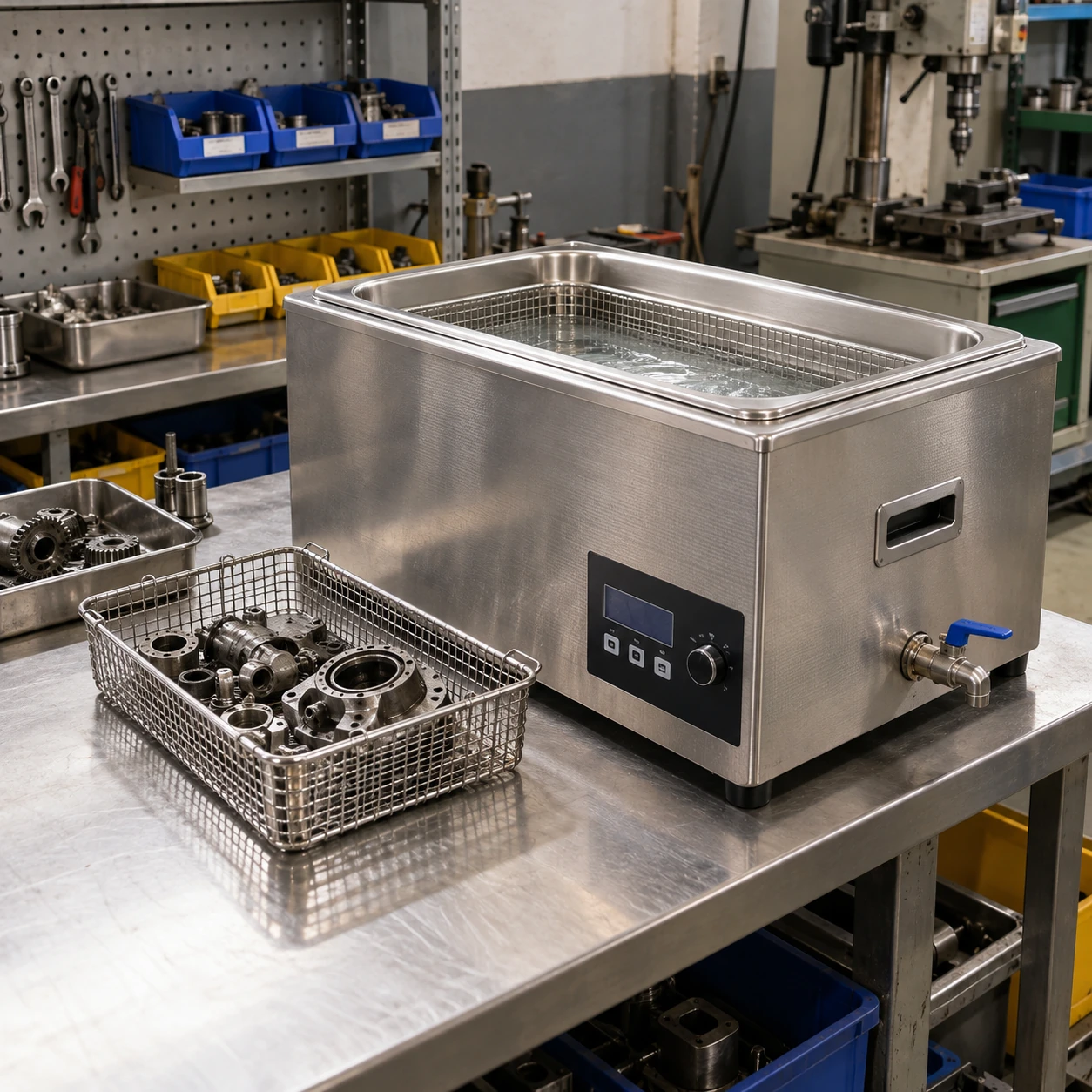
Ultrasonic Cleaners
ultrasonic cleaner commercial
| Tank family | 10 / 15 / 30 L nominal capacity |
|---|---|
| Internal tank W × D × H (mm) | 300 × 240 × 150 / 330 × 300 × 150 / 500 × 300 × 200 |
| External W × D × H (mm) | 330 × 270 × 310 / 360 × 330 × 310 / 530 × 330 × 350, respectively |
| Ultrasonic frequency / power | 40 kHz; 240 / 360 / 600 W options by tank size |
| Heating | 200 / 300 / 500 W; adjustable up to 80 °C, subject to chemistry and material limits |
| Controls | Timer up to 30 minutes; rotary or digital controls; selectable degassing function |
| Construction / accessories | 304 stainless steel tank and case; suspended basket, lid and drain valve |
| Electrical supply | 220–240 V, 50/60 Hz; 100–120 V variants by configuration |
These are professional bench configurations. The number of jobs per day depends on loading, bath changes, rinsing, drying and inspection.
Tank size, basket divisions and operator controls can be configured for your commercial service workflow.
A commercial ultrasonic cleaner serves repeated professional jobs that may vary from one customer or service task to the next. The equipment must make loading, settings and bath maintenance manageable without mixing incompatible parts or returning contamination to finished work.
Keep separate jobs identifiable
Small components can be lost or mixed when several service jobs share a basket. Removable divided inserts help preserve job identity, provided the insert allows cleaning liquid to reach each item and does not encourage dense stacking.
Use separate dry trays for inspected parts. An oily incoming tray should not become the collection point after cleaning. Where the parts contain different metals, coatings or elastomers, separation also allows an appropriate process for each group.
Choose controls that suit changing work
Clear time and temperature settings reduce accidental carryover from the previous job. A digital panel can be useful for this purpose, while simple rotary controls may suit one repeated service task.
A remembered setting is not a cleaning guarantee. Record the suitable solution, concentration and loading arrangement alongside the cycle settings so that another operator can reproduce the process.
Budget for the routine work around the machine
Bath replacement, rinsing and drying consume labour and utilities even when the ultrasonic cycle requires little attention. A larger tank reduces the number of batches only when the normal work can be loaded without shielding surfaces. It also increases the amount of solution to heat and manage.
For occasional high-soil jobs, a separate pre-cleaning step can protect the main bath from rapid contamination. For frequently repeated dirty work, consider whether a floor unit with appropriate bath-care accessories is more practical than repeatedly draining a bench unit.
Service cleaning has a defined scope
The equipment options here concern industrial and professional components suitable for aqueous ultrasonic cleaning. They do not establish a medical-device reprocessing cycle, disinfection claim or compatibility with every finished assembly. Inspect sensitive seals, coatings and bonded parts before agreeing a method.
When requesting a quotation, describe the busiest working period, the typical parts in each job and the space available for clean handling. The digital ultrasonic cleaner page explains which control functions are useful for repeatable work.
Tank size, basket divisions and operator controls can be configured for your commercial service workflow.