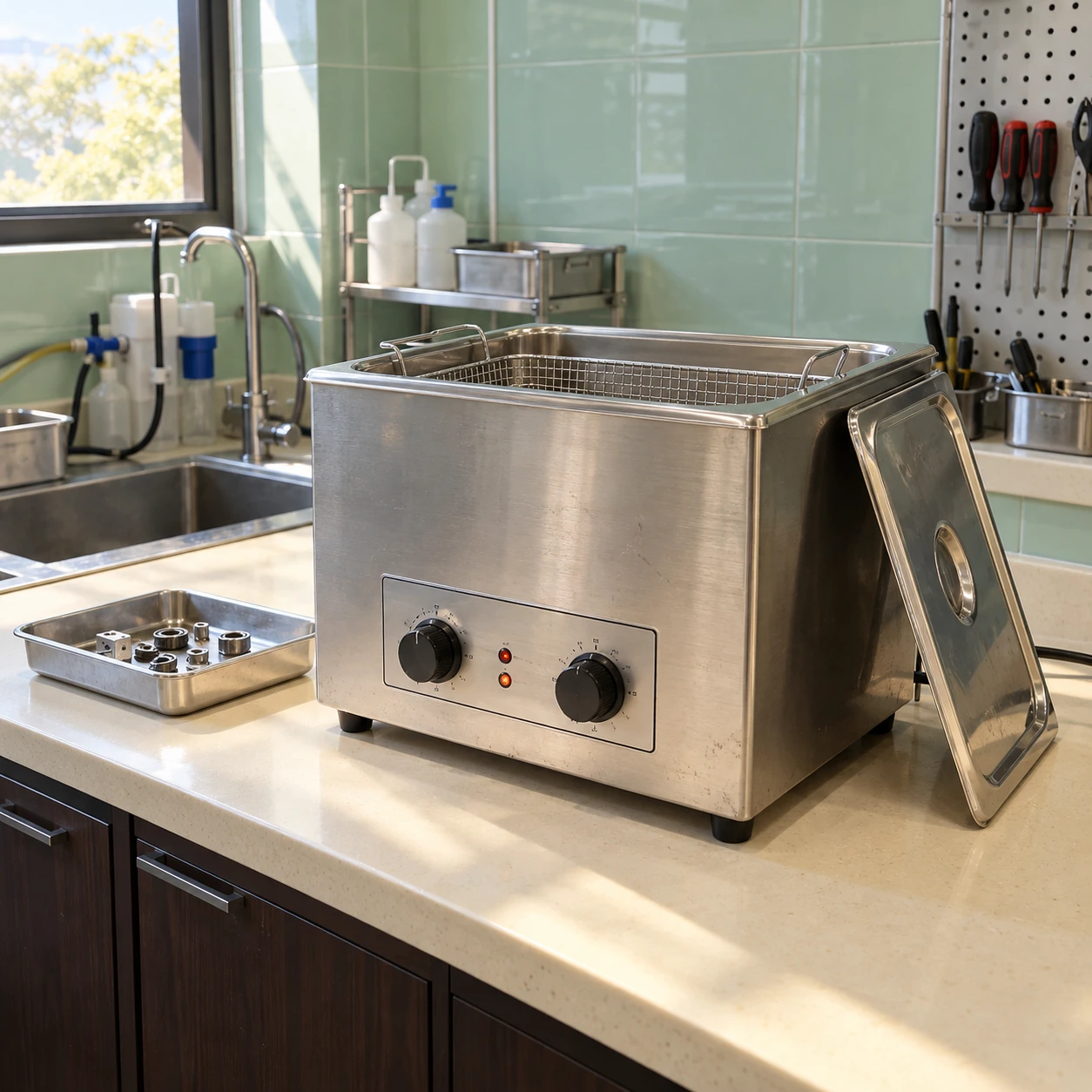
Ultrasonic Cleaners
table top ultrasonic cleaner
| Tank family | 10 / 15 / 30 L nominal capacity |
|---|---|
| Internal tank W × D × H (mm) | 300 × 240 × 150 / 330 × 300 × 150 / 500 × 300 × 200 |
| External W × D × H (mm) | 330 × 270 × 310 / 360 × 330 × 310 / 530 × 330 × 350, respectively |
| Ultrasonic frequency / power | 40 kHz; 240 / 360 / 600 W options by tank size |
| Heating | 200 / 300 / 500 W; adjustable up to 80 °C, subject to chemistry and material limits |
| Controls | Timer up to 30 minutes; rotary or digital controls; selectable degassing function |
| Construction / accessories | 304 stainless steel tank and case; suspended basket, lid and drain valve |
| Electrical supply | 220–240 V, 50/60 Hz; 100–120 V variants by configuration |
External dimensions describe the cleaner only. Table footprint, structural loading and working clearances are additional to these values.
The tabletop cleaner and its basket, drain position and supporting workstation can be arranged for your application.
A table top ultrasonic cleaner should fit the operator's work as well as the table surface. The machine needs space for opening the lid, lifting a wet basket and setting the cleaned work down without crossing the incoming dirty parts.
Reserve the working envelope
Measure the space with the basket held above the bath and the lid fully open or removed. A unit that fits beneath a shelf when closed may be awkward to load. If the drain points toward a wall, a short machine can still require a much deeper table than expected.
A flat, stable support keeps the operating liquid level consistent. The table must carry the combined mass of the cleaner, bath and work; a light office desk or a shelf rated only for the empty machine is unsuitable.
Put water movement on a deliberate route
Use a drip tray where the basket rests after lifting. Route discharge to an approved collection point and keep the drain hose supported so that it cannot pull against the valve. A filled heated bath should not have to be lifted and tipped as part of routine operation.
Position cables and sockets away from this wet route. Keep the generator's ventilation path clear of rags, cartons and adjacent equipment.
Keep controls easy to read during loading
Front controls should remain accessible with the basket in its draining position. Rotary controls can suit a simple repeat task; a digital interface can make time and temperature settings easier to identify when operators handle several component types.
The selected value is only one part of repeatability. A consistent basket arrangement, suitable solution and controlled bath condition also need to be maintained.
A compact station can still have separate cleaning stages
Where the finish requires rinsing, provide a dedicated rinse container or station and a clean drying position. Avoid using the same vessel for every stage without considering retained soil and detergent. Parts can look clean while still carrying a film that interferes with coating, bonding or inspection.
If there is no space to separate these steps, relocating the cleaner may improve the process more than selecting a smaller tank. For capacity and component selection within the bench format, see benchtop ultrasonic cleaner.
The tabletop cleaner and its basket, drain position and supporting workstation can be arranged for your application.