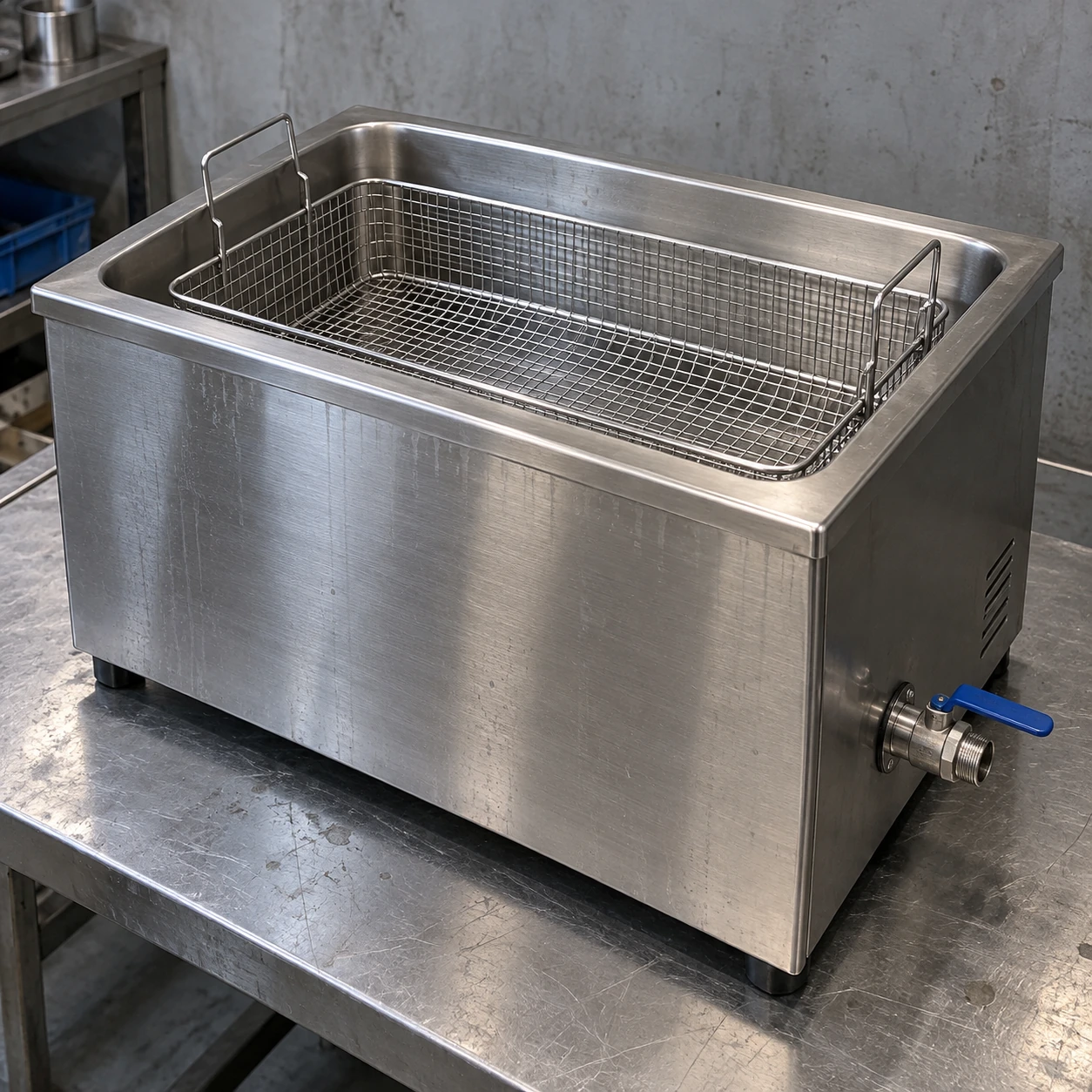
Ultrasonic Cleaners
stainless ultrasonic cleaner
| Internal tank W × D × H (mm) | 600 × 450 × 450 / 1000 × 500 × 400 / 750 × 650 × 500 |
|---|---|
| External W × D × H (mm) | 780 × 550 × 800 / 1180 × 600 × 800 / 930 × 750 × 800 options, respectively |
| Ultrasonic frequency | 25 or 40 kHz, selected for the cleaning task |
| Nominal ultrasonic power | 1–2 kW across the listed tank families; generator matched to transducers |
| Heating / control | 4.8–7.2 kW options; thermostatic control up to 80 °C |
| Tank / frame | Welded stainless tank; 304 or 316L wetted construction selected for the solution |
| Loading / bath care | Suspended basket and lid; optional basket lift, filtration, oil separation and rinse stage |
| Electrical / discharge | 400 V three-phase, 50/60 Hz configuration; drain and overflow connection by tank design |
Wetted material selection covers the tank and connected components. A 316L tank option does not imply that every cabinet part or fitting is 316L.
Wetted materials, surface finish and liquid connections can be specified to suit your cleaning solution and maintenance routine.
Stainless construction is useful in a wet industrial cleaning station, but the word stainless does not define the complete machine. The tank, cabinet, basket, drain and seals may have different material requirements and should be specified accordingly.
Start with what touches the liquid
The cleaning solution contacts more than the main tank. It can reach valves, heater surfaces, basket welds, seals and filtration components. Reviewing only the visible cabinet leaves important compatibility questions unanswered.
304 and 316L are common stainless choices, but neither is universally resistant. The solution's chemical composition, concentration, temperature and duration of exposure determine suitability. A material change should follow this assessment rather than an assumption that a higher grade solves every corrosion problem.
Wet tank construction
Inspect the specified joint and drain arrangement for accessible cleaning and removal of settled debris. Cavitation acts close to the tank surfaces, so deposits and direct contact with heavy parts can create local wear problems.
Use the proper basket supports and keep the work off the tank bottom. When replacing a vessel, preserve the matched relationship between tank, transducers and generator.
Outer enclosure and finish
A brushed outer case is practical for routine wiping and minor handling marks. Its finish does not establish the tank grade or wall thickness.
Cabinet openings must allow electrical components to cool while remaining protected from the intended splash conditions. A stainless enclosure should not be assumed suitable for pressure washing.
Surface care protects more than appearance
Remove settled contamination and rinse the tank in accordance with the equipment and chemical instructions. Do not leave incompatible residues concentrated on a drying surface. Avoid abrasive tools or contaminated steel implements that can damage or contaminate the stainless surface.
Discolouration should prompt an investigation of the solution, water quality, deposits and cleaning routine. Polishing the mark away without addressing its cause can leave the underlying issue unchanged.
Make the material scope traceable
If documented material identity is required, list the components and records needed in the purchase specification. A general brochure statement is not a material certificate for a delivered tank. Also identify the elastomers and other non-metallic wetted parts.
For a new integrated bath or a replacement vessel, see ultrasonic cleaner tank. Include the proposed chemistry and operating temperature when requesting a stainless configuration.
Wetted materials, surface finish and liquid connections can be specified to suit your cleaning solution and maintenance routine.