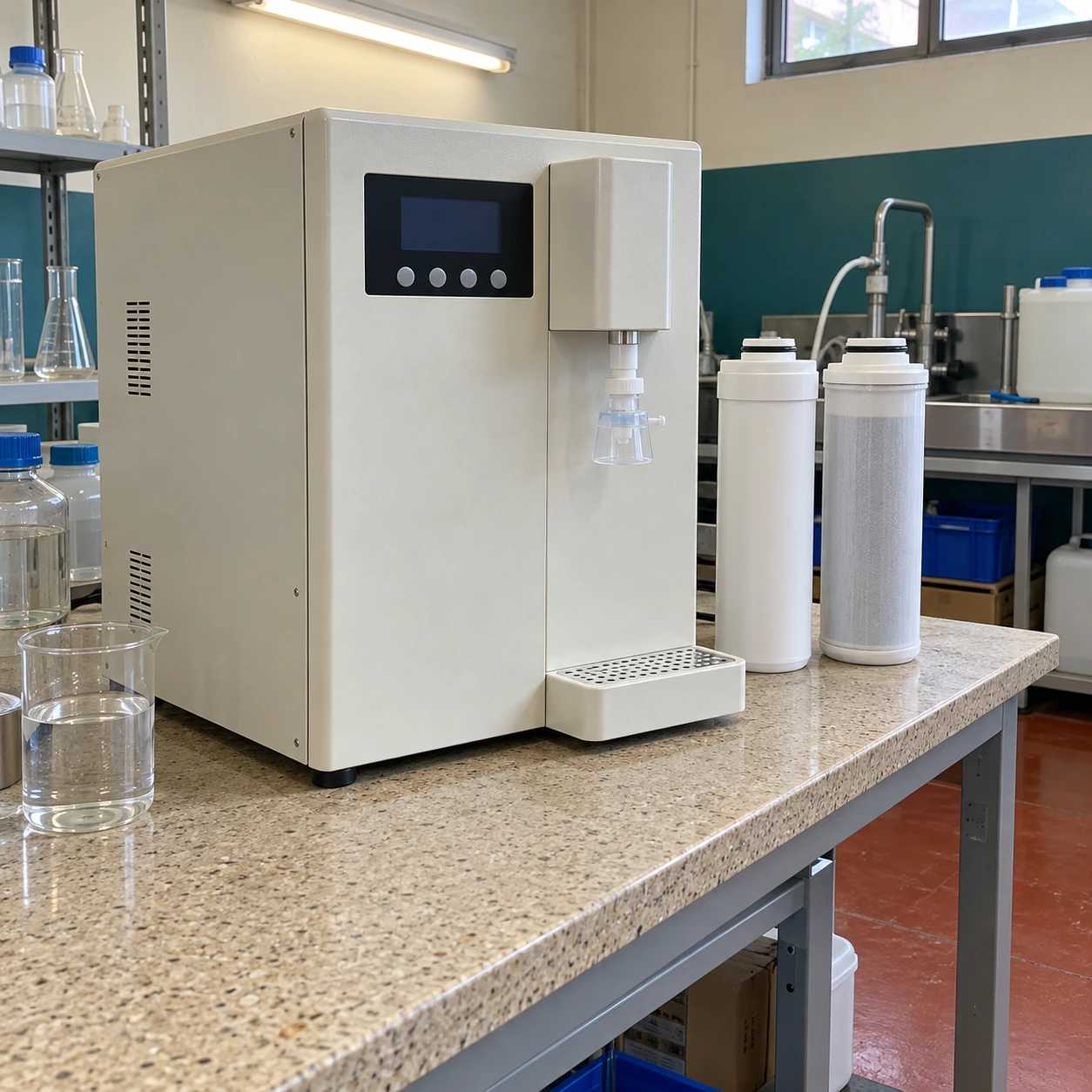
Ultrapure Water Systems
cost-effective ultrapure water system
| Feed arrangement | Tap-water pretreatment with RO and final polishing; prepurified-feed versions also selectable |
|---|---|
| RO production options | 3 / 6 / 12 L/h at 15°C feed temperature; feed pressure and quality affect output |
| Cabinet W × D × H (mm) | 260 × 470 × 470; 280 × 530 × 510; 305 × 400 × 545 — footprint depends on configuration |
| Storage and dispensing | 5 / 6 / 12 L storage options; up to 1 L/min intermittent ultrapure dispense with a matched unit |
| Ionic-purity acceptance | 18.2 MΩ·cm at 25°C at point of dispense, subject to the selected system and agreed feed conditions |
| Treatment options | Ion-exchange polishing; 185/254 nm UV; selected 0.2 or 0.22 μm final filter; application-specific UF |
| Fluid path | Low-leaching polymer tubing and compatible cartridge housings; seals selected for the treatment and cleaning method |
| Power and controls | 100–240 V AC, 50/60 Hz supply options; resistivity/temperature display, tank-level control and feed alarms |
| Installation | Benchtop or approved wall mount; separate allowance for dispenser, reservoir, tubing and service access |
Select a complete matching configuration; production ratings and cartridge consumption depend on feed water and use. Running costs require site-specific inputs.
A cost-effective ultrapure water system delivers suitable water through normal working conditions at a manageable operating cost. The useful comparison includes consumables, utilities, maintenance time and the consequences of a failed batch.
Compare the cost of useful water
A useful cost comparison divides the equipment, consumable, utility and service costs over the comparison period by the volume of water that actually meets the laboratory's requirements and is used. Water discarded during flushing or after failed acceptance contributes to cost but not useful output. This prevents a high production rating from hiding an inefficient fit with the workflow.
Reduce avoidable cartridge loading
Final polishing media should receive water within the intended inlet specification. When an upstream membrane deteriorates or pretreatment is neglected, more contamination reaches the polishing stage. Replacing resin more frequently treats the symptom and can conceal the underlying fault.
Where laboratory methods permit, use a separate less highly treated outlet for bulk rinsing. Reserve final polishing for tasks that require it. The benefit depends on the actual demand split and cannot be represented by one universal saving percentage.
Avoid paying for unused capacity
An oversized reservoir uses space, increases the volume to maintain and may extend water residence time. An undersized arrangement can force operators to wait or store water in extra containers, introducing handling work and contamination opportunities.
Compare the busiest withdrawal period, replenishment time and usual idle interval. The most economical arrangement is not necessarily the smallest or the one with the highest hourly output.
Account for costs that do not appear on the cabinet price
Consumables
List pretreatment, membrane, resin, final filter, UV lamp and any reservoir protection separately. Their life depends on loading, use and the supplied maintenance instructions. A single “annual cartridge cost” can be misleading if it omits some of these items.
Utilities and waste
Include feed water, reject disposal, flushing and power during both production and idle control. For an RO unit, the comparison needs the same feed conditions and working cycle. The low-drain discussion explains the water-balance boundary.
Labour and interruption
A low-cost cartridge is less attractive if replacement requires dismantling a bench or stopping adjacent work. Include the time for isolation, replacement, rinsing and return-to-use checks, plus the consequence of delaying a critical preparation.
Use local information to compare supply packages
Start with recent feed-water information, an estimate of useful daily consumption, the site's utility costs and the proposed consumable schedule. Compare complete packages over the same period. Keep assumptions visible so a change in demand or water quality can be evaluated without rebuilding the comparison.
There is no defensible fixed payback period without those inputs. If an existing prepurified supply can be retained, a local polisher may be appropriate. If its quality is unstable, paying for improved upstream treatment can be more useful than adding another final cartridge. The quotation request can include both situations for a scope-based comparison.
Treatment capacity, consumable scope, storage and operating controls can be customized to balance your water demand and ongoing costs.