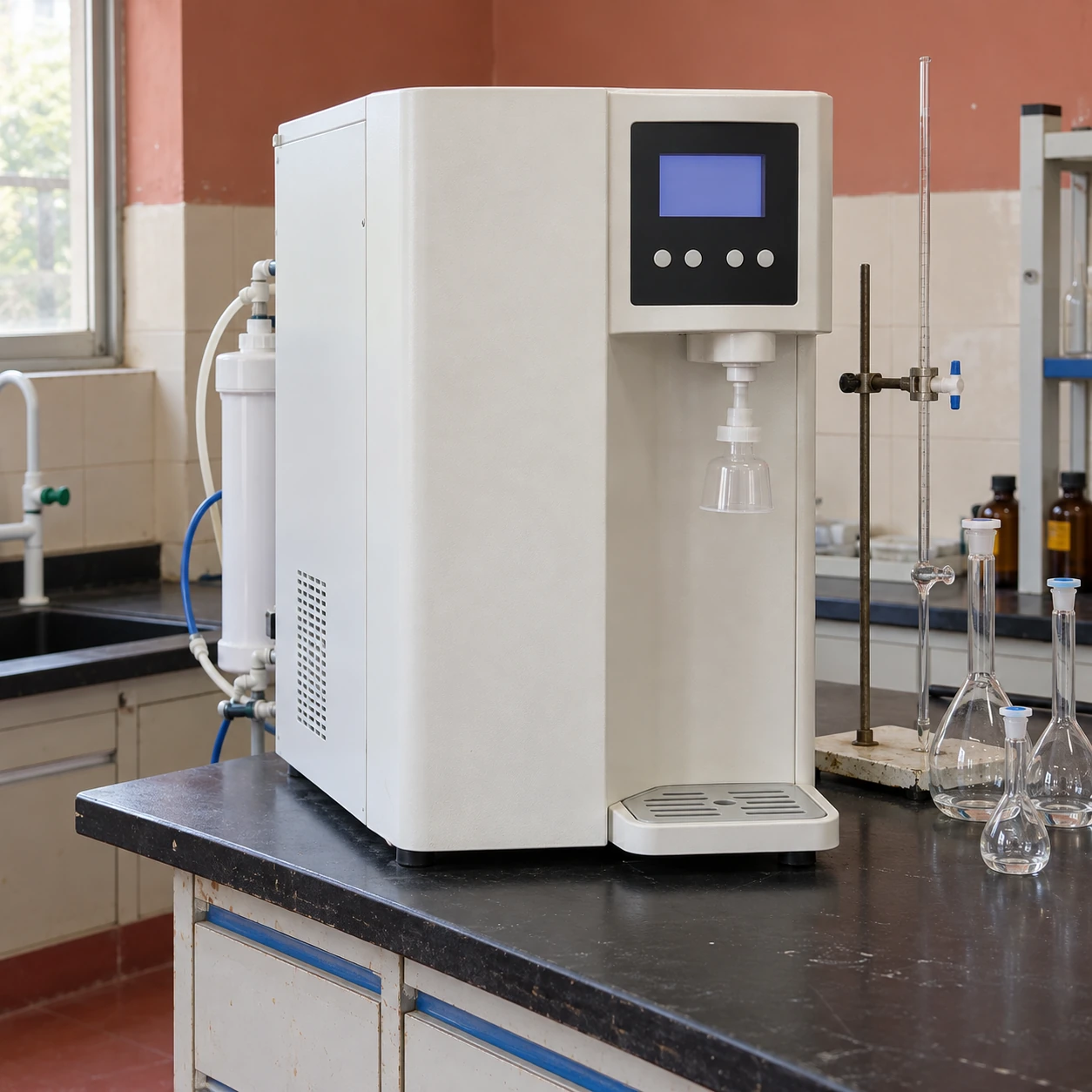
Ultrapure Water Systems
best ultrapure water system for general chemistry
| Feed arrangement | Tap-water pretreatment with RO and final polishing; prepurified-feed versions also selectable |
|---|---|
| RO production options | 3 / 6 / 12 L/h at 15°C feed temperature; feed pressure and quality affect output |
| Cabinet W × D × H (mm) | 260 × 470 × 470; 280 × 530 × 510; 305 × 400 × 545 — footprint depends on configuration |
| Storage and dispensing | 5 / 6 / 12 L storage options; up to 1 L/min intermittent ultrapure dispense with a matched unit |
| Ionic-purity acceptance | 18.2 MΩ·cm at 25°C at point of dispense, subject to the selected system and agreed feed conditions |
| Treatment options | Ion-exchange polishing; 185/254 nm UV; selected 0.2 or 0.22 μm final filter; application-specific UF |
| Fluid path | Low-leaching polymer tubing and compatible cartridge housings; seals selected for the treatment and cleaning method |
| Power and controls | 100–240 V AC, 50/60 Hz supply options; resistivity/temperature display, tank-level control and feed alarms |
| Installation | Benchtop or approved wall mount; separate allowance for dispenser, reservoir, tubing and service access |
Choose a matched configuration from the options above. Water grade, organic limits and acceptance tests follow the intended method; they are not interchangeable certifications.
For general chemistry, the best ultrapure water system is the one that satisfies the laboratory method without creating unnecessary treatment, handling or maintenance work. A purity label alone cannot make that decision.
Let the chemistry define the water
General chemistry spans tasks with very different sensitivity to background contamination. A routine preparation may tolerate water that would interfere with a trace measurement. The starting point is the method's water specification, its blank limits and the contaminants most likely to affect the result. Selecting the highest advertised grade for every task can add cost without addressing the real source of error.
Ultrapure water is useful when the water contribution becomes significant compared with the analyte or reagent concentration. It can support sensitive standard preparation and final rinsing where the approved method calls for it. Routine washing and less sensitive preparation may be served from a separate pure-water output, avoiding unnecessary use of the final polishing stage.
Three questions that change the configuration
Could ions change the measurement?
Ionic contamination can affect conductivity-based work, trace-element blanks and some reagent preparations. Evaluate the complete handling system: the collection vessel and any transfer tubing can add material after the water has passed the unit's sensor.
Could organic background interfere?
Methods sensitive to organic residues need an organic-control strategy as well as ion removal. UV-assisted polishing and a relevant TOC assessment can be appropriate. A resistivity reading alone cannot reveal every organic impurity that contributes to a blank.
Is particle or biological control relevant?
Final filtration can address particles at the collection point. Microbiological, endotoxin or nuclease limits are separate requirements; they should not be added to a general chemistry purchase without a method-based reason and a defined verification approach.
Improve the blank before adding more hardware
When a blank rises, compare water taken directly from the outlet with water after the normal collection and storage routine. Consider the container cleaning method, closures, room vapours and contact time. This separates a treatment problem from contamination introduced later.
A larger purifier will not solve contamination from a poorly chosen bottle. Likewise, replacing the final filter will not necessarily correct dissolved contaminants entering from a failing upstream stage.
Choose a unit the team can maintain
A modest system with suitable treatment, clear status information and accessible cartridges may fit routine analytical work better than a complex unit whose extra functions are never used. Check that the selected supplies and maintenance requirements can be supported throughout the equipment's intended use.
The maintenance-focused option covers access and return-to-use considerations that are easy to overlook during purchase.
A practical basis for comparison
Compare systems against the same methods, incoming water, useful daily volume and acceptance tests. Include the final dispense filter, storage arrangement and necessary monitoring in each supply scope. This gives “best” a defensible meaning for your laboratory without relying on a universal ranking or an unsupported performance claim.
The water grades, polishing options and dispense arrangement can be customized for your general chemistry methods and bench layout.