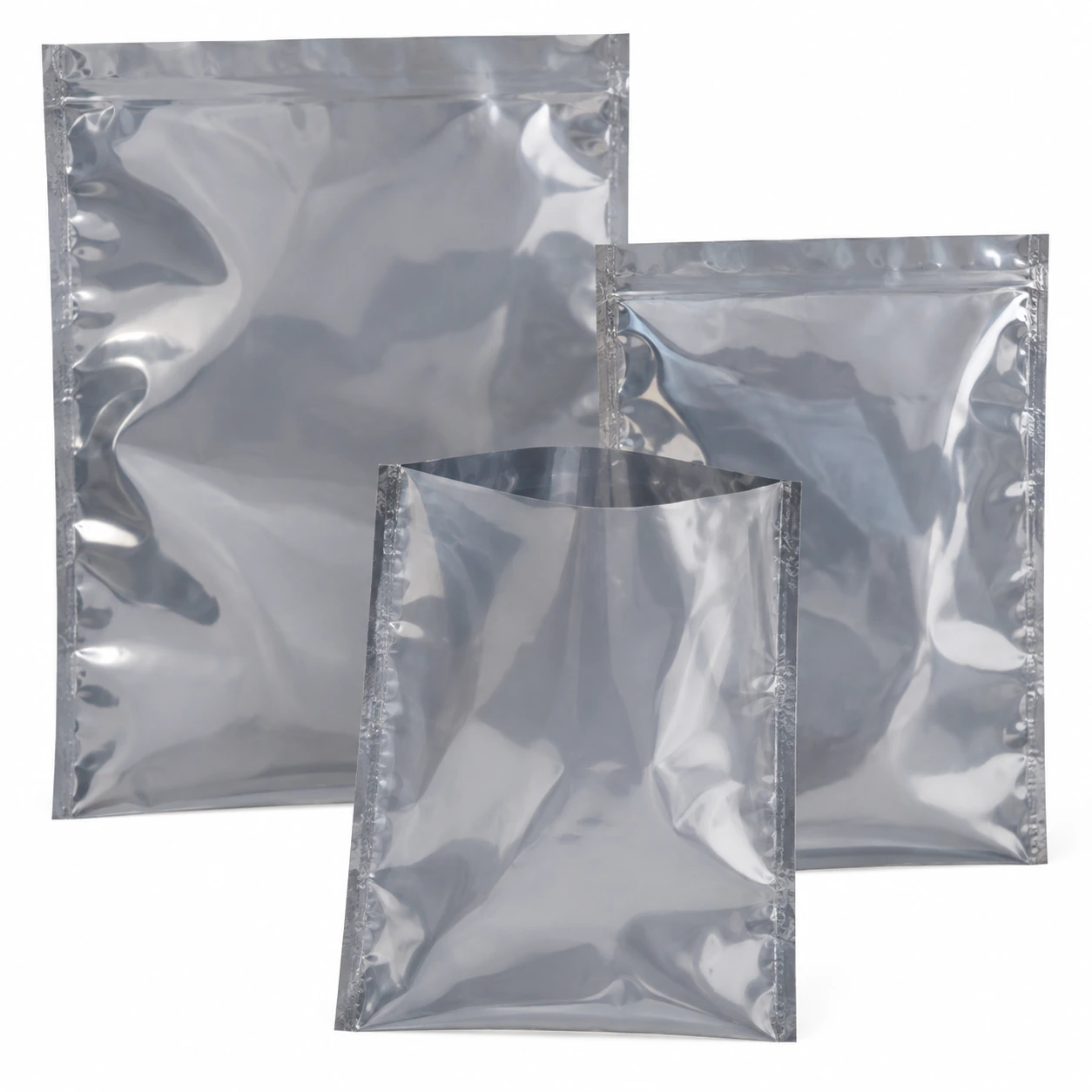
Static Shielding Bags
static shielding bags
| Bag construction | Semi-transparent metal-in laminate; polyester / metallized layer / polyethylene |
|---|---|
| Nominal flat sizes, W × L | 76.2 × 127; 152.4 × 203.2; 203.2 × 304.8; 254 × 304.8 mm |
| Film thickness options | Approximately 0.071 or 0.081 mm, selected by laminate construction |
| Opening | Open top with an approved closure method; press-to-close zipper option |
| Protection properties | Low charging, suitable contact-surface resistance and discharge shielding, qualified for the supplied bag |
| Identification | ESD identification and batch traceability marking; marking layout by order |
W × L identifies the nominal flat bag size, not the maximum component size. Usable space depends on the seams, closure and item thickness; the selected bag specification governs.
Static shielding bags enclose ESD-sensitive electronic parts during storage and movement. A suitable bag combines low-charging contact surfaces with a shielding structure, then fits into a packing method that protects the part from bending, punctures and uncontrolled opening.
Protection continues after the part leaves the bench
A control board may be handled correctly at assembly and then move through stores, inspection and dispatch where the same ESD controls are unavailable. Enclosing it in a qualified shielding package reduces its exposure during those transfers. The bag must remain properly closed until it reaches a suitable ESD protected area for unpacking.
The metal layer contributes to discharge shielding, while the contact surfaces address charge generation and dissipation. A metallic appearance alone does not establish either property. Select the complete bag against the sensitivity and handling requirements of the assembly, with documentation for the actual material and construction being supplied.
Choose the opening around the work
Open-top bags suit packing operations with a defined closing method. Heat sealing can provide a controlled, single-opening package when the film and sealing process are compatible. A loose fold is not a universal substitute for an approved closure.
A zipper is useful when a spare is repeatedly removed and returned. It reduces the need to cut away a sealed edge, but the operator still has to close the whole mouth. See reclosable bag handling for repeated-access applications.
Protect the shape as well as the circuit
Shielding film is flexible. It does not stop a carton from crushing a connector or a sharp pin from piercing the bag. Use a compatible tray, connector protection or cushioning where the assembly needs mechanical support.
Leave enough space for the bag to wrap around the part without pulling its seams tight. Oversized loose bags can also be troublesome when excess material catches in a tote or is folded sharply around a board.
Match the package to the next destination
Between production stages
Keep the part identifiable through the film and organize the handover so the package stays closed outside the protected work area.
Stored maintenance spares
Keep individual assemblies separated and support projecting parts. Put the part identity where it can be read without repeatedly opening the bag.
Shipment to another site
Combine electrical protection with suitable transit packaging. Define how the receiver should unpack the assembly and retain its identification.
Moisture and cleanliness are separate selections
A standard shielding pouch is not automatically a moisture barrier or a cleanroom-qualified package. Moisture-sensitive parts may need a specified barrier construction, closure and dry-packing process. Particle-sensitive work needs its own cleanliness evidence. Describe these requirements when requesting a bag so that silver film is not mistaken for an all-purpose protective enclosure.
Bag dimensions, closure, marking and packing configuration can be customized to suit the electronic parts and handling conditions.