Static Shielding Bags
anti static shielding bags
| Product form | Metallized shielding bag with low-charging contact surfaces |
|---|---|
| Nominal flat W × L | 76.2 × 127; 152.4 × 203.2; 254 × 304.8 mm |
| Base construction | Metal-in laminated film with a heat-sealable inner layer |
| Common film option | Approximately 0.071 mm laminate; heavier constructions selected by handling need |
| Closure choices | Open top for an approved closing process or press-to-close zipper |
| Performance selection | Contact-surface behavior and discharge shielding assessed separately |
Nominal bag dimensions are not usable component dimensions. Electrical and cleanliness requirements must be matched to the supplied packaging and the handling environment.
Anti static shielding bags combine control of charging at the package surfaces with a shielding structure around the contents. The words describe different jobs: reducing charge generation during contact does not, by itself, shield an electronic assembly from a discharge outside the package.
Low charging starts at contact
Parts rub against packaging when they are inserted, transported and removed. Low-charging materials help limit charge generation through that contact. The behavior depends on the materials involved, which is why replacing an approved liner with ordinary plastic can change the package even if the outer bag stays the same.
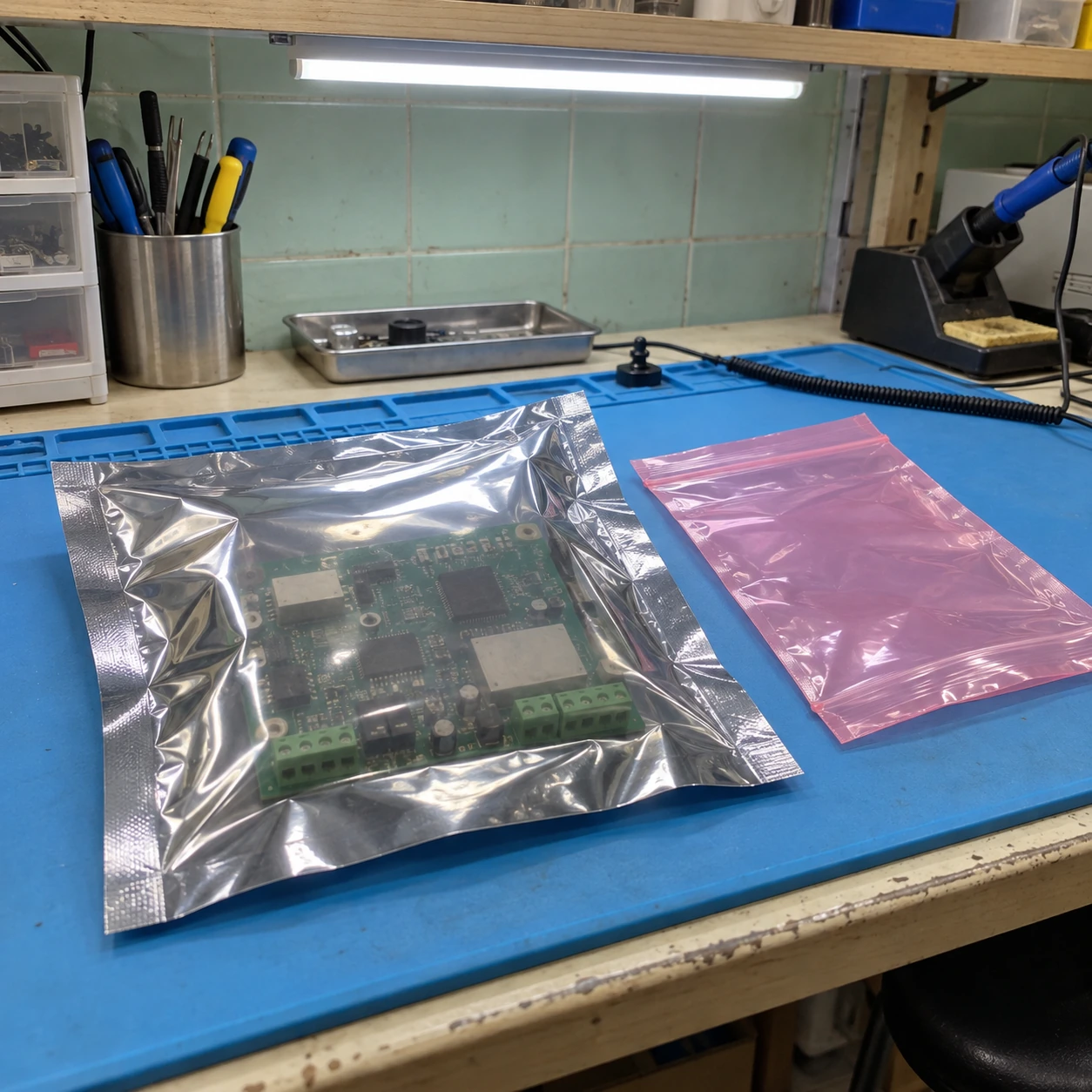
A pink or clear bag may be sold for low-charging use. Its color does not establish shielding. If the assembly will leave the ESD protected area, select the whole package for that journey rather than relying on an antistatic description.
Shielding addresses an outside event
A shielding structure surrounds the sensitive item and limits the effect of an external electrostatic discharge. That protection depends on the selected construction and on keeping the package closed and intact. A metallized bag laid open beneath a board is not the same protective arrangement as a closed enclosure.
The shielding bag also does not replace the grounded handling arrangements required when the board is unpacked. Move the closed package to the designated protected station before exposing the contents.
Choose for the weakest handover
A board may travel from a controlled assembly bench to a general warehouse, then to a service technician. The purchasing decision should include the least controlled part of that route. Packaging suitable only for movement within a protected area may be insufficient for dispatch or field-service transport.
- Identify whether the part is exposed or enclosed at each transfer.
- Select contact materials compatible with the component and its ESD requirements.
- Keep the shielding enclosure closed throughout unprotected movement.
- Provide mechanical support so pins, mounting tabs and carton loads do not damage the package.
Do not let an extra layer undo the choice
Unspecified bubble wrap, loose foam and paperwork placed against an exposed board introduce new contact materials. Decide where each belongs in the packing arrangement. A label on the outside of a closed pouch is often easier to use than a document that requires opening the bag to identify the part.
For controlled-environment production, also specify whether the bag needs documented particle or chemical cleanliness. Dissipative behavior and low particle release are different properties; neither should be inferred from the other.
What to include in an inquiry
State the assembly type, whether it travels outside an ESD protected area, the required contact materials and the intended closure. If the acceptance specification names a test method, include the applicable limit and document revision. ESD qualification and receipt checks explain how to keep those requirements connected to the delivered bag.
The bag size, contact material, closure and marking can be customized to suit the part and its route through production and dispatch.