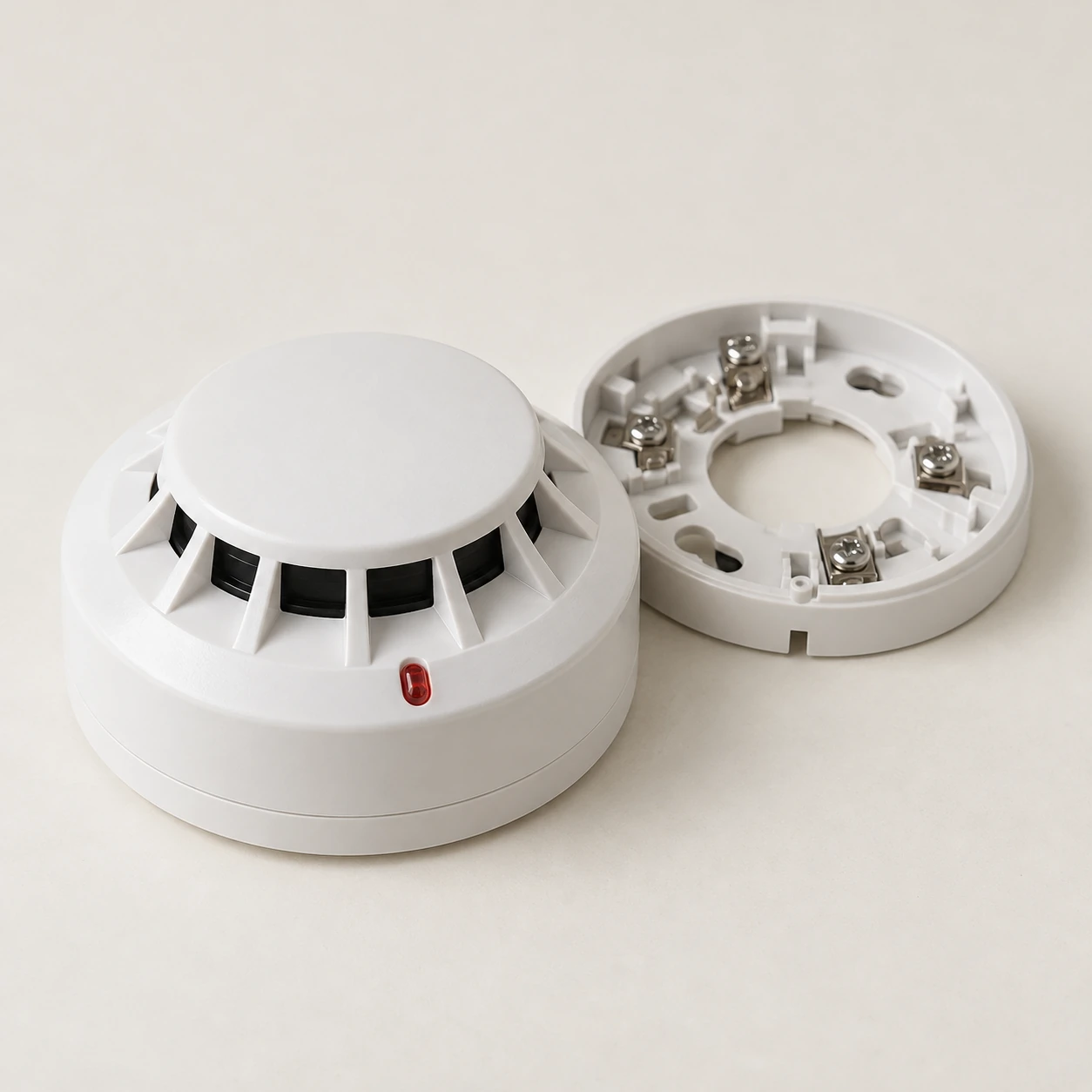
Smoke Detectors & Alarms
photoelectric smoke detector
| Sensing principle | Optical light scattering in a protected smoke chamber |
|---|---|
| Detector body, diameter × height (mm) | 100 × 42 round head; wireless assembly option 110 × 70 |
| Conventional assembled size (mm) | 100 diameter × 50 height with matching standard base |
| Wired power option | Nominal 24 V DC; selected conventional families operate within a documented 9–33 V DC range |
| System interface | Conventional zone, supported addressable protocol or supervised wireless receiver |
| Housing | Moulded polymer with perimeter smoke-entry passages |
| Mounting accessories | Compatible base; selected remote indicator or sounder-base arrangements |
| Selection documentation | Exact detector/base pairing, operating limits and destination-appropriate product evidence |
The wired voltage range applies only to the selected compatible family. Wireless and addressable alternatives have their own supply and interface requirements.
The optical detector configuration, compatible bases and installation supply package can be customized for your application.
A photoelectric smoke detector uses light within a sensing chamber to respond to smoke entering the device. Selecting one for a commercial building means matching that sensing method to the environment and matching the detector electronics to the fire alarm system.
How particles become a warning signal
Inside a light-scattering detector, an emitter and receiver are arranged so that smoke particles entering the chamber change the light reaching the receiver. The electronics evaluate that signal and report an alarm through the selected system interface.
This method is commonly used for smoke associated with smouldering materials. It does not identify every combustion product, measure oxygen or provide carbon monoxide protection unless a separate supported sensing function is included.
Smoke must reach the chamber
A suitable sensor can still be poorly installed. Beams, high ceilings, strong supply-air jets and enclosed pockets affect how smoke travels. A detector hidden behind services may also be difficult to inspect and test.
Use the building's approved detection design for location and spacing. The circular diameter of the product has no direct relationship to its protected floor area; a universal square-metre claim would ignore the room and installation conditions.
Optical detection in working facilities
Office and support areas
Relatively stable indoor conditions can suit point optical detection when the overall design specifies it. Ceiling finish and maintenance access still affect the mounting choice.
Dust and process aerosols
Normal airborne material can reach the chamber along with smoke. Review contamination sources and suitable detector technology instead of treating frequent unwanted signals as a normal operating cost.
Changing layouts
New partitions, racks and ventilation changes can alter smoke movement. Reassess the installed coverage when the space changes, even if the detector itself remains in working order.
Keep the sensor and control system together
Conventional and addressable heads can look alike while communicating differently. The base may add isolation, a relay, a sounder or simply a connection point. Match the complete combination; equal voltage and matching screw holes are insufficient proof of interchangeability.
For identification and service reporting at individual points, compare a smart smoke detector within a supported commercial control platform. Where long-term maintenance is the priority, specify accessible mounting, a clear device schedule and the manufacturer's cleaning and test arrangements.
shengtongJH can organize the supply selection around those requirements. The final order should identify the approved detector family and accessories rather than relying on an exterior photograph to define electrical performance.
The optical detector configuration, compatible bases and installation supply package can be customized for your application.