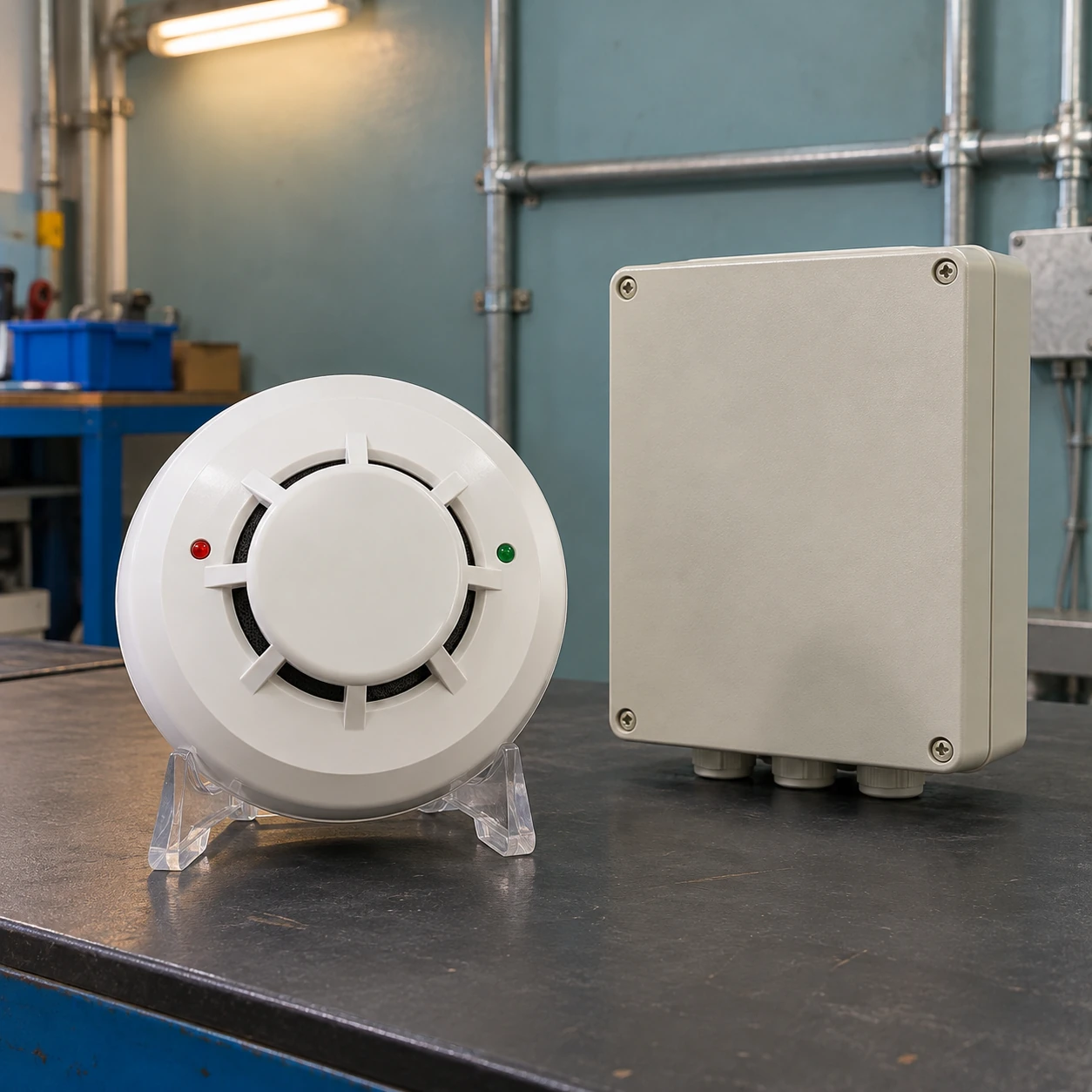
Smoke Detectors & Alarms
smart smoke detector
| Smart functions | Point identification and supported status reporting through a compatible control platform |
|---|---|
| System choices | Wired addressable loop or supervised wireless detector with matched receiver |
| Housing options, diameter × height (mm) | 100 × 42 addressable head; 110 × 70 or 111 × 57 wireless assembly |
| Sensing | Optical smoke; selected multi-sensor functions only where supported |
| Power | Compatible loop supply or approved primary lithium cells for wireless arrangements |
| Communication | Device-family protocol; wireless band and receiver selected for the destination |
| Accessories | Approved base, translator/receiver, repeater or sounder option as required |
| Maintenance records | Device identity, location, event history and battery/fault reports where the platform provides them |
Connectivity, radio range and battery duration depend on the selected platform and site conditions. An app or network gateway is not a substitute for the building's required alarm system.
The detector, receiver and accessory supply arrangement can be customized for your facility's approved control platform and reporting needs.
A useful smart smoke detector gives the facility meaningful information about a specific detection point. In commercial systems this can mean addressable identification, supervised wireless communication and supported maintenance reporting, rather than a standalone phone notification.
Better information helps the response
A useful device name points to a real location: a room, corridor or defined plant area. A generic identifier leaves staff searching for the source of an event. During commissioning, coordinate the detector schedule with the panel labels and site plans.
Status information can also help maintenance distinguish a sensor issue from a communication or supply fault. The feature must be supported by the detector, interface and panel; it should not be assumed from the word “smart” on a quotation.
The reporting path needs its own design
Local warning, panel reporting, remote monitoring and optional app messages are separate functions. Determine what remains available if a network connection, gateway or site power supply fails. The required protection cannot depend solely on someone noticing a phone alert.
For a managed facility, agree who receives events, who acts on them and who maintains access credentials. A well-connected device without an operational response arrangement can still leave an unresolved fault.
Wired and wireless solve different installation problems
Addressable wiring
Can suit an existing supported loop or a planned new cable route. Compatibility includes protocol, device limits, bases and control-panel configuration.
Supervised radio
Can reduce new detector cabling in an occupied building. Walls, metal stock and future changes require a site-specific radio assessment and suitable receivers.
Ongoing service
Both arrangements need testing and records. Wireless devices also need an approved battery-service plan; wired devices rely on the system's supervised power arrangements.
Specify the information you will actually use
For procurement, distinguish essential alarm and fault reporting from optional analytics or remote access. Ask for the supported functions of the complete proposed combination, including software or interface dependencies. Do not treat a wireless range measured in open air as a guaranteed distance through a warehouse.
A battery powered smoke detector can be a supervised commercial system component, but battery power alone does not make it smart or interconnected. shengtongJH can coordinate the equipment list around the chosen platform; installation design and commissioning must remain with the responsible fire-system professionals.
The detector, receiver and accessory supply arrangement can be customized for your facility's approved control platform and reporting needs.