Product overview
Silicone Dust Removal Tools
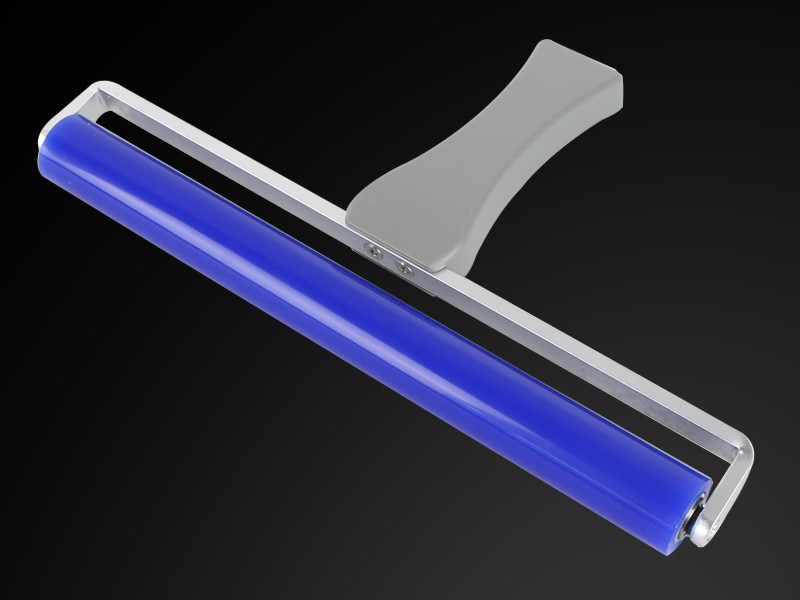
Silicone Dust Roller with Aluminum Handle
| Contact material | Blue silicone |
|---|---|
| Handle | Aluminum handle; metal support frame |
| Contact widths | 4, 6, 8, 10 or 12 in; customized |
| Tack options | Medium or high tack |
| Hardness designation | 25–30; test scale unspecified |
| Listed packing | 30 units/carton; selected format to be confirmed |
| Cleanliness designation | General |
Tack and hardness require agreement for the workpiece. No ESD certification or fixed service-life guarantee is specified.
Contact width and tack can be customized around the workpiece and cleaning method.
The flat aluminum handle and metal frame support a wide silicone contact roller. This format suits manual passes across panels where stable guidance and even contact are more useful than concentrated pressure.
Guide the roller evenly
Hold the handle so the roller remains parallel to the workpiece. Excess pressure at one end can produce uneven contact and put unnecessary load on the end supports. Check free rotation and bracket condition before use.
A wide roller can span a panel efficiently, but it should not bridge raised features or sharp steps. Use a smaller contact tool around local obstructions instead of forcing the roller into an unsuitable area.
Choose tack and maintenance as a pair
Confirm pickup and release behavior using representative parts. Define how particles are removed from the roller between passes and how the clean tool is protected during storage.
Replace a roller with a damaged or contaminated surface rather than relying on increased pressure. The metal handle is a construction feature; it does not, by itself, establish grounding continuity or certified electrostatic performance.
Contact width and tack can be customized around the workpiece and cleaning method.