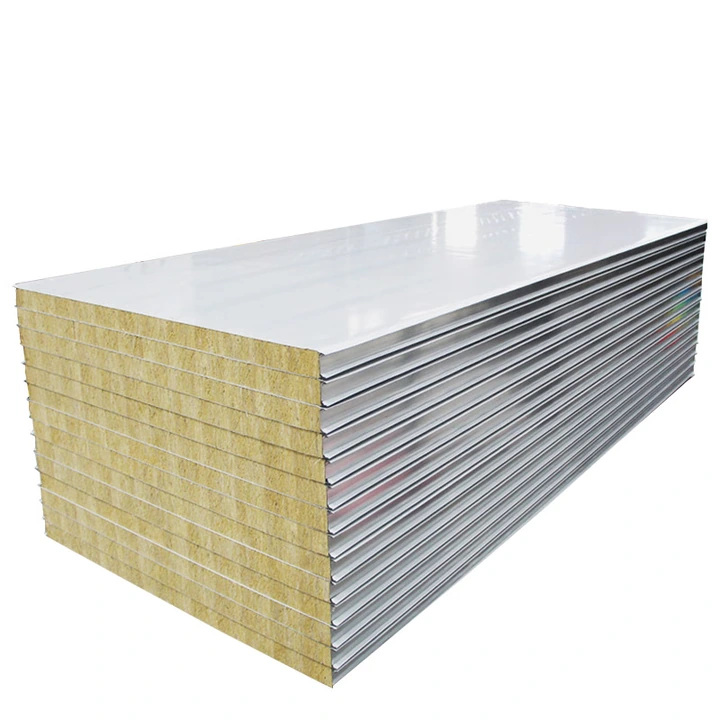
Rock Wool Sandwich Panels
rockwool insulated panels
| Brand | shengtongJH |
|---|---|
| Applications | Industrial envelopes; temperature-separated process areas; partitions |
| Insulating core | Rock wool / stone wool |
| Thickness options | 75 / 100 / 150 / 200 mm |
| Module width | 900 / 1150 mm options |
| Facing options | PPGI or SS304 |
| Finish options | PE / SMP / PVDF, selected for exposure |
| Connections | Interlocking joints and compatible perimeter seals |
| Length | Project-cut; configuration and transport limits apply |
Panel dimensions, surface finish and connection details can be configured for your application.
Rockwool insulated panels help form a thermal boundary between spaces. The insulation in the middle matters, but the joints, supports and openings determine how much of that benefit survives in the completed enclosure.
Define both sides of the boundary
Record indoor and outdoor conditions, or the conditions in the two adjoining rooms. A workshop kept comfortable during working hours differs from a continuously conditioned process area. Air leakage, door operation and equipment heat can dominate the load even after the wall insulation is improved.
Select panel thickness using the required thermal design rather than assuming that the thickest option is always the best purchase. Available space, junction geometry, fixing length and transport also change with thickness. A panel U-value must correspond to the actual core, skin arrangement and declared calculation or test method.
Continuous insulation
Carry the intended thermal boundary through corners, heads and bases. A steel member crossing the boundary can create a local thermal bridge. Detail these locations with the designer instead of expecting the panel field to compensate for them.
Continuous sealing
Air passing through a joint can carry both heat and moisture. Seals need a defined position and continuity at intersections. Trim appearance alone does not show whether the air barrier is complete behind it.
Prevent a local cold surface from becoming a maintenance problem
Condensation depends on surface temperature and surrounding moisture conditions. A damp patch at a fixing or corner should prompt a check of the junction and air leakage path, not an automatic decision to increase every panel's thickness. In high-moisture production areas, coordinate ventilation and cleaning practices with the enclosure design.
For refrigerated or freezer construction, use a complete cold-store panel and vapour-control assessment. An industrial wall panel should not be treated as a freezer panel simply because both contain insulation.
Compare like-for-like configurations
Check thickness, facings, joint type and support conditions together when comparing quotations. Ask which assembly the thermal information describes. The insulation selection page explains why core properties and wall performance are different measures.
shengtongJH can coordinate thickness, finish and joint accessories around your application and installation constraints.