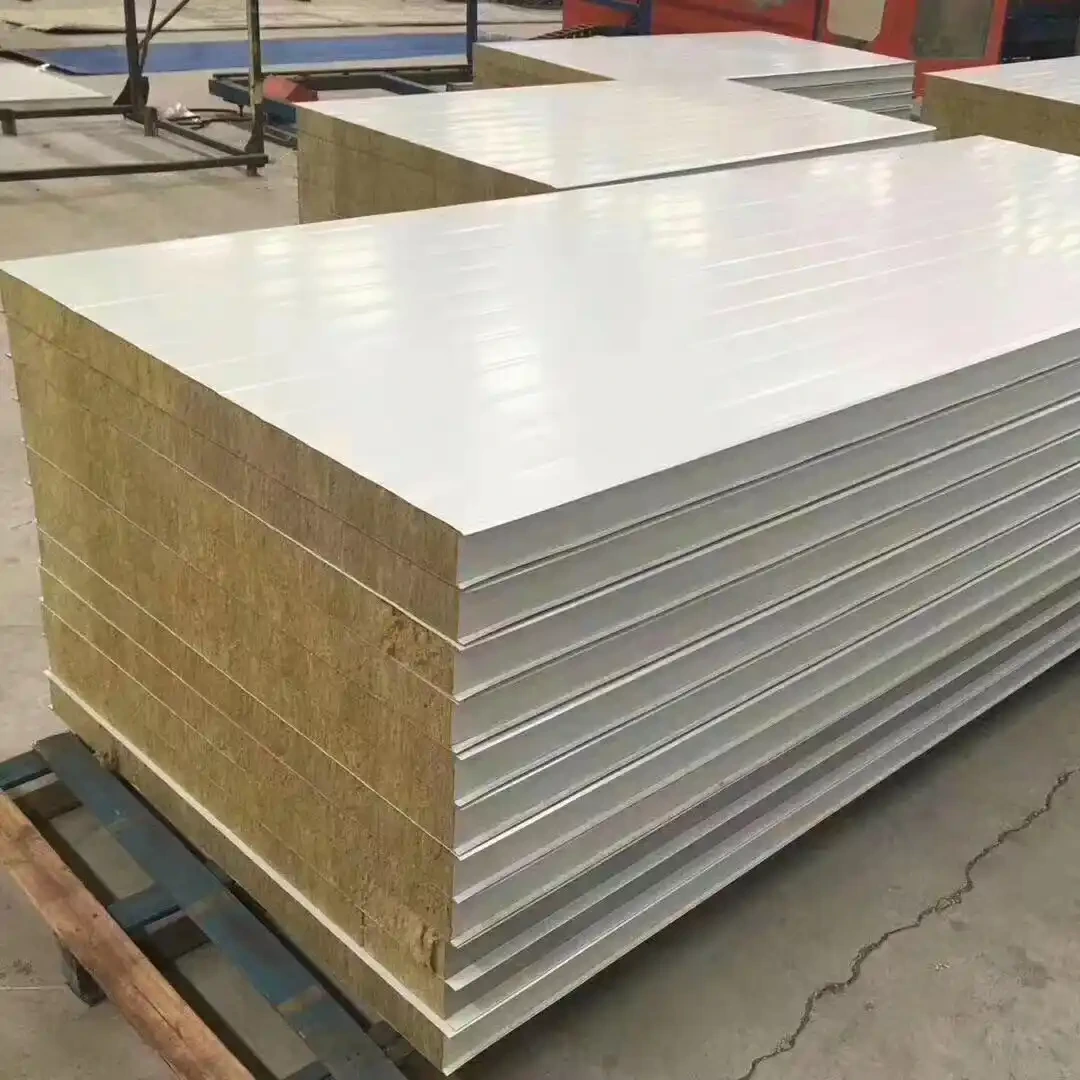
Rock Wool Sandwich Panels
rockwool panel insulation
| Brand | shengtongJH |
|---|---|
| Supplied format | Rock wool core within metal-faced sandwich panels |
| Core | Stone wool |
| Thickness choices | 50 / 75 / 100 / 150 / 200 mm |
| Panel widths | 900 / 1150 mm |
| Facings | PPGI; SS304 option |
| Edge protection | Interlocking profile and closed cut edges |
| Length selection | Made to the project cutting schedule |
| Use | Insulated industrial walls and internal enclosure systems |
Panel dimensions, surface finish and connection details can be configured for your application.
Rockwool panel insulation works as part of a wall build-up. A core's material properties explain only part of the result; the finished panel and its installed junctions must be considered together.
Three different questions behind an insulation specification
What is the core?
Core composition and declared thermal conductivity help describe the insulation material. Do not substitute the conductivity of an unrelated stone wool board for the core used in a particular sandwich panel.
What is the panel?
Thickness, facings, adhesive and edge geometry define the finished product. Its thermal and mechanical data need to describe that construction rather than the raw insulation alone.
What is the installed wall?
Connections, openings, supporting steel and air leakage affect the completed boundary. Even a correctly selected panel can perform poorly when joints or perimeter closures are incomplete.
Keep water out of exposed insulation
Protect bundles and unfinished cut edges during storage and installation. Metal skins protect broad surfaces, but the ends and site-cut openings still need appropriate closures. Inspect weather exposure and packaging condition after delivery, particularly where installation will be delayed.
Persistent wetting is a defect to investigate. Find the entry route, assess affected material and repair the detail; simply covering a wet joint with another trim can hide the cause. The correct response depends on the panel condition and the installation system.
Choose thickness around the actual purpose
For a partition separating similar indoor conditions, surface durability and room layout may drive the choice. Where there is a substantial temperature difference, thermal design becomes more significant. Fire and acoustic requirements introduce separate assessment criteria; a single thickness cannot stand in for every performance measure.
Specify whether you need a complete metal-faced panel or bare insulation for a separate lining system. This product range concerns the complete panel. That distinction prevents a quotation for the wrong installation method and missing facing or fixing materials.
Turn the insulation requirement into an order
Provide the wall location, operating temperatures, exposure, required thickness and intended support arrangement. shengtongJH can organize compatible panel configurations and finishing components for the project, with dimensions and surfaces selected for the application.