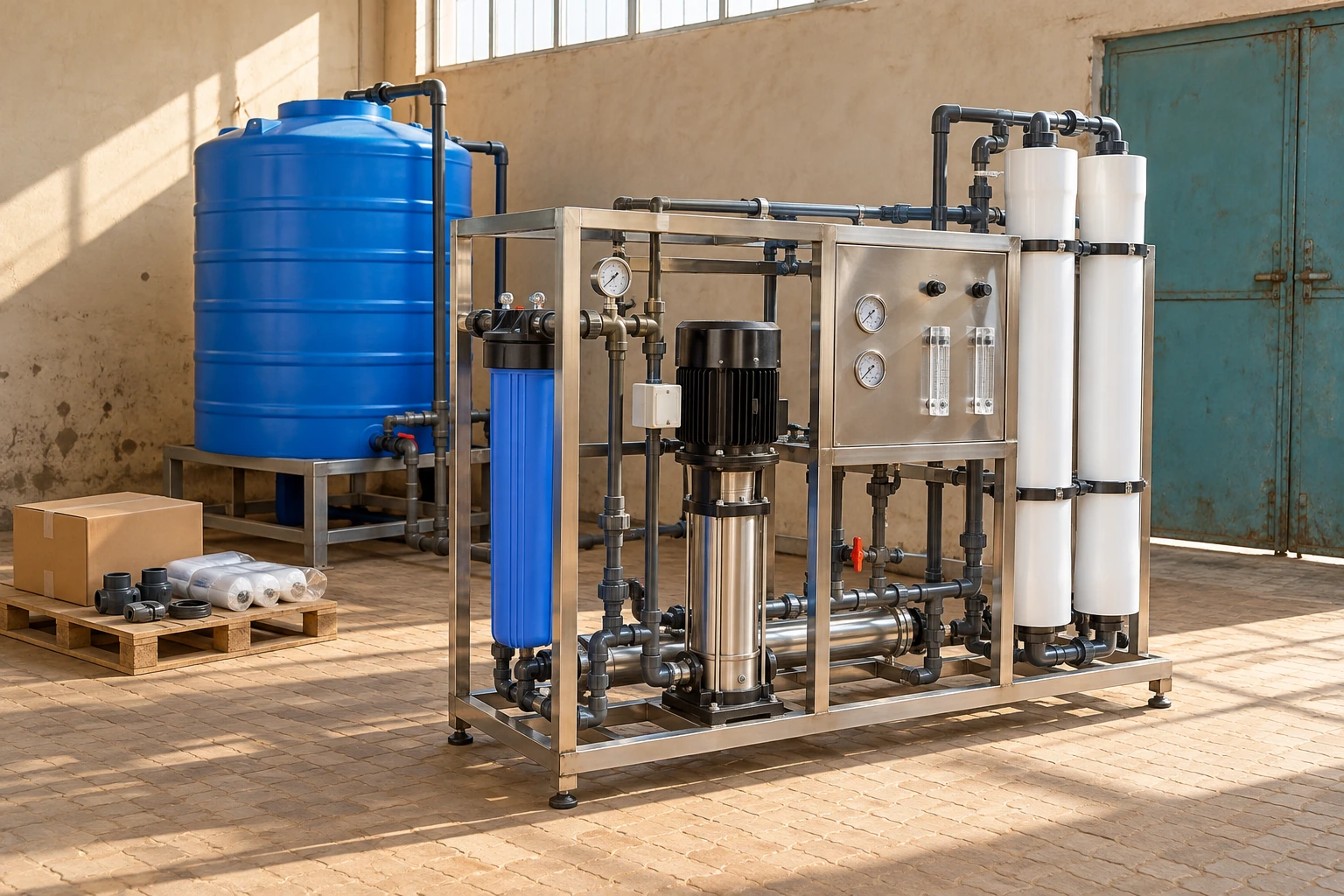
Reverse Osmosis Systems
reverse osmosis water purification system kenya
| Project scope | Commercial and industrial water treatment; source-specific pretreatment and RO equipment supply |
|---|---|
| Production classes | 250, 500 or 1,000 L/h, selected for the tested feed composition and operating temperature |
| RO frame, L × W × H (mm) | 559 × 660 × 1,397; 559 × 787 × 1,397; 864 × 940 × 1,524 |
| Membrane selection | Tap-water or brackish-water RO elements according to the analysis; seawater duties require a separate design |
| Feed conditioning | Media filtration, carbon, softening or antiscalant and cartridge protection as justified by the water report |
| Power configuration | 220–240 V single phase or 380–415 V three phase, 50 Hz options; confirm the site's measured supply and phase availability |
| Delivery package | RO skid, separately defined tanks and pumps, documented connections and a matched initial consumables scope |
| Control options | Low-water and low-pressure protection, tank-level signals, conductivity monitoring and controlled restart |
Listed dimensions cover the RO frame only. The project layout must also allow for pretreatment, tanks, drainage, membrane removal and any separate power equipment.
The RO package, source-water pretreatment, spare-parts scope and installation interfaces can be customized for your Kenyan project.
For a reverse osmosis water purification system Kenya project, the right package depends on the actual source water and the facility using it. A commercial service room, an industrial rinse line and a borehole-fed installation need different pretreatment and supply arrangements even when their requested output is similar.
Use a site water report, not a country-wide assumption
Municipal water, borehole water and other approved sources can differ substantially. A water analysis should address the constituents relevant to the proposed source and end use: salinity, hardness, alkalinity, suspended solids and potential membrane foulants, with specific contaminants included where the local assessment identifies them.
Do not select fluoride, iron or another treatment duty merely from the word Kenya on an enquiry. If a tested constituent is a concern, define the required outlet limit and assess the complete treatment route against it. RO reduction varies by substance and operating condition; a generic rejection percentage is not evidence that every end-use limit will be met.
A source with significant suspended matter or iron may need treatment before a standard RO skid can operate reliably. Highly saline feed also changes pump, membrane and pressure-vessel selection. A modest tap-water package should not be substituted for a seawater system.
Coordinate water availability and operating hours
If the site's incoming supply is intermittent, suitable raw-water storage and pump protection can keep the RO from repeatedly stopping on inadequate feed. Size this arrangement from the site's actual supply pattern. Product-water storage has a different purpose: buffering treated-water demand while the RO runs or is serviced.
Where the facility uses backup power, verify voltage, frequency, motor starting and the combined connected load with the site's electrical designer. A pump selected for one supply should not be assumed to operate correctly on a different phase arrangement.
Provide a workable drain and service route
The concentrate stream and pretreatment backwash need an approved discharge arrangement. Their composition and peak flow differ, so the drain decision belongs in the site design. Reusing concentrate is a separate application assessment rather than an automatic feature of a water-saving package.
Transport access, doorway dimensions and the space needed to remove membrane elements can determine whether equipment ships as one skid or several modules. Protect exposed outdoor connections and select enclosure conditions for the actual installation environment.
Resolve import documentation before dispatch
The Kenyan importer should establish the current conformity route for the exact equipment and shipment with KEBS or its appointed inspection provider. The KEBS PVoC guidance describes pre-export conformity procedures; applicability, required evidence and any exemption must be confirmed for the consignment. A supplier brochure or general quality certificate is not a substitute for the required shipment documents.
The procurement scope should align equipment descriptions, the packing list, invoice, component documentation and any agreed test records. Confirm responsibility for freight, clearance, inland movement and installation in the quotation. No local stock, local office or installation service should be assumed from a Kenya-focused product page.
Arrange maintenance supplies with the equipment
Choose an initial consumables and spares scope from the actual bill of materials. Record membrane size and connection details, cartridge dimensions, pump service parts and control specifications so future orders are identifiable. Availability of replacement parts and competent local maintenance may influence the preferred configuration more than a small difference in nominal output.
For drinking-water or food-related use, final treatment, hygienic storage and the required water-quality verification must cover the delivered water at the point of use. RO equipment alone does not establish the safety of the whole installation.
shengtongJH coordinates equipment procurement for the agreed project scope. Send the site water report, demand pattern, utility details and delivery destination with your enquiry. The factory supply scope explains the construction and acceptance information that helps connect the order to the site requirements.
The RO package, source-water pretreatment, spare-parts scope and installation interfaces can be customized for your Kenyan project.