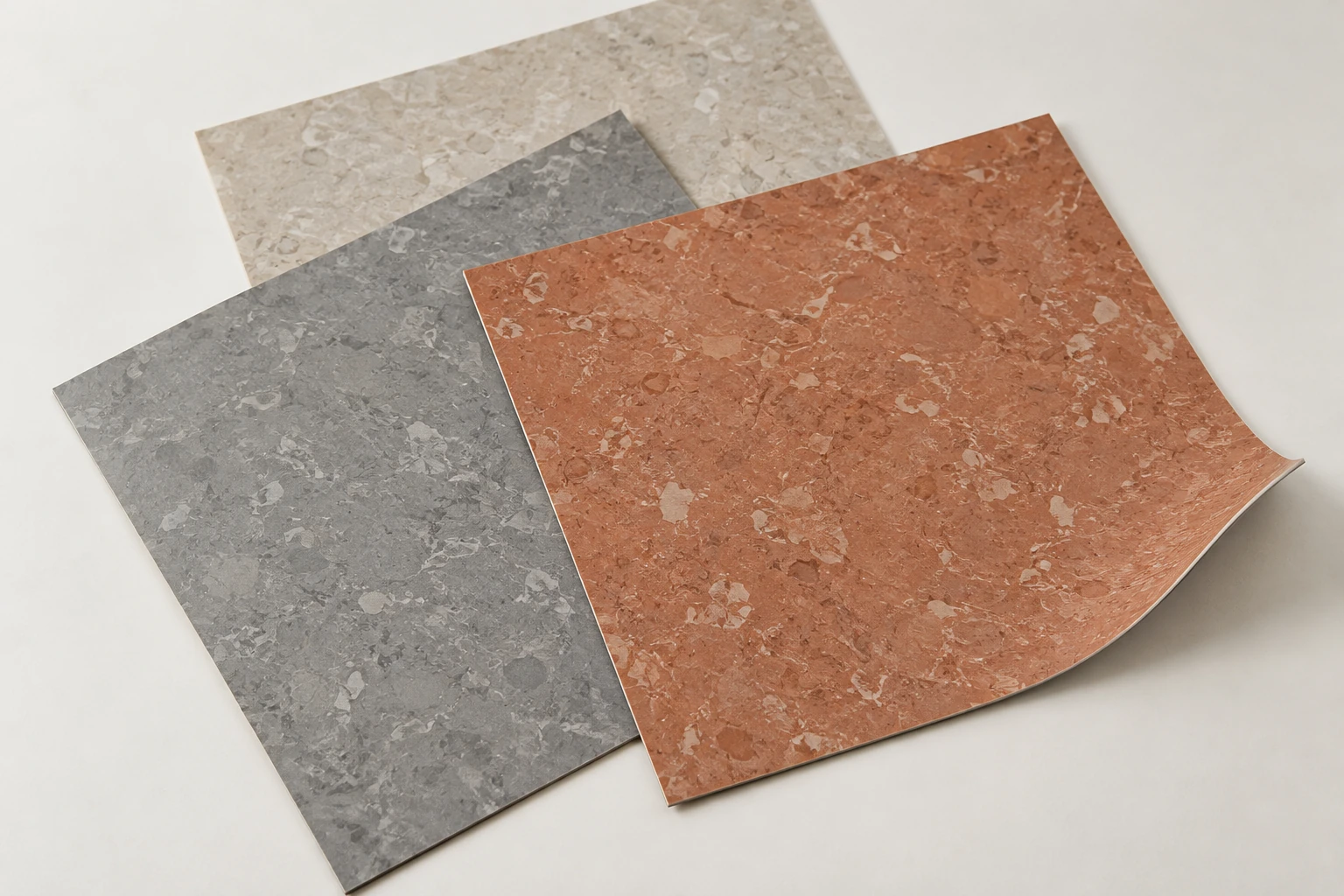
PVC Flooring
pvc flooring tile
| Material choice | Homogeneous PVC; selected color and surface pattern |
|---|---|
| Tile format, W × L | 300 × 300 mm at 2.0 or 2.5 mm; 608 × 608 mm at 2.0 mm |
| Edge construction | Square, straight-cut edges for the selected bonded installation |
| Sample assessment | Overall thickness, dimensions, squareness, face condition and underside identity |
| Fixing | Compatible adhesive on a prepared supporting floor |
| Supply identification | Approved construction, color designation and batch reference |
Approve dimensions and tolerances for the selected tile. Material identity and supporting performance documents must relate to the supplied construction.
A PVC flooring tile should be assessed as a full component, including its face, edges and underside. This is especially important when matching an existing floor or approving a sample for a new workplace. A color chip cannot show all the details that affect fit and installation.
Read the edge as well as the face
The edge helps distinguish a homogeneous tile from a layered product and reveals whether the quoted thickness describes the full construction. That distinction matters when comparing two samples with a similar appearance. A separate wear layer, a foam backing and a solid body have different implications for fixing and use.
Check a complete tile on a flat surface. Look at the cut edges, corner condition and flatness after the product has been conditioned as instructed. A raised corner or a damaged edge may become a visible joint defect. Measuring only the center thickness will not identify every problem that can affect a close-fitting tile field.
A replacement must meet the surrounding floor
Take measurements from the actual opening and retained floor, not only from an old invoice. The new piece needs to meet the adjacent finish without a step or an unnecessarily wide gap. Existing adhesive, patching material and the condition of the substrate must be assessed before deciding whether a nominally matching tile can be installed successfully.
Approve a sample that represents the order
- Record the construction. Identify the material, thickness, backing and intended installation method so that a visually similar substitute is not accepted by mistake.
- View it in the working light. Surface pattern and sheen can look different under a warehouse rooflight and a laboratory fitting. Compare beside the actual adjoining finish where possible.
- Check practical contact. Consider the shoes, trolley wheels and cleaning equipment that will touch the floor. Appearance does not establish suitability for those contacts.
- Match supporting documents. Any test evidence should identify the same product construction. Do not transfer a rating from another floor in the supplier's catalogue.
- Retain an identified sample. Keep a record of what was approved and the permissible variation. This provides a useful reference at delivery.
Color matching has limits
New material cannot always match an aged floor invisibly. Cleaning, traffic and exposure can change the surrounding surface. For a conspicuous repair, a deliberate small replacement zone may look more coherent than one nearly matching tile. Agree the visual approach before removing sound material.
A special duty needs a special specification
Standard PVC should not be substituted into an electrical-control floor merely because its dimensions fit. Use the correct ESD tile construction and reinstate the required continuity. Similarly, a wet-cleaned joint needs the system's approved treatment rather than a general-purpose filler selected only for color.
Tile format, finish selection and matching accessories can be customized to the intended floor layout or repair requirement.