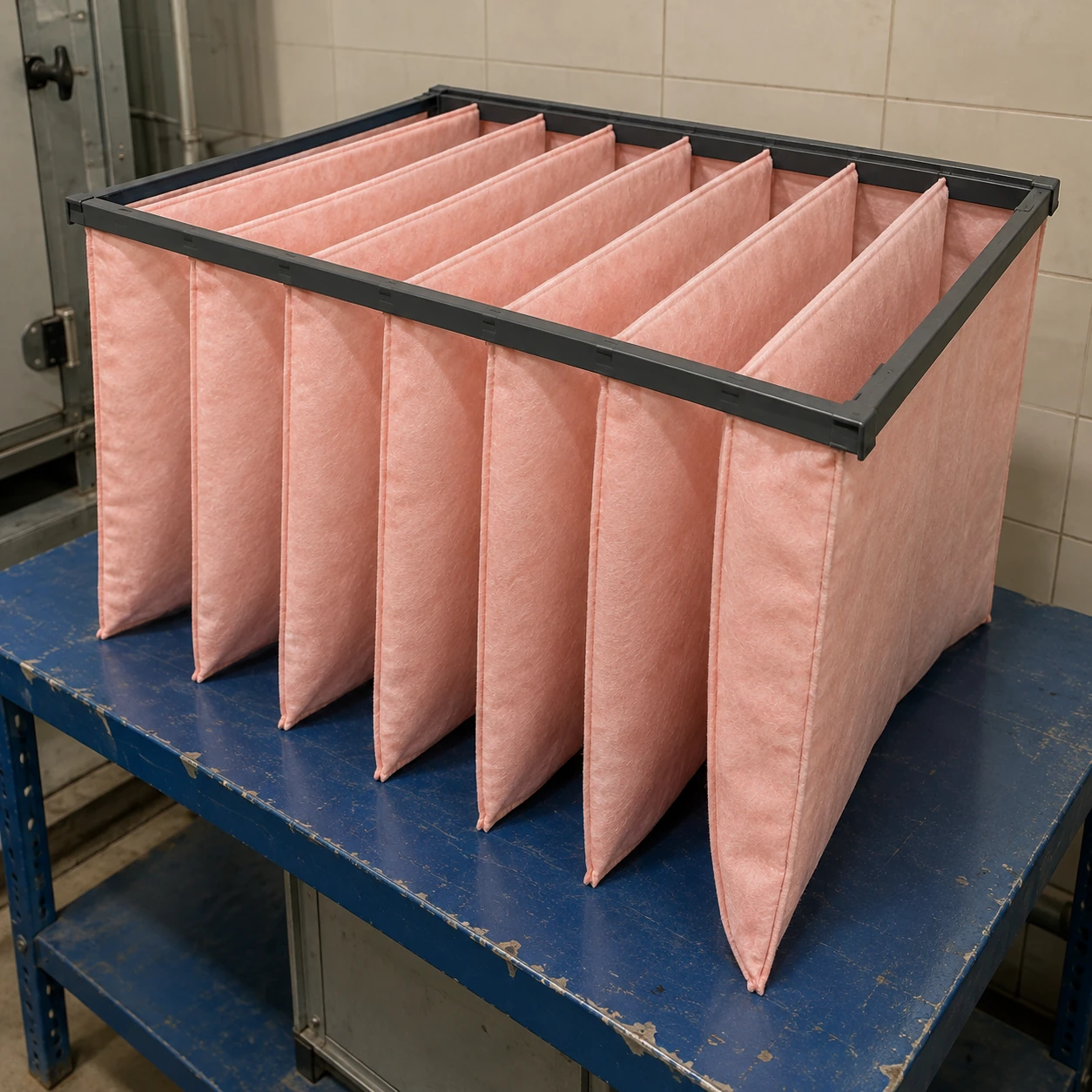
Pocket Filters
rigid pocket filters
| Pocket construction | Stiff synthetic nonwoven pockets with welded seams and spacing features |
|---|---|
| Face dimensions W × H (mm) | 592 × 592; 287 × 592 |
| Depth configuration (mm) | 635 mm for the full-face configuration; complete element dimensions confirmed in the selected drawing |
| Pocket and header options | Eight-pocket full-face or four-pocket half-width arrangement; 25 mm molded polymer header |
| Filtration selection | ISO Coarse or ePM10 duty; grade and percentage specified for the chosen element |
| Installation | Gasket and retaining clips matched to the frame; airflow range established for the selected construction |
A rigid pocket element is a distinct construction. Its pressure resistance, permissible airflow and environmental limits must be supported by the selected product data.
Rigid pocket filters use stiff, shaped filter pockets that hold their geometry more independently of the air stream than soft bags. The rigidity belongs to the pocket construction as well as the header. This is useful to examine when a system cycles frequently, operates across changing airflows or has limited clearance around the filter stage.
Look at what keeps the pockets open
A metal perimeter frame does not by itself make a bag filter rigid. Soft textile bags can hang from a strong frame and still change shape substantially as the fan starts and stops. In a self-supporting construction, the media stiffness, welded pocket form and internal spacing features work together to preserve the air passages.
Also distinguish this product from a compact V-bank cassette containing pleated panels. Both may be described informally as rigid filters, but the media arrangement, depth and sealing interface differ. Identify the actual construction before treating the two as interchangeable replacements.
During shutdown
Shape retention can help keep pockets separated when the fan stops. It does not remove the need for clearance beneath and around the element. The installation should remain free of standing water and obstructions.
At reduced airflow
A stable pocket shape may address a geometry problem where soft bags do not open evenly. Filtration and resistance still need to be evaluated within the selected filter's operating range; stiffness is not a universal low-flow rating.
At the frame
The seal must remain continuous under the available clamping force. Check a polymer header against the existing retainers rather than assuming that an equal face size guarantees a correct fit.
Solve the reason for changing construction
If a soft bag repeatedly rubs against a downstream brace, first establish whether the selected depth and mounting position are correct. A rigid replacement that occupies the same obstructed space can still be damaged. Where the problem is inconsistent opening, review pocket spacing and the incoming air distribution as well as the element itself.
Moisture needs a separate investigation. Humid air, condensed droplets and direct spray are different exposures. A published relative-humidity limit is not permission to wash the element or leave it standing in condensate. Correct upstream water carryover and drainage defects before expecting a new filter construction to solve them.
Check installation handling
Support the header during transport and insertion. Do not push on the pocket tips to force an element past a narrow access opening. Inspect the welded seams, header corners and seal after fitting; a shape-stable bag is still filter media and can be punctured.
Keep the duty unchanged
When replacing an existing element, record its filtration requirement and operating flow before comparing rigid alternatives. A more robust shape with a lower particle class is not an equivalent upgrade. For the broader selection sequence, see pocket filter selection and maintenance.
Rigid pocket filters can be customized around the mounting dimensions, operating airflow and service conditions of the application.