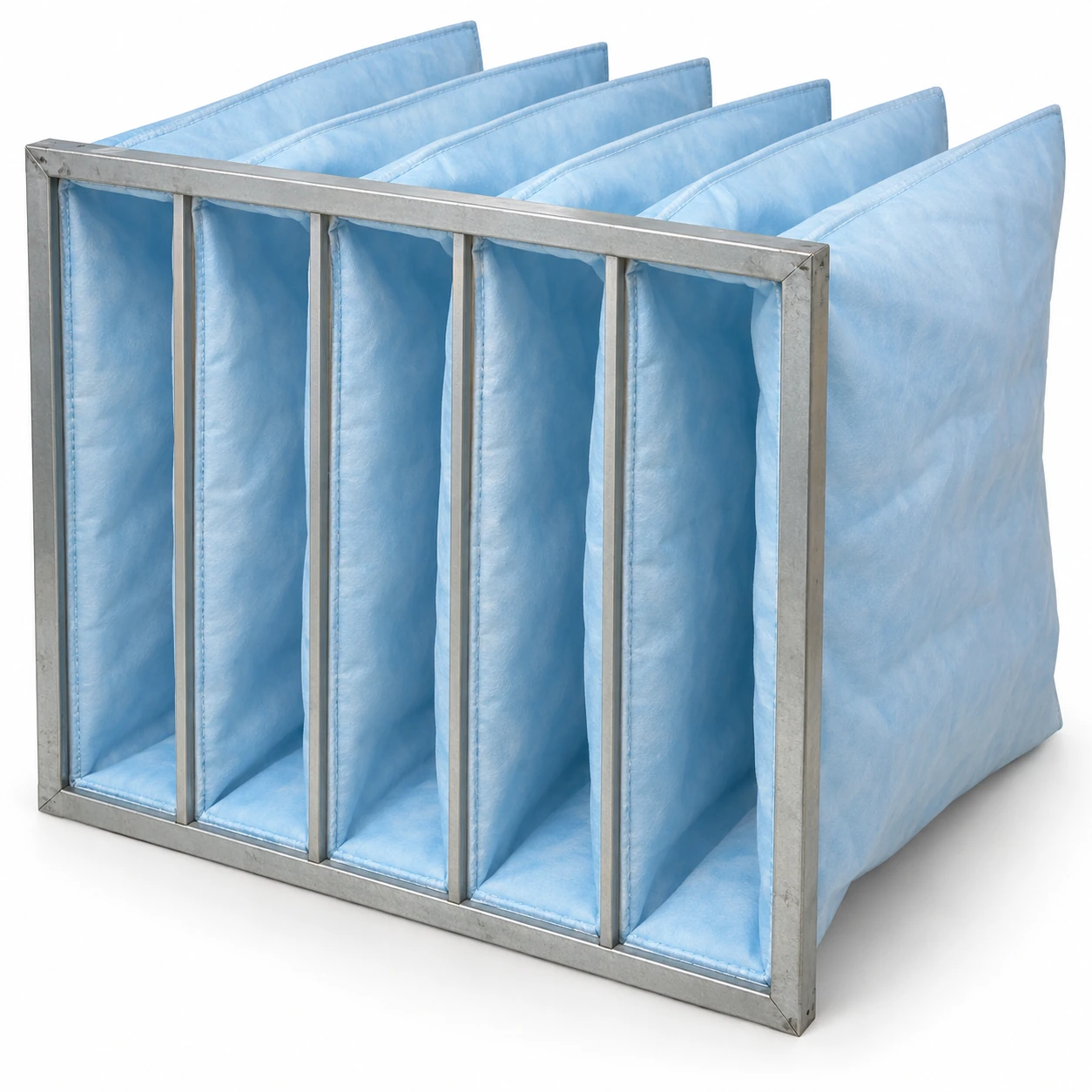
Pocket Filters
pocket filters
| Filter format | Replaceable multi-pocket element for air-handling units and filter banks |
|---|---|
| Element dimensions W × H × D (mm) | 592 × 592 × 520; 490 × 592 × 520; 287 × 592 × 640 |
| Media choices | Synthetic nonwoven or glass-fibre bag media, selected for the duty |
| Header and sealing | Galvanized steel or polymer; 20 or 25 mm header options; gasket position matched to the housing |
| Particle-removal selection | ISO 16890 ePM10, ePM2.5 or ePM1 class specified with its percentage and supporting report |
| Operating selection | Airflow, initial resistance and change-out limit matched to the chosen element and fan capacity |
Dimensions describe the filter element, not the housing opening. Bag count, media grade and header details are selected together for the required airflow.
Pocket filters place several deep fabric bags behind a compact header. Air enters the open bags and passes through their walls, leaving collected particles in the media. This arrangement fits a substantial working surface into an air-handling unit, provided the bags have room to open and the header seals correctly against the housing.
Give each filter a defined job
In a ventilation system, a pocket filter may be the main particle filter protecting occupied or production areas, or an intermediate stage protecting a downstream high-efficiency filter. The correct choice depends on what enters the system and what must be protected. General workshop ventilation, office outdoor-air treatment and a process air supply do not necessarily need the same media.
Decide the particle-removal duty before comparing price or bag colour. An ISO 16890 designation identifies a measured filtration class; it does not establish the cleanliness of an entire room. A pocket element also does not remove gases simply because it traps airborne dust. Where the duty requires a different filtration stage, review the wider air filter range with the complete system in mind.
Fit at the header
The perimeter seal forces air through the media. A bent frame, an interrupted gasket or a clamp that cannot fully close leaves a bypass path. Raising the media grade will not correct that leak. Match the sealing face and retention method, then check the frame sits squarely without forcing the access door shut.
Space behind it
The bags need a clear downstream volume. A coil, internal brace or adjacent filter can restrict the opening of the pockets and concentrate the airflow. Leave the element clear of wet floor surfaces and moving equipment. Access space must also allow removal of a dust-loaded filter without dragging it across the next stage.
Read the filter bank, not just the calendar
Record the pressure difference across the installed stage when it is clean and running at its intended airflow. Later readings are meaningful only when the airflow and measurement points are comparable. A rising reading can indicate loading; a sudden drop may instead reflect a torn pocket, a loose element or reduced fan airflow. Inspect the cause before treating either change as a maintenance success.
A useful replacement plan combines resistance, physical condition and the process hygiene requirement. Damaged or wet elements may need attention before a pressure limit is reached. Do not wash a disposable bag filter or blow collected dust back through it unless its specific construction and instructions expressly allow that treatment.
Pocket filters can be customized for the installation dimensions, filtration duty and operating conditions of your application.