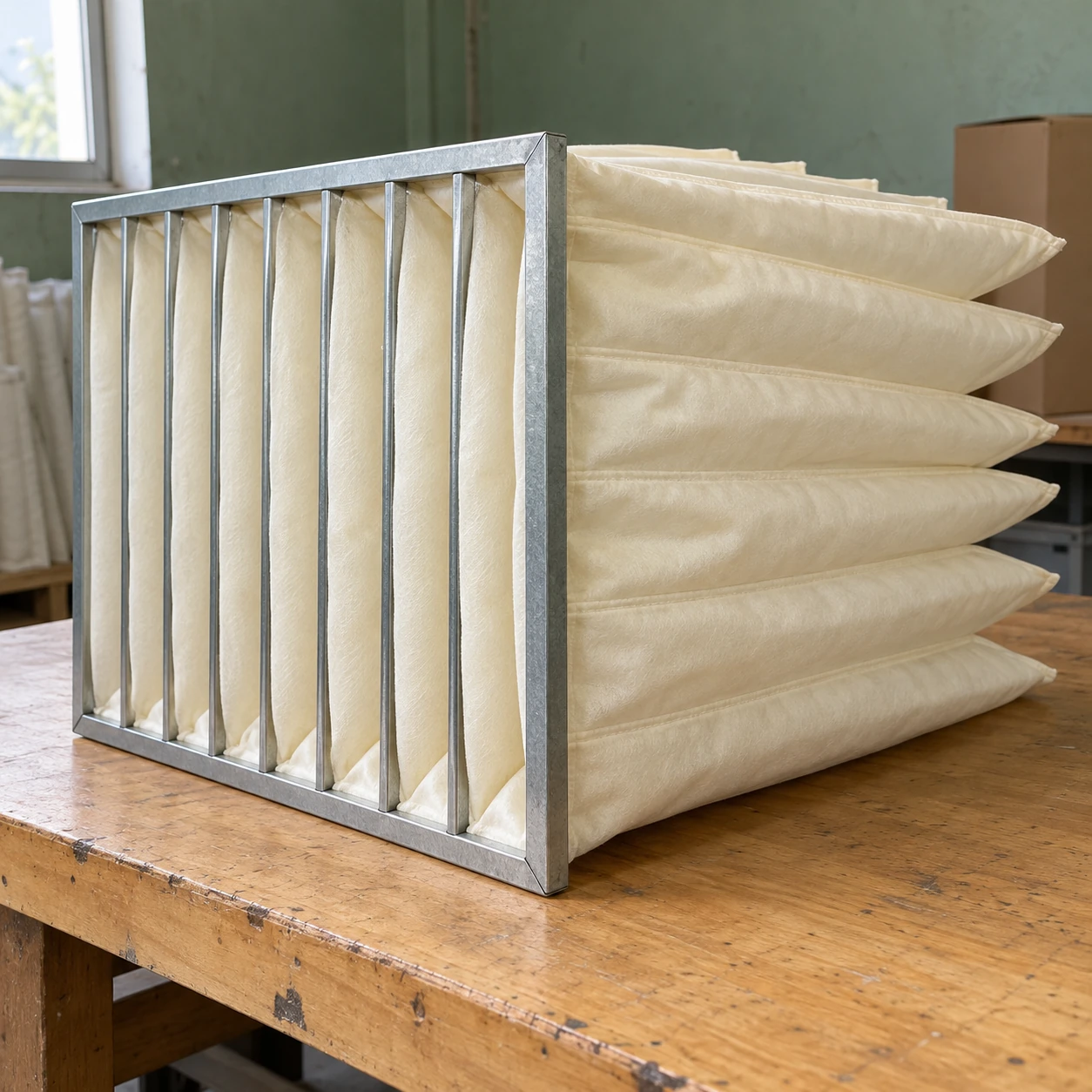
Pocket Filters
extended surface pocket filters
| Extended-depth formats W × H × D (mm) | 592 × 592 × 640; 490 × 592 × 640; 287 × 592 × 640 |
|---|---|
| Shallower alternatives W × H × D (mm) | 592 × 592 × 520 or 592 × 592 × 370 |
| Pocket arrangement | Separated tapered bags; pocket count matched to face width, media and airflow |
| Media and frame | Glass-fibre or synthetic media with metal or polymer header |
| Comparison data | Effective media area, airflow-resistance curve and dust-loading data for the selected construction |
| Service selection | Particle class, operating hours, dust exposure and acceptable final resistance |
Longer and shorter formats are configuration choices. Compare complete elements at the same airflow and required filtration class before selecting by area alone.
Extended surface pocket filters use bag depth and multiple open pockets to provide more media than a flat face can hold. Their value comes from bringing that area into use. A long filter squeezed against a coil, or crowded pockets that touch each other, can lose the advantage suggested by the headline surface-area figure.
More area helps when air reaches it
At a given volume flow, spreading the air over more active media reduces the average velocity through that media. This can help control resistance and distribute the dust load. The result still depends on the fibre structure, seams, pocket entrances and spaces between neighbouring bags. Gross fabric area alone cannot describe how evenly the filter works.
Tapered pockets and controlled spacing preserve passages as the bags open. If adjacent surfaces press together, part of the nominal area becomes difficult to use. Adding pockets without checking their geometry can therefore be less effective than selecting a well-spaced element with fewer pockets.
When depth is available
A deeper element can be worth considering in an air-handling unit with unobstructed downstream space and long operating hours. Check the full bag envelope, the next component and the removal path. A filter that fits only while its bags are compressed does not have a usable installation envelope.
When the section is shallow
A shorter element may be the sounder choice where the housing cannot accommodate a long bag. Compare its resistance at the required flow and allow for its loading behaviour. Do not reduce the filtration duty simply to match the clean pressure drop of a deeper alternative.
Compare the operating cost in the right order
- Hold the filtration requirement constant. Compare the same required particle class and percentage, with evidence for the actual media construction.
- Use the installed airflow. A low resistance measured at a lower flow is not a like-for-like comparison. Check both the initial value and how resistance develops with loading.
- Include the fan and maintenance regime. Fan control, operating hours, replacement labour and disposal affect the result alongside the element price.
- Check the first service interval. Record airflow, differential pressure and the reason for change-out so that later purchases reflect the actual environment.
Make space and duty part of the enquiry
Provide the clear depth behind the mounting face, the filter-bank layout and the operating flow. If the available space is irregular, the custom configuration process can address the mounting interface and pocket arrangement together. The objective is a usable filter surface that remains accessible throughout service.
Extended surface pocket filters can be customized to suit the available housing depth, filter-bank arrangement and particle-removal requirement.