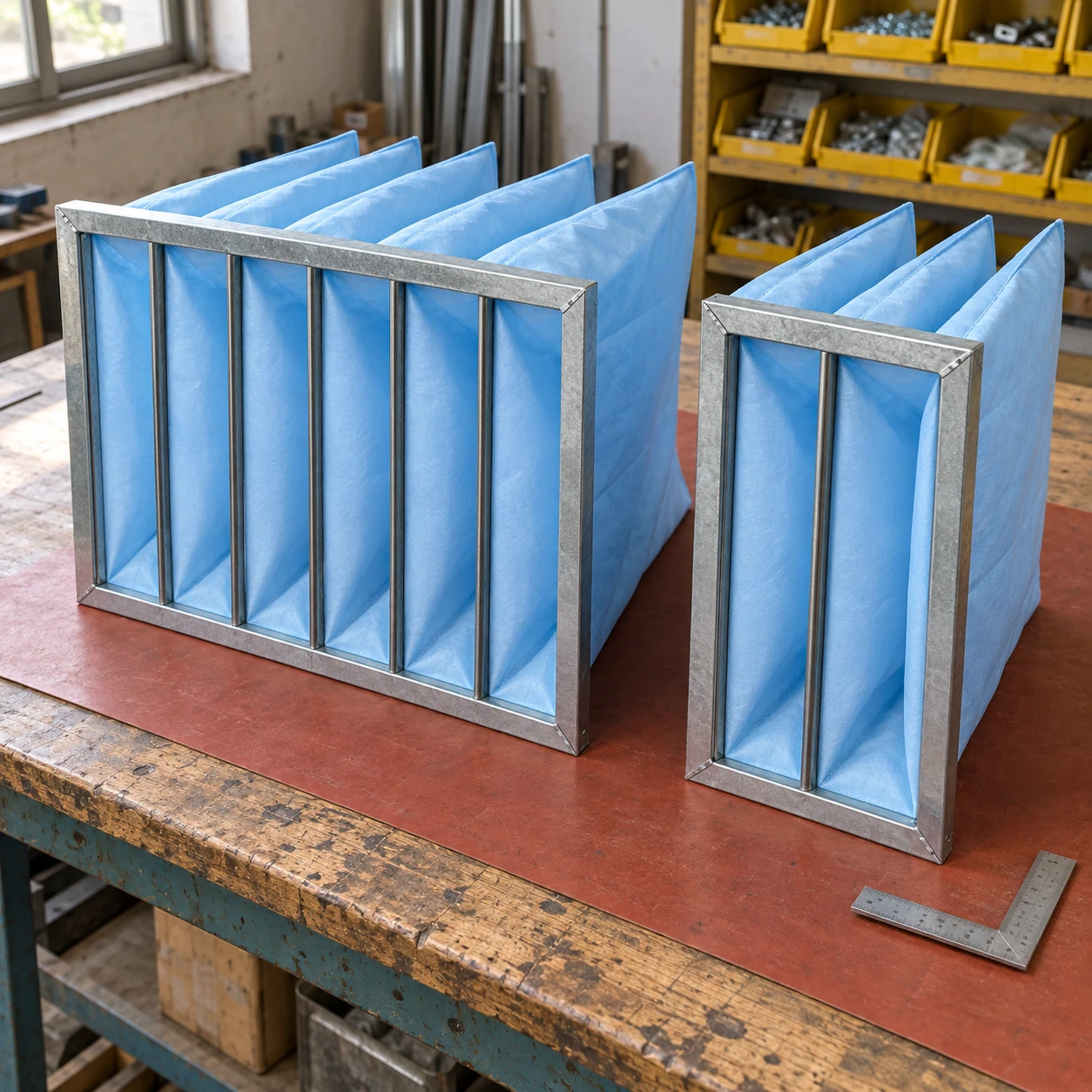
Pocket Filters
customize pocket filters
| Face formats W × H (mm) | 592 × 592; 490 × 592; 287 × 592; other dimensions by agreed drawing |
|---|---|
| Bag-depth choices (mm) | 370, 520 or 640, selected with clearance and airflow |
| Header depth (mm) | 20 or 25, with profile matched to retaining clips or slide rails |
| Sealing options | Flat or formed gasket; clean-side, inlet-side or perimeter location as required by the housing |
| Media and pocket layout | Synthetic or glass-fibre media; bag count and spacing selected with the filtration requirement |
| Order definition | Dimensioned element drawing, tolerances, orientation, airflow duty and acceptance requirements |
Face sizes refer to the element, not the surrounding mounting frame. Header depth and overall filter depth are separate dimensions; all custom interfaces belong on the approved drawing.
Customizing a pocket filter begins with the interface it must fit. Face size, header profile, gasket location and usable downstream space affect whether an element can be installed and sealed. The media and pocket arrangement then have to satisfy the airflow duty within that physical envelope.
Measure the parts that determine fit
- Identify the element face. Measure the existing header in both directions. Keep width and height tied to its installed orientation; a rectangular element may have orientation-specific pockets or supports.
- Record the retention profile. Note the header thickness, flange and clip position, or the shape of a side-access rail. Photograph how the existing filter is held when the door is open.
- Locate the sealing surface. Show which side compresses the gasket and whether the seal belongs to the filter or the housing. An added gasket can change how the clips engage.
- Map the free volume. Measure behind the mounting plane to coils, braces and other obstructions. Include the path used to insert and remove the whole element.
Do not copy the outside dimension of the mounting frame onto the filter order. The frame includes its own structure and is deliberately larger than the element it holds. An old filter label, a face measurement and a photograph of the fixing arrangement together are more useful than a nominal size alone.
Changing the shape changes the selection
A narrower face carries more air per unit of face area when total flow is unchanged. Shortening the pockets may remove active media area. Either alteration can affect resistance and loading, so the performance of a standard element cannot simply be assigned to its custom version.
After the fit is defined, select the media class, pocket layout and operating flow together. Where a restricted housing prevents a satisfactory combination, reconsider the filter-bank arrangement or required duty with the system designer. A smaller element should not be presented as an equivalent replacement purely because it can be made to fit.
Can an old sample define the order?
It can help identify the interface, but a bent frame, compressed gasket or stretched bag can mislead measurement. Compare the sample with the housing and record its condition. Preserve an approved dimensional record for future orders instead of relying on a worn element indefinitely.
What should a trial fit establish?
Confirm insertion, clip engagement, seal contact and bag clearance before a bulk order. Dimensional acceptance does not prove particle efficiency; the technical evidence must also match the supplied media and construction.
For a quotation, attach the housing photographs, finished dimensions, quantity and operating duty through the project enquiry. Separate confirmed requirements from measurements that still need checking so that the proposed configuration can resolve them explicitly.
Pocket filters can be customized for non-standard mounting interfaces, access restrictions and application-specific filtration requirements.