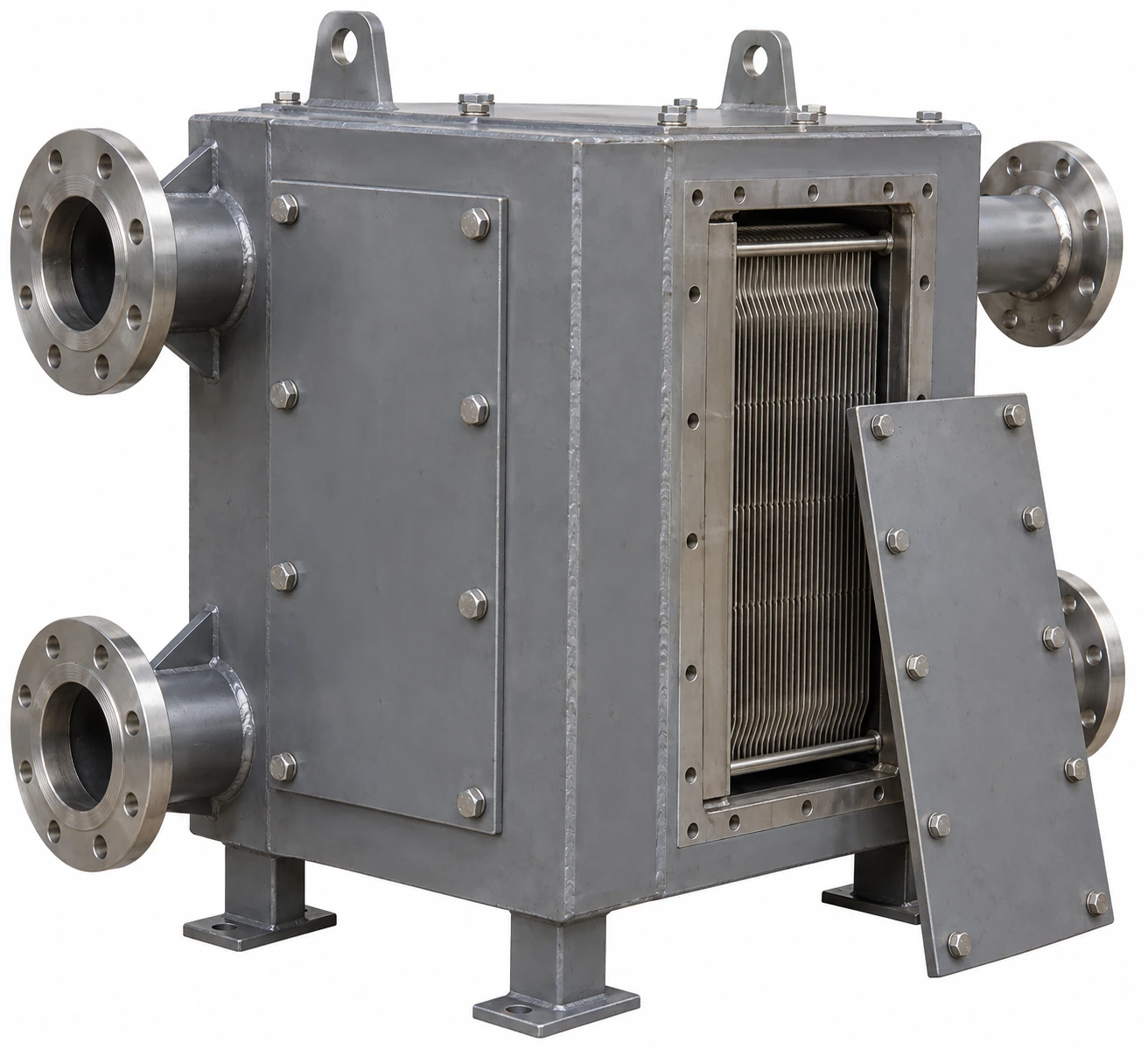
Plate Heat Exchangers
welded plate heat exchanger
| Brand | shengtongJH |
|---|---|
| Configuration | Compact welded plate block; fully welded or selected serviceable-panel design |
| Plate material | 316L stainless steel; alternative alloy by fluid review |
| Requested heat-transfer area | 2 / 5 / 10 / 20 m², subject to thermal selection |
| Connection choices | DN25 / DN50 / DN80 |
| Pressure enquiries | 10 / 16 / 25 bar; verified against the selected design temperature |
| Temperature selection | Specified for both streams, including startup and cleaning conditions |
| Body dimensions | W × D × H in mm determined by plate block, access panels and nozzle arrangement |
| Inspection access | Design-specific removable panels or cleaning ports |
| Installation | Supported base, independently supported piping and accessible drains |
| Documentation | Selected equipment drawing and applicable pressure-test documentation |
Welded construction is not a universal high-temperature or high-pressure rating. Panel seals and other joints may remain; verify the complete selected design.
The welded construction, alloy, nozzle positions and cleaning arrangement can be customized for the industrial duty.
A welded plate heat exchanger joins its heat-transfer plates by welding rather than relying on a removable gasket at every channel. It can address duties where ordinary gasketed construction is unsuitable, but the precise welded design determines access, sealing and service options.
Identify what has actually been welded
Fully welded plate packs, semi-welded cassettes and welded blocks are different arrangements. Removing channel gaskets may address a compatibility limitation, but it does not automatically eliminate every seal from the equipment. Access covers and other joints must still be assessed for the service.
Ask for the flow path and accessible surfaces when comparing offers. A compact external box does not tell you whether either circuit can be inspected mechanically or whether cleaning must be performed through connected pipework.
Cleaning access is a selection decision
A fluid that deposits material on the plates may require more than periodic flushing. Consider the deposit, available cleaning method and accessible side of the exchanger before choosing a permanently joined pack. If a blocked channel cannot be reached, the repair options may be more limited than with a gasketed frame.
Materials must tolerate both the operating fluid and the intended cleaning solution. Changing cleaning chemistry later can introduce a compatibility problem that was not present in normal production.
Allow for changes in operation
Startup, shutdown and uneven heating can produce conditions different from steady operation. Include temperature cycles and the pressure on each side in the enquiry. A duty sheet showing only average temperatures does not describe the complete mechanical requirement.
Define the required evidence
Where pressure-equipment documentation is required, identify the applicable requirement before purchase. A brochure statement about another manufacturer's product does not establish certification for the unit being supplied.
Keep the configuration proportional to the job
For ordinary compatible water circuits, an accessible gasketed exchanger may remain the simpler purchase. Choose welded construction because the fluid, conditions or maintenance strategy justify it. shengtongJH can source against a defined requirement without assuming premium construction is always necessary.
For a cylindrical pressure-shell arrangement, review the separate shell and plate heat exchanger option rather than treating every welded exchanger as the same product.
The welded construction, alloy, nozzle positions and cleaning arrangement can be customized for the industrial duty.