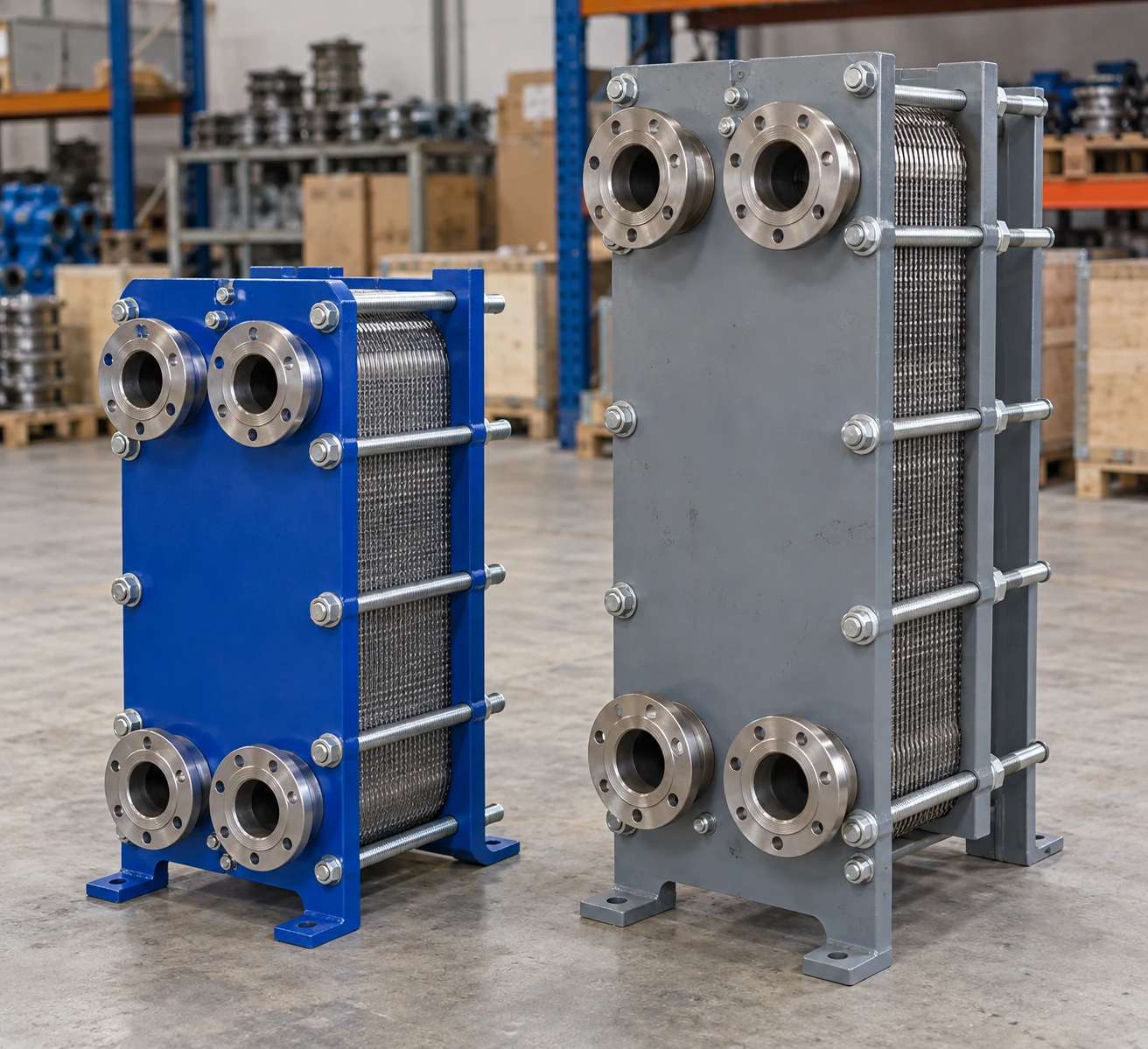
Plate Heat Exchangers
plate heat exchanger manufacturers
| Brand / procurement contact | shengtongJH |
|---|---|
| Product families | Gasketed, brazed or welded construction according to service |
| Duty schedule | Both fluids, flow rates and all required terminal temperatures |
| Material options | 304 / 316L plates; suitable seals or joining material |
| Common gasketed pressure classes | 10 / 16 bar, matched to design temperature |
| Connection choices | DN25 / DN50 / DN65 / DN100 |
| Dimensional comparison | Overall W × D × H in mm, port centres, opening travel and support positions |
| Frame face classes | Approx. 250 × 750 / 330 × 950 / 500 × 1,100 mm, width × height |
| Performance information | Selected heat duty and pressure drop on each circuit |
| Supply options | Bare unit, insulation, defined accessories and identified spares |
| Required documents | Selection sheet, outline drawing and agreed material/test documents |
Compare complete selected configurations. A source manufacturer's certification or published performance is not automatically a certification or rating of another supplied unit.
The equipment specification and procurement package can be tailored to the operating duty, budget and maintenance requirements.
Comparing plate heat exchanger manufacturers is useful only when each offer addresses the same operating duty and supply scope. shengtongJH acts as an equipment sourcing and procurement contact, helping organise the requirements for a practical comparison rather than claiming its own manufacturing plant.
Put every quotation on the same basis
An apparently cheaper exchanger may use a different temperature approach, a greater permitted pressure loss or a narrower supply scope. Issue one duty schedule and ask suppliers to state deviations. This makes the price comparison meaningful before time is spent comparing brand names or plate counts.
Specify the actual fluid composition. A calculation based on water should not be compared directly with one based on glycol or oil. Similarly, the design temperature and pressure must describe the same service conditions.
Evaluate the equipment selection
Look for a coherent thermal and hydraulic result, compatible wetted materials and an installation drawing that fits the available space. Extra plates are not, by themselves, proof of a better design. Ask how the proposed configuration meets the specified pressure-loss limit.
Evaluate support for the supplied pattern
For openable units, the availability of correctly identified gaskets and plates matters after the purchase. Ask how spare parts will be specified and whether the drawing and plate arrangement will accompany the equipment.
Match documentation to the risk and duty
Agree which material, inspection and pressure-test documents are required. For regulated pressure service, the applicable approval must cover the actual supplied assembly and destination requirements. A generic certificate from an unrelated product range does not settle that question.
Choose a manageable procurement scope
A small industrial purchaser may benefit from ordinary serviceable equipment with clear interfaces rather than an elaborate package. Define whether pumps, controls, insulation and installation are excluded or included, and assign responsibility for each connection.
shengtongJH can organise sourcing around this schedule and present the selected supply terms. Factory ownership, production capacity and delivery promises should only be stated when established for the actual order. For delivery and accessory coordination, see plate heat exchanger suppliers.
The equipment specification and procurement package can be tailored to the operating duty, budget and maintenance requirements.