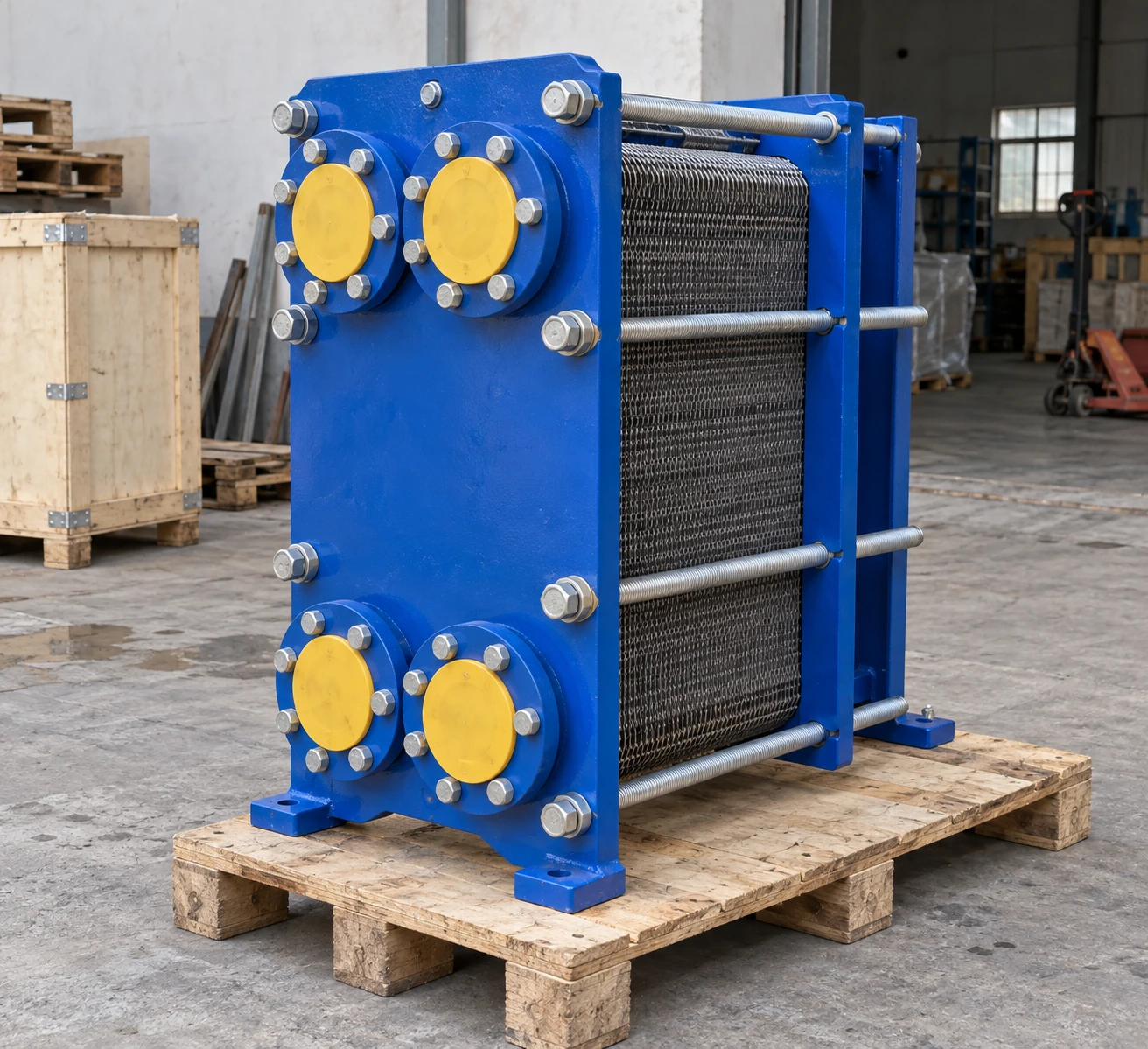
Plate Heat Exchangers
plate heat exchanger manufacturer
| Brand / procurement contact | shengtongJH |
|---|---|
| Enquiry types | Identified replacement, equivalent-duty selection or new equipment |
| Construction | Gasketed, brazed or welded according to the requirement |
| Common wetted materials | 304 / 316L stainless steel; fluid-compatible seals or joints |
| Connection options | DN25 / DN50 / DN65 / DN100; exact standard and orientation agreed |
| Pressure selection | Common 10 / 16 bar gasketed classes; other constructions selected separately |
| Dimensions | Overall W × D × H, port spacing and support positions recorded in mm |
| Small-frame face classes | Approx. 250 × 750 / 330 × 950 mm, width × height |
| Performance schedule | Both-side flow, temperature programme and permitted pressure loss |
| Order identification | Approved configuration, drawing revision and agreed supply boundary |
| Documents and spares | Selected equipment data, required inspection records and identified service parts |
An equivalent-duty replacement is not necessarily a physically interchangeable or original-manufacturer part. Confirm the actual equipment identity and interfaces before ordering.
The replacement configuration, documentation and accessory scope can be tailored to the existing equipment and application.
When looking for a plate heat exchanger manufacturer for a particular replacement, the useful question is whether the supplied unit matches the required duty and interfaces. shengtongJH is a sourcing and procurement business; manufacturing responsibility and equipment documentation are established with the selected supplier.
Identify what must remain unchanged
A replacement project may need to retain connection centres, overall height or the existing pump. Other aspects may be flexible. List the fixed interfaces first so a supplier does not optimise the thermal selection around a unit that cannot be installed.
If the old operating duty has changed, say so. Copying the original nameplate is useful for identification but does not prove that its selection still suits the current plant. Added production equipment, different fluid or revised temperatures can justify a fresh calculation.
With an identifiable original unit
Provide the nameplate, drawing and clear connection photographs. For an openable exchanger, plate and gasket codes can help identify the service pattern. Record existing faults and any changes made since installation.
Without reliable identification
Build the enquiry around measured interfaces and operating conditions. An apparently similar frame is not enough to establish an interchangeable plate pack. A complete reselected unit may be more practical than trying to guess unidentified internal parts.
Approve one consistent equipment description
The quotation, drawing and technical schedule should describe the same configuration. Confirm materials, plate arrangement, connection standard and supply accessories before the order is released. Record any agreed change so a later substitution does not quietly alter a critical interface.
Know who supplies what
Clarify responsibility for thermal selection, manufacturing, inspection, transport and installation. shengtongJH coordinates the agreed sourcing scope; it does not present another company's factory or certification as its own.
For service continuity, include the required spare seals or plate identification information in the order. Delivery dates and inspection arrangements should be confirmed for the actual purchase rather than inferred from a generic listing. Where several offers are being compared, use the manufacturer comparison requirements to keep the technical basis consistent.
The replacement configuration, documentation and accessory scope can be tailored to the existing equipment and application.