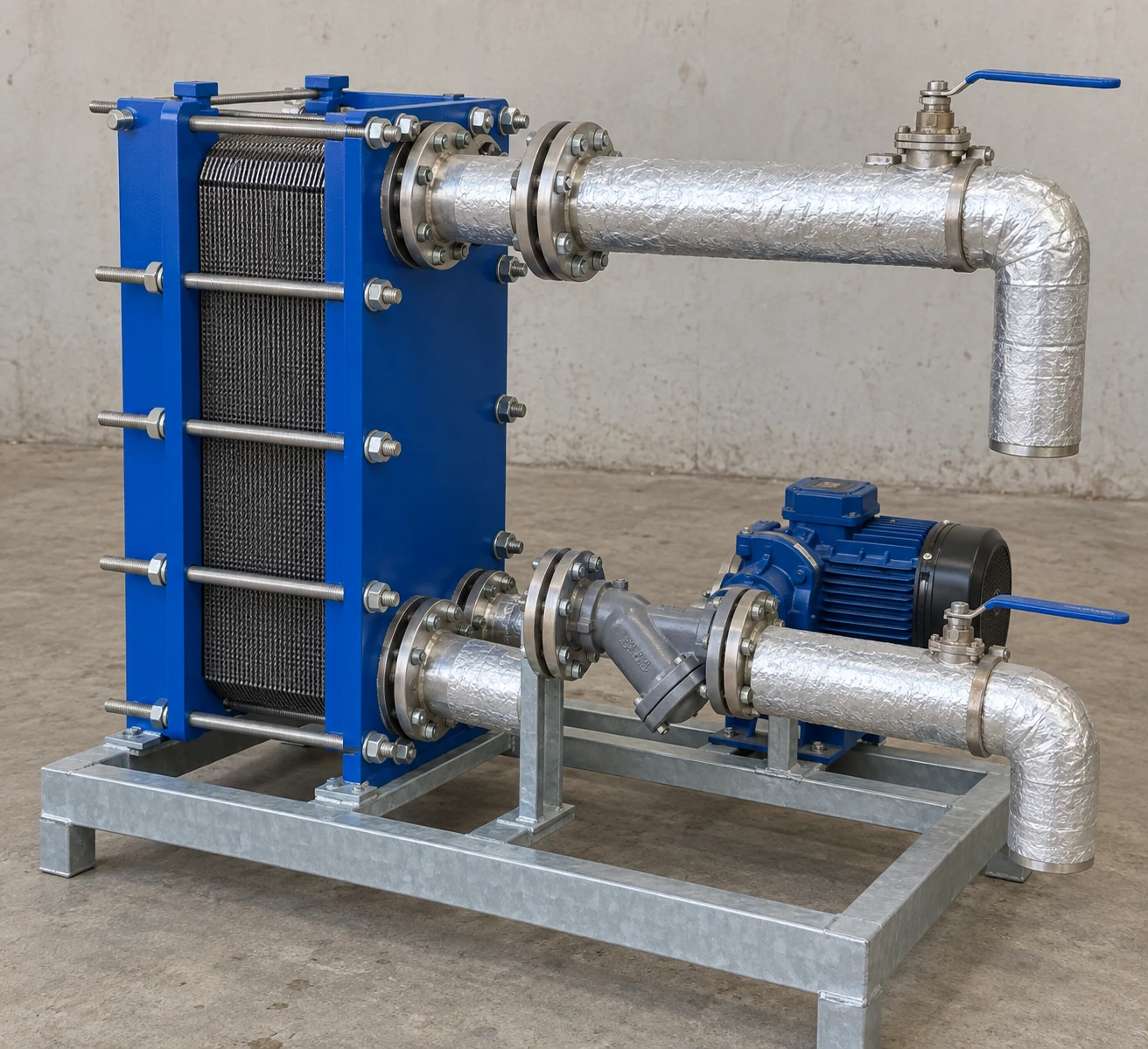
Plate Heat Exchangers
plate heat exchanger for hvac
| Brand | shengtongJH |
|---|---|
| Application | Commercial or industrial central hydronic systems |
| Heat-duty enquiries | 50 / 100 / 200 kW, calculated at the project temperature programme |
| Construction | Ordinary gasketed plate-and-frame; brazed where suitable |
| Wetted materials | 304 / 316L plates and compatible seals or brazing material |
| Connection options | DN32 / DN50 / DN65 / DN100 |
| Design pressure options | 10 / 16 bar for selected gasketed units |
| Frame face classes | Approx. 330 × 950 / 500 × 1,100 mm, width × height |
| Assembly dimensions | W × D × H in mm; include skid and service access where ordered |
| Control provisions | Temperature sensor points, flow proving and control-valve interface |
| Accessory options | Strainer, vents, drains, insulation and separately selected pump |
Pump and control accessories require their own selection. Heat duty, approach and allowable pressure loss must be agreed together before equipment sizing.
The exchanger and defined accessories can be customized to the HVAC duty, plant-room layout and commissioning requirements.
Selecting a plate heat exchanger for HVAC starts with the system duty and ends with an installation that can be controlled, vented, cleaned and maintained. A clear specification helps prevent a correctly built component from being poorly integrated into the central water system.
Write a duty schedule that can be priced
State the source and load-side fluids, required heat transfer, inlet temperatures and intended outlet conditions. Identify which values are fixed and which may be selected. Include the minimum and maximum operating loads so a design based only on the peak does not overlook ordinary part-load use.
Where glycol is used, give its type and concentration. Include the permitted pressure loss on each circuit and the available installation space. These details allow a supplier to produce a useful selection instead of guessing from a nominal capacity.
Coordinate three installation decisions
Hydraulic arrangement
Identify the pumps, control valves and pressure zones on both sides. Maintain the required exchanger flow and account for strainers and connecting pipework in the pump duty.
Temperature control
Place sensors to represent the water temperature being controlled. Agree the operating sequence with the building system so pumps and valves do not work against the intended heat-transfer duty.
Service access
Provide isolation, venting, draining and an accessible cleaning route. Keep sufficient frame-opening space or a practical replacement route for a permanently joined unit.
Commission against operating conditions
Record both-side temperatures and flow after the system is filled, vented and operating steadily. Compare the readings with the selected duty at the actual load. A light-load observation does not establish peak capacity, and a temperature reading without flow does not demonstrate transferred heat.
Retain baseline readings for later maintenance. A subsequent change in pressure loss or temperature approach can then be investigated against the original operating record.
Keep an ordinary project manageable
For a modest commercial plant, a conventional accessible exchanger with clearly specified accessories may be sufficient. Add pumps, skids and controls only where the installation scope requires them. shengtongJH can coordinate the equipment package while the project team retains responsibility for the overall system design and commissioning plan.
For existing equipment problems, see HVAC replacement and troubleshooting considerations before deciding whether a new exchanger is necessary.
The exchanger and defined accessories can be customized to the HVAC duty, plant-room layout and commissioning requirements.