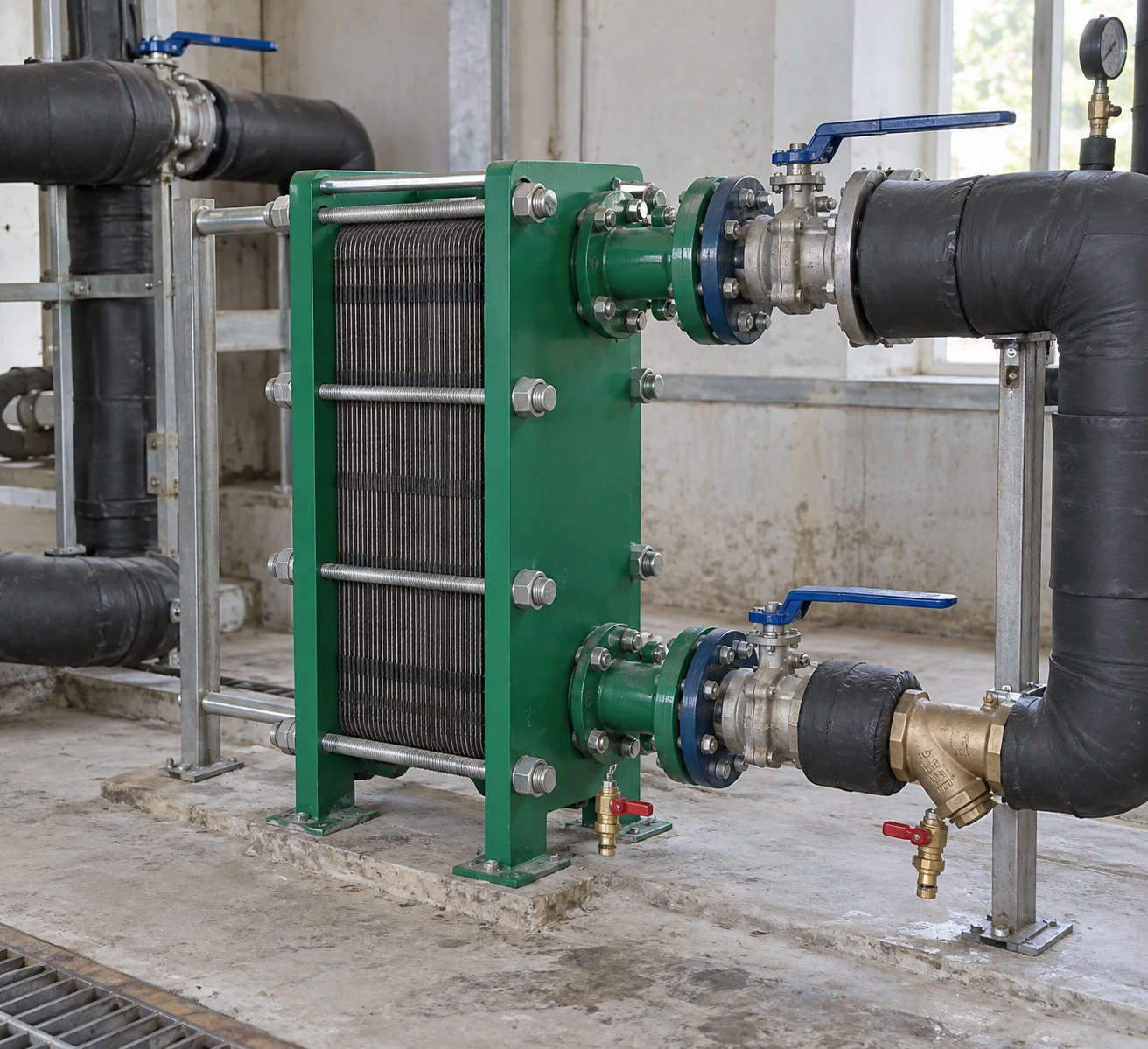
Plate Heat Exchangers
plate heat exchanger hvac
| Brand | shengtongJH |
|---|---|
| Supply arrangement | Like-duty replacement or reselected plate-and-frame unit |
| Required operating data | Inlet/outlet temperatures and flow on both circuits |
| Common duty enquiries | 50 / 100 / 150 kW, verified at actual conditions |
| Plate material | 304 / 316L stainless steel as compatible |
| Gaskets | Fluid-compatible EPDM / NBR compound |
| Connection options | DN32 / DN50 / DN65; match flange standard and orientation |
| Frame face classes | Approx. 250 × 750 / 330 × 950 / 500 × 1,100 mm, width × height |
| Pressure classes | 10 / 16 bar design selection |
| Depth and access | Selected pack depth plus removable-pressure-plate travel |
| Service fittings | Strainers, temperature points, pressure tappings and cleaning ports |
A higher catalogue heat duty does not prove better performance on existing pumps. Confirm allowable pressure loss and operating temperatures before replacement.
The replacement plate pack, connections and service fittings can be customized to the existing HVAC installation.
In an existing HVAC system, poor plate exchanger performance may come from operating conditions, fouling or inadequate flow rather than an undersized plate pack. A replacement should address the identified cause and fit the actual pipework and maintenance space.
Check the source temperature
If the entering source water is already too warm for cooling or too cool for heating, a new exchanger cannot recover the missing temperature difference. Record source conditions during the complaint, not only during light load.
Check the flow path
A partly closed valve, blocked strainer or air pocket can reduce circulation. Compare actual flow and pressure readings with the original selection before concluding that the plate area is inadequate.
Check the heat-transfer surfaces
Deposits can reduce heat transfer and change pressure loss. Use the operating history and fluid quality to decide whether compatible cleaning, inspection or replacement is justified.
Take measurements under the same operating condition
Read both circuits at a stable load, with sensors in representative positions. Measurements taken on different days or with different control-valve positions can create a misleading comparison. For water circuits, the flow and temperature change should be consistent with the heat being transferred, allowing for measurement limitations.
Trend readings over time where possible. A gradual deterioration suggests a different investigation from a sudden failure after maintenance or a control change. The equipment history is useful evidence when defining a replacement.
Fit is more than connection diameter
Record port centres, orientation, flange standard, support positions and the route for removing the old unit. A replacement with the same nominal connection size can still require substantial pipe changes. Keep space for strainers and the moving pressure plate after the work is complete.
Retain the useful parts
Where the frame is sound and the plate pattern is identified, a correctly selected pack or seal replacement may be worth comparing with a complete unit. Do not assume it is economical without checking compatibility and condition.
Reselect when the duty has changed
New loads, different glycol concentration or revised supply temperatures may justify a fresh selection. shengtongJH can coordinate replacement options using those conditions instead of treating an old nameplate as a complete current specification.
The replacement plate pack, connections and service fittings can be customized to the existing HVAC installation.