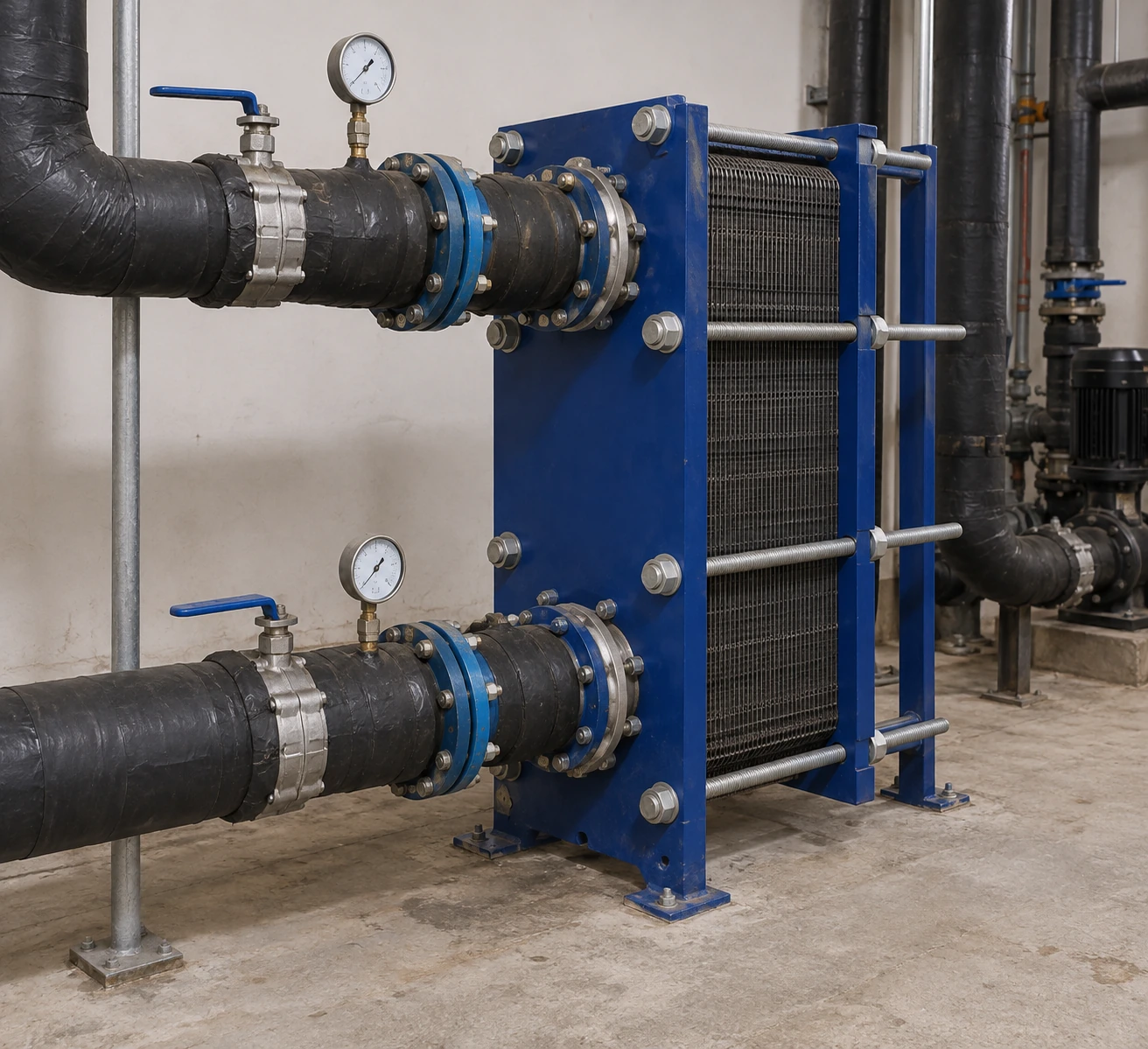
Plate Heat Exchangers
hvac plate heat exchanger
| Brand | shengtongJH |
|---|---|
| Service | Commercial and industrial central heating or cooling water |
| Duty enquiries | 50 / 100 / 200 kW at stated four-terminal temperatures |
| Construction | Gasketed plate-and-frame |
| Plates and seals | 316L stainless plates; compatible EPDM or NBR |
| Connections | DN32 / DN50 / DN65 / DN100 |
| Pressure selection | 10 / 16 bar classes; each side selected for its own design conditions |
| Frame face classes | Approx. 330 × 950 / 500 × 1,100 mm, width × height |
| Assembly depth | Plate-count dependent; opening travel additional |
| Fluids | Treated water or specified water/glycol mixture |
| Options | Removable insulation, vents, drains, strainers and temperature sensor points |
Design pressure is not the allowable pumping pressure loss. Glycol concentration and temperature must be included in the thermal and hydraulic selection.
The exchanger, pressure selection, insulation and pipe interfaces can be customized for the building's central water circuits.
An HVAC plate heat exchanger separates two water circuits while passing heat between them. In commercial central systems, that separation can help manage different water quality, pressure zones or glycol requirements without combining the fluids.
Separate the circuits for a defined reason
A plate exchanger can keep an outdoor glycol loop separate from indoor water, or divide systems with different pressure requirements. It can also isolate a less controlled water source from a cleaner distribution circuit. Decide which problem the separation solves before adding equipment.
The two sides still need their own circulation and pressure management. Heat exchange does not provide pump head, expansion capacity or automatic protection against every pressure event. Those functions remain part of the respective water systems.
Allow for the temperature approach
Transferring heat requires a usable temperature difference. Adding an exchanger between a cooling source and a building circuit changes the temperatures available downstream. If the source already operates close to the required supply temperature, the new interface needs careful selection.
Do not copy the old coil duty into an exchanger enquiry without the actual source conditions. Specify all four terminal temperatures, or identify which outlet temperature the selection must determine from the available flow and heat load.
Glycol changes the calculation
A water selection cannot simply be reused for a glycol mixture. Concentration and operating temperature affect fluid properties and pressure loss. Identify the glycol type and mixture actually used, including any planned seasonal changes.
Pressure zones need explicit limits
Check static head, pump operation and shutoff conditions for each circuit. The difference across the plate also matters. A broad nominal pressure label is not a complete description of the installation.
Coordinate the controls and access
Place temperature sensors where they represent the intended controlled water supply, and maintain sufficient flow through the exchanger. Arrange vents and drains so commissioning does not leave trapped air or inaccessible water pockets. Cold-service insulation should address condensation at connections as well as the plate pack.
For a new project, the HVAC specification page develops the enquiry and commissioning requirements. shengtongJH supplies against the agreed equipment scope rather than assuming the complete building controls are included.
The exchanger, pressure selection, insulation and pipe interfaces can be customized for the building's central water circuits.