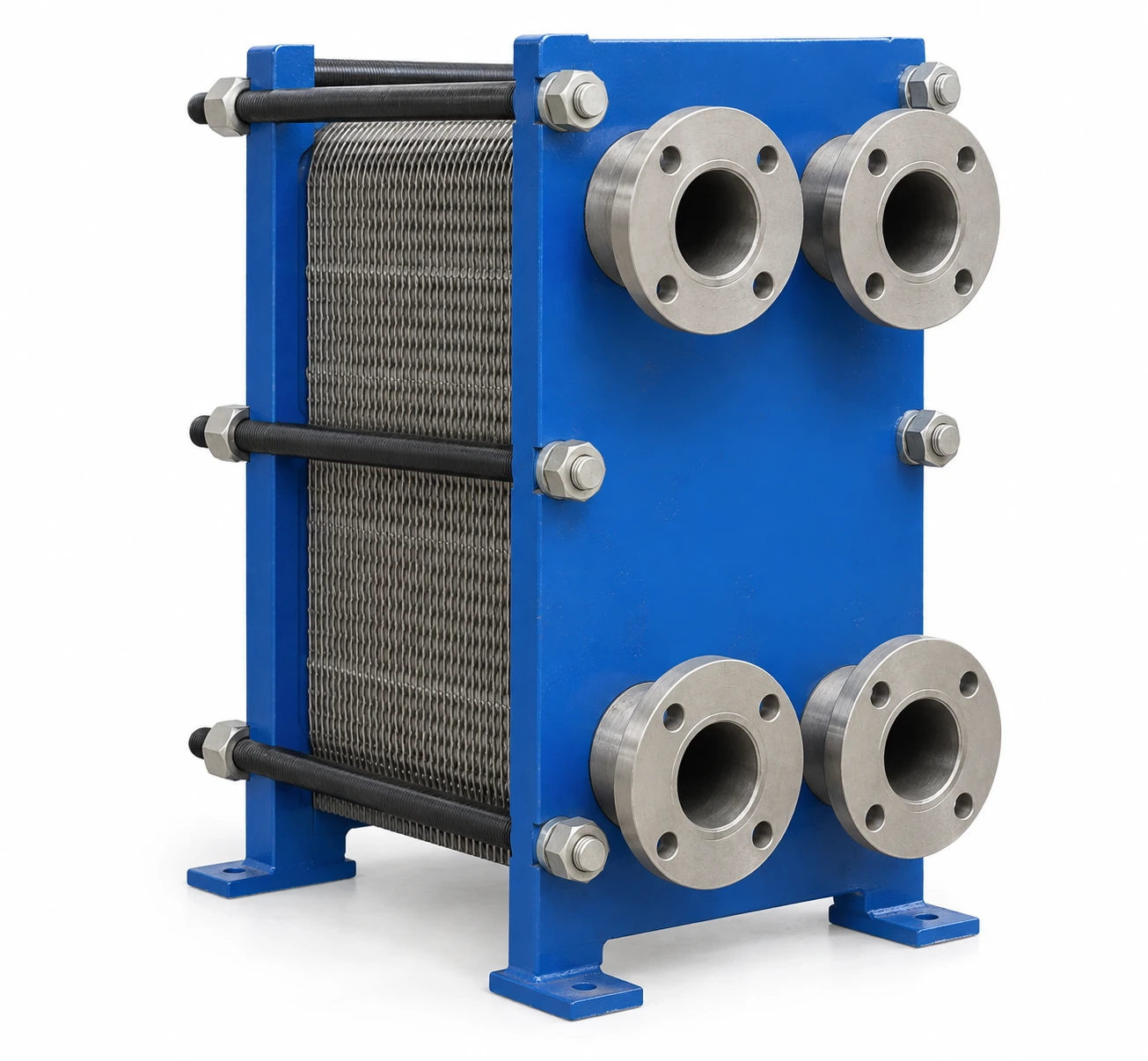
Plate Heat Exchangers
flat plate heat exchanger
| Brand | shengtongJH |
|---|---|
| Product arrangement | Compact gasketed frame; brazed alternative for suitable clean circuits |
| Typical duty enquiries | 20 / 50 / 100 kW at specified inlet/outlet conditions |
| Heat-transfer plates | Corrugated 304 / 316L stainless steel |
| Gasketed frame face classes | Approx. 250 × 750 / 330 × 950 mm, width × height |
| Brazed face classes | Approx. 120 × 290 / 120 × 530 mm, width × height |
| Depth | Selected plate-pack depth plus frame or mounting requirements |
| Connections | DN25 / DN50; suitable threaded or flanged pattern |
| Pressure options | 10 / 16 bar for selected gasketed construction |
| Insulation | Removable heating jacket or sealed cold-service insulation |
| Service provisions | Isolation, vent, drain and cleaning connections |
Dimensions describe equipment classes, not guaranteed interchangeable models. Include pipe bends, insulation and service travel when checking the installed envelope.
The construction, connections and installation arrangement can be customized for the available space and operating duty.
A flat plate heat exchanger uses a stack of thin formed plates to provide heat-transfer area in a compact space. The name describes the plate-based construction; it does not mean the heat-transfer surfaces are smooth or that all units share one configuration.
Compact does not mean zero service space
A small footprint can help when adding heat recovery or separating water circuits in an existing utility room. However, the outline of the exchanger is only part of the space requirement. Valves, strainers, insulation thickness and pipe supports can occupy more room than expected.
For a framed unit, the plate pack needs opening space. For a brazed component, provide access to disconnect or replace it. Avoid putting a serviceable item in a recess where removing it requires dismantling unrelated equipment.
Trade area against pumping demand
A tight temperature approach and a small unit envelope may conflict with a limited pump head. Tell the supplier the permitted pressure loss on each side. An exchanger that meets the heat duty only at a flow your pump cannot deliver will not solve the site's temperature problem.
Choose the right compact format
Brazed construction can reduce size for appropriate clean fluids. An openable frame offers access where inspection and mechanical cleaning matter. The better choice depends on the fluid and maintenance plan, rather than the word flat in the product name.
Keep insulation and leakage access compatible
Hot-water service benefits from suitable insulation and protection against accidental contact. Cold-water service needs control of condensation, including seams and connections. A cover should not hide service points or prevent the frame from being opened later.
Route drains so small leaks can be noticed without reaching electrical equipment or damaging the floor. Provide independently supported pipes, particularly when heavy valves connect close to a lightweight exchanger.
Useful information for a space-limited replacement
Supply the accessible opening, installed footprint and pipe connection positions alongside the fluid and temperature data. Distinguish the space available during installation from the space available during future maintenance. shengtongJH can compare ordinary compact options using those practical limits, including brazed units where the operating conditions suit them.
The construction, connections and installation arrangement can be customized for the available space and operating duty.