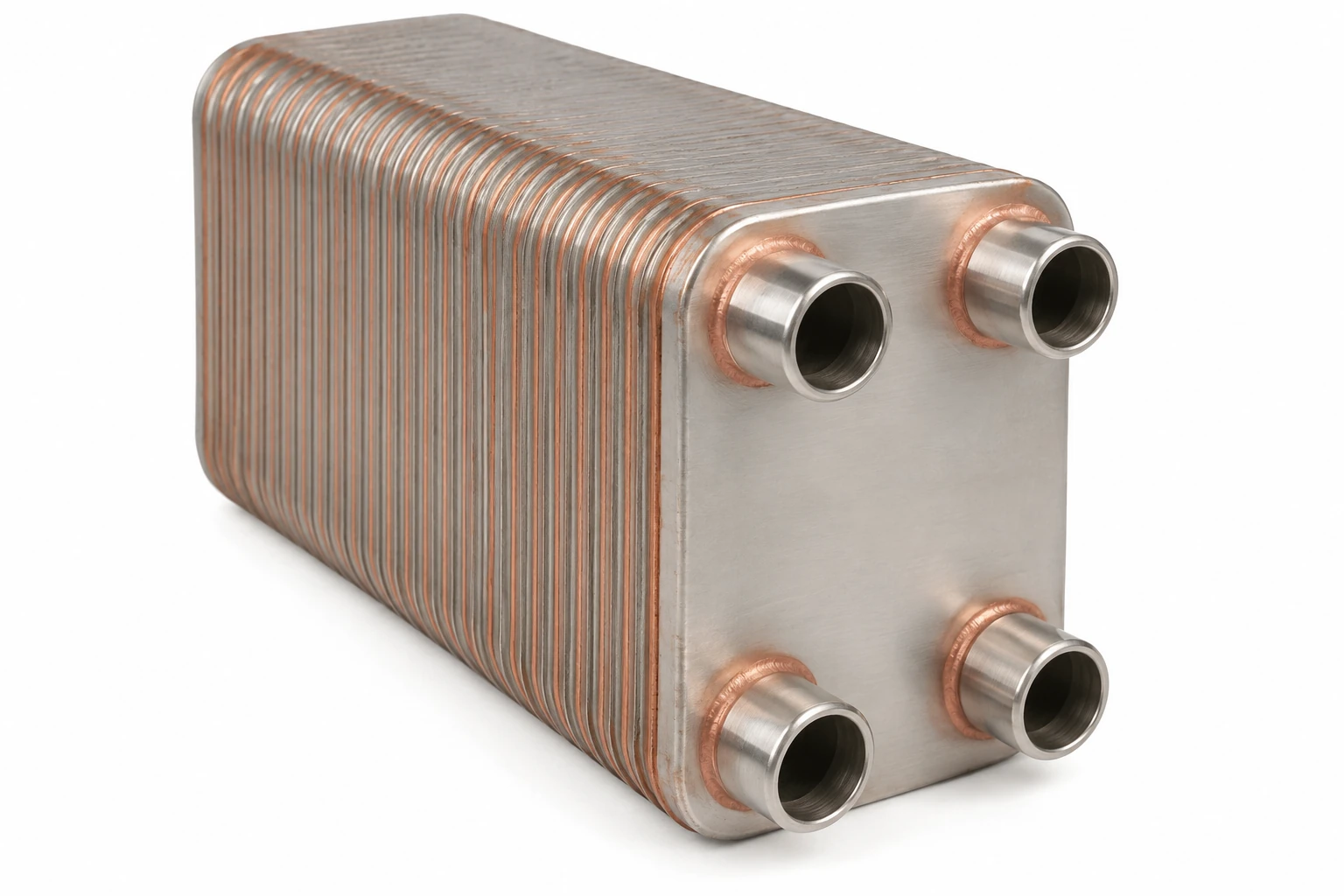
Plate Heat Exchangers
brazed plate heat exchanger
| Brand | shengtongJH |
|---|---|
| Plate material | 316L stainless steel; selected alternatives |
| Brazing material | Copper; nickel-brazed option where the selected duty requires it |
| Plate count choices | 20 / 30 / 50 / 80 plates, subject to thermal and hydraulic selection |
| Body face size classes | Approx. 120 × 290 / 120 × 380 / 120 × 530 mm, width × height |
| Pack depth | Varies with plate count, channel design and end plates |
| Connections | 3/4 / 1 / 1 1/4 inch threaded or suitable welded fittings |
| Pressure selection | 10 / 16 / 30 bar design classes depending on construction and temperature |
| Fluid selection | Water or compatible water/glycol; other fluids require a specific selection |
| Mounting | Brackets or mounting studs where supplied; independently supported piping |
| Accessories | Strainer, insulation and flushing connections |
Not every pressure class is available with every brazing material. Maximum pressure and maximum temperature must be checked together for the selected unit.
The plate pack, brazing material, connections and mounting can be customized to the circuit conditions and available space.
A brazed plate heat exchanger joins its plate pack permanently, producing a compact component without a removable compression frame. It is useful for suitable clean industrial fluid circuits where installation space is limited and a defined cleaning strategy is available.
A small component still needs a complete selection
Two brazed units can look similar while having different channel patterns, pressure ratings and connection arrangements. Plate count alone does not establish interchangeability. Match the required heat duty and allowable pressure drop before accepting a replacement based on body dimensions.
The brazing material contacts the fluid and forms part of the compatibility assessment. Stainless steel plates do not make every copper-brazed unit suitable for every chemical or water supply. Consider the complete wetted construction, including joints and connections.
Protect narrow passages
Installation debris can obstruct the channels. Flush the system and select an accessible upstream strainer suited to the equipment. A hidden strainer that cannot be cleaned becomes another cause of lost flow.
Avoid pipe stress
The compact unit should not support heavy valves or long pipes. Use suitable mounting and pipe supports, with connection methods consistent with the selected construction.
Provide a cleaning route
Isolation and flushing connections let the unit be serviced without emptying the entire plant. Cleaning chemistry must suit the plate and braze materials as well as the deposits.
When openable construction is preferable
If frequent mechanical cleaning is expected, an accessible gasketed exchanger may be easier to maintain. Brazed construction does not provide the same direct access to each heat-transfer surface. This trade-off matters more than a small difference in purchase price when the fluid routinely carries solids.
Check the actual operating envelope
Water cooling, refrigerant evaporation and oil cooling require different selections. A water-to-water catalogue entry is not evidence of suitability as a refrigerant evaporator. Freeze protection, fluid distribution and pressure containment must be addressed for that service.
For a replacement enquiry, include the existing nameplate, connection sizes, fluid composition and operating temperatures. shengtongJH can coordinate a suitable supply comparison without assuming that an externally similar unit has the same duty.
The plate pack, brazing material, connections and mounting can be customized to the circuit conditions and available space.