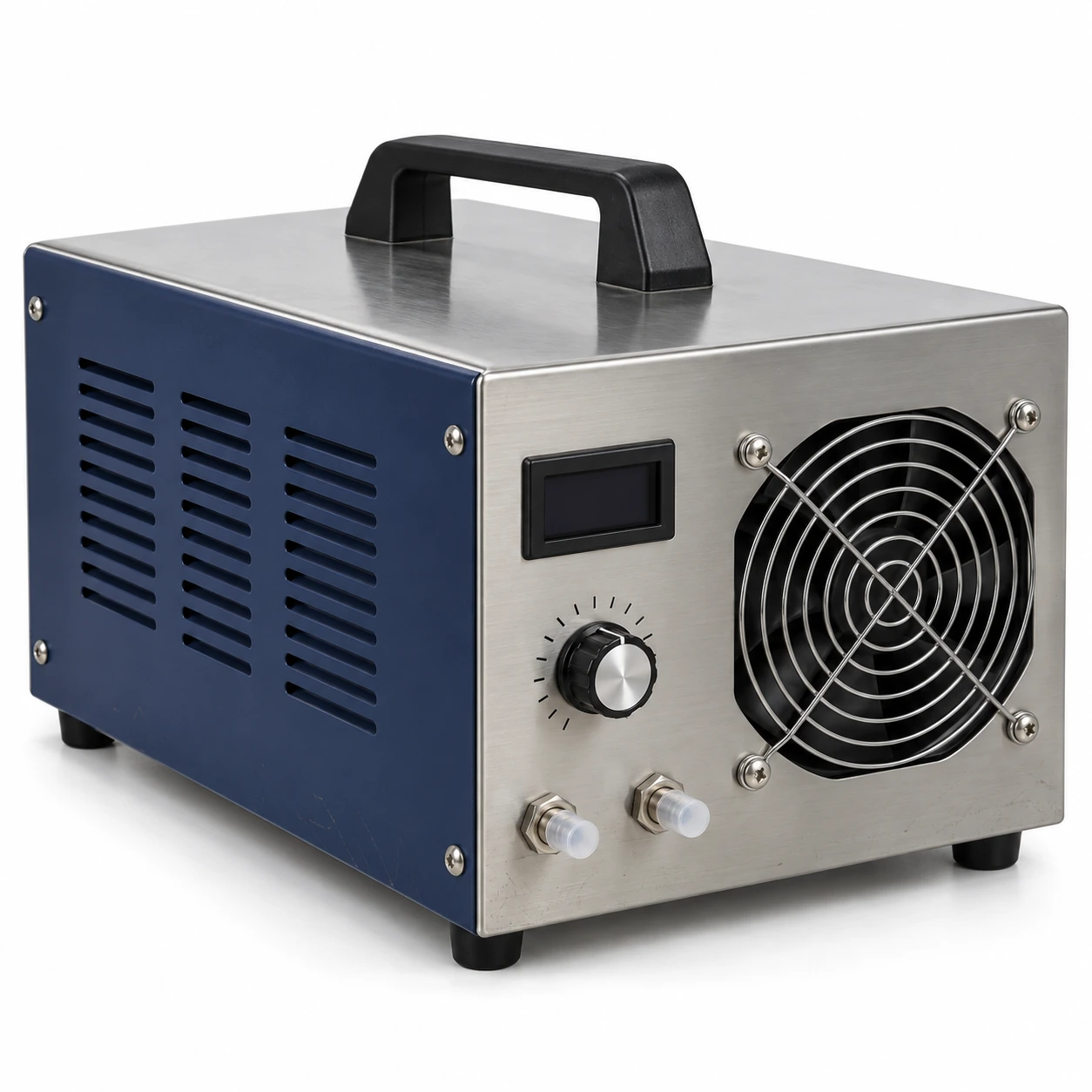
Ozone Generators
ozone generator
| Generator arrangement | Compact gas-output unit or cabinet with integrated oxygen supply |
|---|---|
| Nominal production options | 1, 2, 3 or 4 g/h compact units; 10 or 20 g/h oxygen-fed cabinets |
| Compact external W × D × H (mm) | 180 × 135 × 295; 280 × 140 × 350 |
| Cabinet external W × D × H (mm) | 420 × 200 × 560; approximately 610 × 305 × 914 |
| Feed gas | Conditioned dry air or oxygen supply matched to the selected generator |
| Cooling | Air cooling; water-cooled configuration for suitable process duties |
| Gas connection | Ozone-compatible outlet tubing and fittings; connection size by assembly |
| Electrical and controls | Mains supply to destination specification; output adjustment and external enable options |
| System accessories | Gas preparation, injection or contact equipment, off-gas destruction and monitoring by application |
Dimensions describe the generator enclosure. Pipework, service clearances and treatment accessories need additional space; rated output depends on the specified feed gas and operating conditions.
The ozone generator configuration can be customized for the treatment process, installation space and required control interfaces.
An ozone generator produces ozone at the point of use for a defined oxidation process. Choosing the machine starts with where the gas must go: into a contained water-treatment circuit, through a process connection, or into an access-controlled, unoccupied treatment space. These duties need different supporting equipment even when the quoted production rate looks similar.
Choose the delivery method before the output
A contained water circuit
The generator is one part of an assembly that introduces gas into flowing water, provides contact and manages undissolved gas. An injector or contactor needs the correct hydraulic conditions. A larger generator cannot compensate for a mixing arrangement that sends most of its gas straight to the off-gas line.
A connected industrial process
At a process connection, gas flow, pressure and concentration must agree with the receiving equipment. The scope should identify who supplies the isolation valves, compatible tubing and protective devices. A cabinet described as complete may still exclude the equipment between its outlet and the process.
A temporary treatment zone
Professional odour treatment requires a controlled space and an agreed release procedure. Access restrictions, the surrounding occupied areas and the ventilation arrangement influence whether a portable machine is appropriate. It is not a substitute for routine occupied-space ventilation or particle filtration.
Dry air and oxygen change the package
Feed-gas preparation affects both the purchase scope and day-to-day operation. An air-fed assembly may need drying and filtration ahead of the discharge cell. An oxygen-fed unit can use an integrated concentrator or an external supply, with different connections, maintenance tasks and space requirements.
Compare production figures on the same gas basis. Ask for the gas-flow range and the temperature and pressure conditions behind the rating. Treat a quoted maximum as a conditional equipment rating, rather than the amount that will necessarily reach the water or workpiece.
Leave room to maintain the equipment
The installation needs access to intake filters, cooling paths and the parts that require periodic service. Placing a compact cabinet tightly between other machines can restrict airflow and turn a simple filter change into a shutdown. A service-side layout is therefore as relevant as the enclosure footprint.
Discuss the local environment too. Water spray, heat from adjacent equipment and dusty production air can change the enclosure and cooling requirements. An ordinary indoor cabinet should not be assumed suitable for washdown, outdoor installation or a hazardous atmosphere.
Bring the process requirement into the enquiry
shengtongJH coordinates equipment selection around the intended use and the interfaces your site can provide. State the treatment purpose, working medium, available utilities and installation constraints. For water systems, include the flow and the process objective; for professional temporary air treatment, include the controlled-use arrangement and destination market.
If the need is continuous particulate removal, start with Air Filters. For a connected production-water installation, the industrial ozone generator page explains the supporting process equipment in more detail.
The ozone generator configuration can be customized for the treatment process, installation space and required control interfaces.