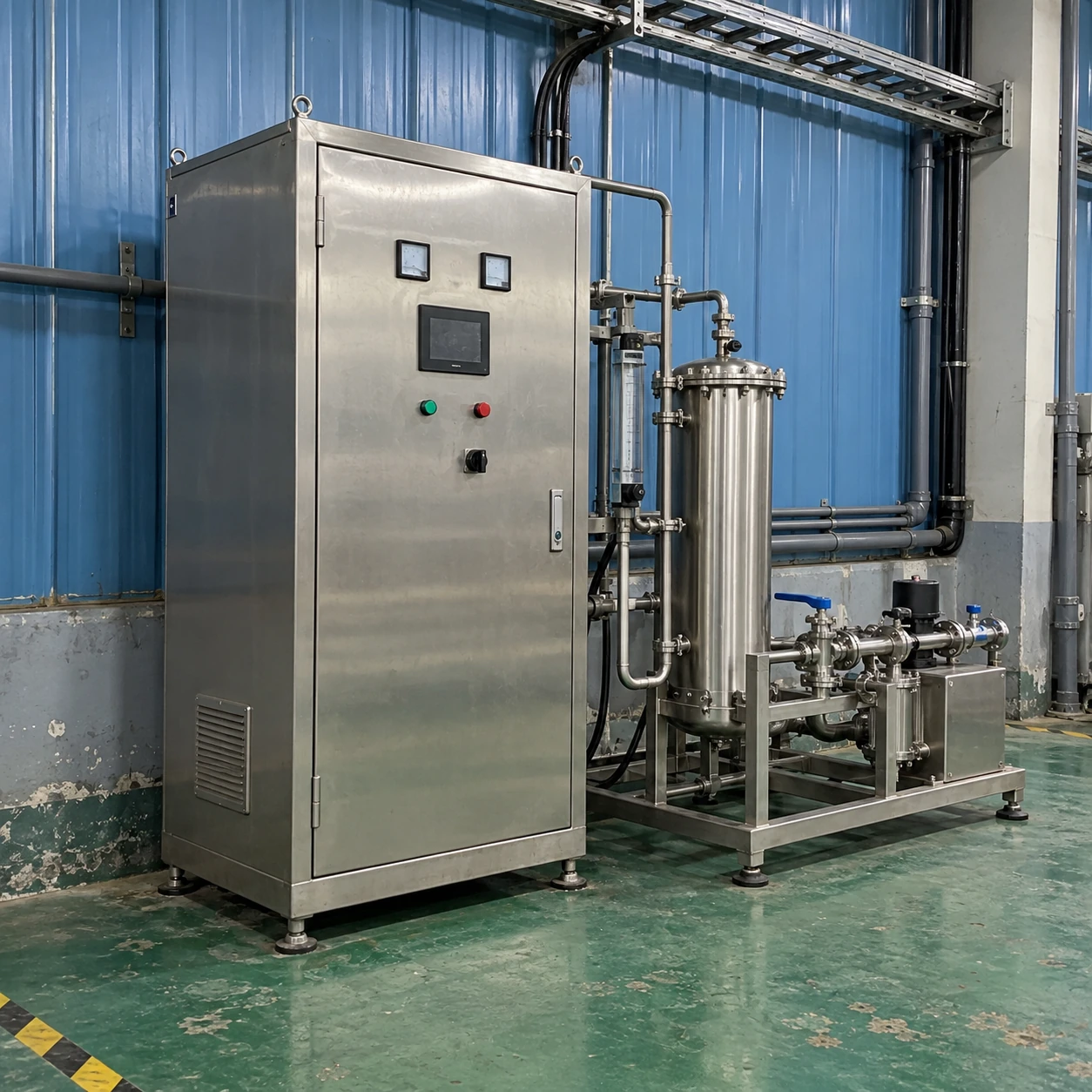
Ozone Generators
industrial ozone generator
| System arrangement | Standalone generator cabinet or integrated gas-supply and water-treatment assembly |
|---|---|
| Nominal production selections | 10, 20, 30, 40, 60, 80 or 100 g/h, according to feed gas and cooling |
| Cabinet external W × D × H (mm) | Approximately 610 × 305 × 914; 660 × 305 × 965; 762 × 305 × 965 |
| Wall-cabinet external W × D × H (mm) | Approximately 760 × 300 × 760; 800 × 300 × 1001 |
| Feed-gas preparation | Dry filtered air or oxygen supply; conditioning matched to the generation cell |
| Cooling options | Air cooling or a specified cooling-water circuit |
| Process connections | Compatible gas line, injection or mixing assembly and contact equipment |
| Control integration | External enable, fault signals and process interlocks to the required scope |
| Residual-gas handling | Gas separation, off-gas destruction and ambient monitoring designed with the process |
These are enclosure options. Contact vessels, pumps, gas preparation and service access require a separate installed-layout drawing; output is specified at agreed gas, temperature and pressure conditions.
The industrial ozone system can be customized for the process medium, available utilities, installation layout and control integration.
An industrial ozone generator supplies a process with ozone, but the complete installation also has to prepare the gas, transfer it into the treatment medium and manage residual gas. For a water-treatment duty, these interfaces usually determine the practical package as much as the generator cabinet does.
Specify the treatment duty, then the gas train
For a water process, the required result depends on incoming water quality and the intended reaction. A circulation flow alone does not establish the ozone requirement. The process designer must define the treatment objective, how changing loads will be accommodated and where the result will be verified.
A gas generator can then be selected with an appropriate control range. A unit that matches only a peak estimate may be difficult to operate efficiently at a normal lower load, while a package selected from average conditions can have insufficient capacity when the incoming load changes.
Follow the interfaces through the installation
- Feed-gas preparation: filtration, drying or oxygen supply must deliver the gas condition required by the generation cell. Include the consumables and service access in the procurement scope.
- Generation and cooling: the cabinet needs a dependable cooling path. Evaluate the installation temperature and utility conditions, rather than relying only on a rating obtained under different conditions.
- Transfer and contact: an injector, mixer or contactor must work with the actual water flow and pressure. Pipe connections and backflow protection belong in the engineered assembly.
- Gas separation and destruction: undissolved ozone must be handled through a suitable designed path. Include the components beyond the contact vessel instead of treating the gas outlet as the end of the project.
- Measurement and control: define the instruments needed for the process and for personnel protection, with appropriate locations, calibration and fault responses.
Coordinate stops as well as starts
A process demand signal is only one input to an integrated system. Loss of water flow, an unsuitable gas condition or a cooling fault can make continued generation inappropriate. Specify the required interlocks and the state of the system following a fault or power restoration.
The interface schedule should distinguish local controls from signals provided by the plant. Identify which party supplies and commissions each device. This avoids an installation in which the generator has a terminal labelled for an interlock but no corresponding field device has been included.
Use the layout to reduce service disruption
Gas preparation and cooling components need regular access. Arrange replacement filters, valves and service panels so they can be reached without dismantling the main process pipework. Keep service space distinct from the enclosure dimensions shown in a quotation.
Materials in contact with ozone need compatibility for the concentration, temperature and wet or dry condition involved. Stainless steel construction on the outside does not describe the internal seals, tubing or connected pump. The material schedule should cover those components individually.
Procure against a complete connection schedule
Provide the process flow information, installation environment, available gas and cooling utilities, and the plant control requirements. shengtongJH can use that schedule to coordinate an equipment package and clarify where site engineering or separately supplied components are required.
Where output figures from different offers appear inconsistent, use the distinctions on ozone generator ozone to compare production rate, concentration and delivered process measurement on the same basis.
The industrial ozone system can be customized for the process medium, available utilities, installation layout and control integration.