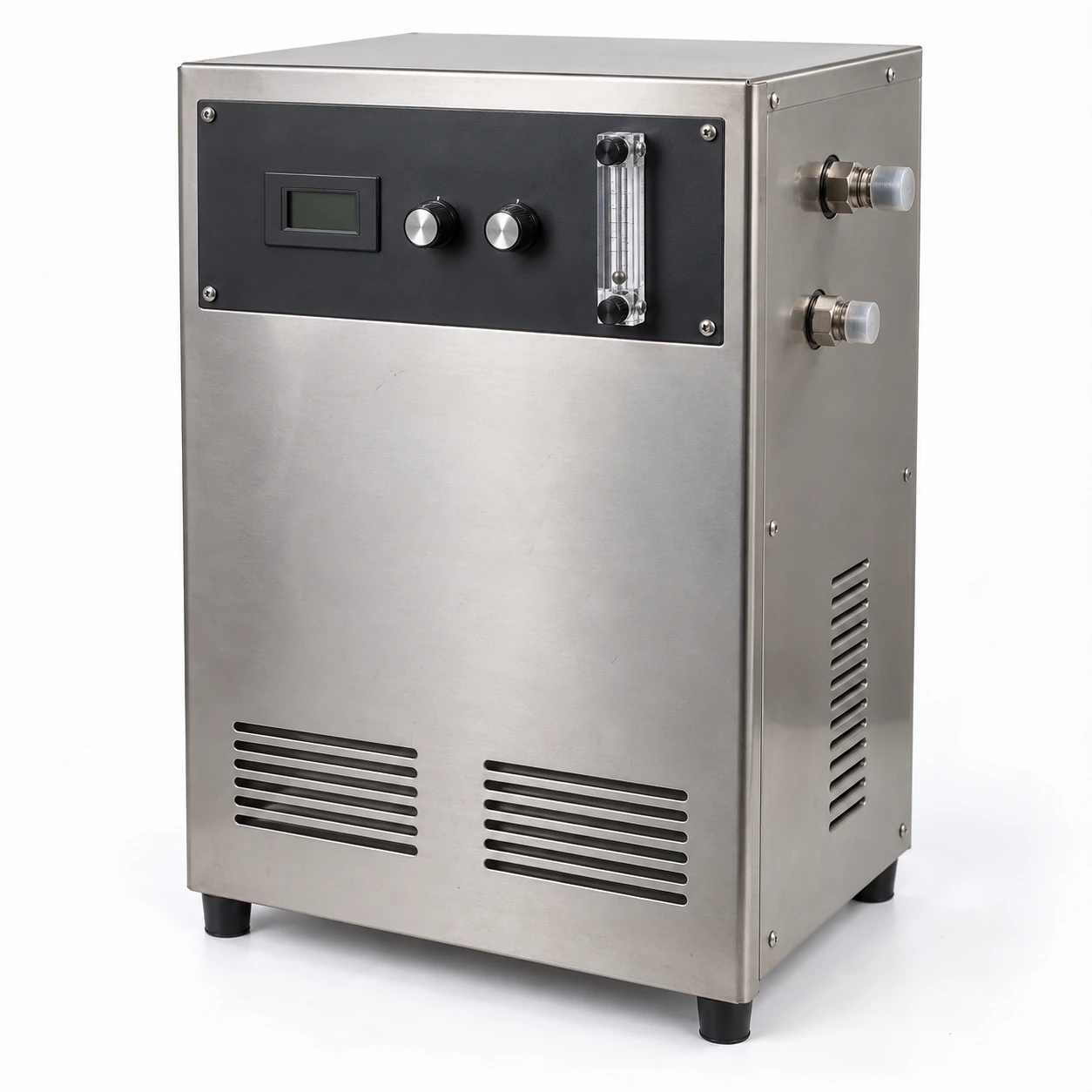
Ozone Generators
ozone generator ozone
| Equipment formats | Gas-output compact unit; oxygen-fed cabinet |
|---|---|
| Production selections | 1–4 g/h compact range; 10, 20, 30, 40 or 60 g/h cabinet configurations |
| Compact external W × D × H (mm) | 180 × 135 × 295; 280 × 140 × 350 |
| Cabinet external W × D × H (mm) | Approximately 610 × 305 × 914; 660 × 305 × 914; 660 × 305 × 965 |
| Gas basis | Dry-air or oxygen-fed generation; rating to identify the selected feed condition |
| Output delivery | Tubed gas outlet with compatible fittings; gas flow selected with the process |
| Indication | Gas-flow indication; output setting; operating and fault status options |
| Integration | External enable and fault contacts; process measurement supplied to the required scope |
Cabinet dimensions exclude external gas preparation, contact equipment and service space. Output settings are not measurements of the ozone concentration in a room or in water.
Gas production, enclosure arrangement and measurement interfaces can be customized to the intended process.
Comparing an ozone generator by its ozone figure alone can lead to the wrong purchase. Production rate, gas concentration, gas flow and the amount reaching the process describe different things. A useful specification connects those values to the same operating condition and to the equipment downstream.
Four figures that should not be treated as one
- Production rate
The mass produced per unit of time describes generator capacity under stated conditions. Check whether the figure refers to dry air or oxygen, and whether it is a maximum or a controlled operating point.
- Gas concentration
This describes how much ozone is carried in the gas stream. A process receiving a small gas volume may need a different concentration from a process able to handle a larger gas volume. Concentration and production capacity should be quoted together.
- Gas flow
This is the volume of carrier gas delivered per unit of time. It influences the connection, mixing equipment and downstream handling. Increasing it does not automatically increase the ozone transferred into the treatment medium.
- Process residual or treatment result
The downstream measurement reflects transfer, reaction and losses as well as generation. It must be measured at an appropriate process point. A power-setting display cannot serve as a result at that point.
Compare offers on a common basis
Two suppliers can give different output figures for similar-looking equipment because the gas supply, cooling condition or pressure differs. Put the rating condition alongside the price. Then compare the included dryer or oxygen source, measuring equipment, cooling requirement and replacement parts.
Specify where the capacity must be demonstrated. Factory measurement at the generator outlet and commissioning of the complete treatment system answer different questions. Both can be relevant, but one should not be presented as evidence of the other.
When the process result falls, look beyond the generator
A change in incoming water quality can consume more oxidant. A restricted injector or an altered water flow can reduce gas transfer. Dirty cooling paths, a feed-gas problem or deteriorated components can affect production. These possibilities call for different corrective work; buying a higher-output cabinet before locating the change may leave the original problem in place.
Establish a record of the approved operating condition during commissioning. Service staff can then compare gas supply, cooling status and the relevant process measurement with that baseline. Fault diagnosis and adjustments should follow the equipment instructions and the site's qualified maintenance procedure.
What to put on the purchase schedule
- Required duty and the point at which output or process performance will be checked.
- Feed-gas supply, cooling arrangement and the outlet conditions the receiving system permits.
- Included instruments, their measurement range and the responsibility for calibration.
- Accessible service parts, replacement details and the agreed commissioning documents.
This information lets shengtongJH compare a complete, compatible supply scope. See ozone generator for the choice between compact gas units and integrated cabinets, or pro ozone generator for maintenance and operating records.
Gas production, enclosure arrangement and measurement interfaces can be customized to the intended process.