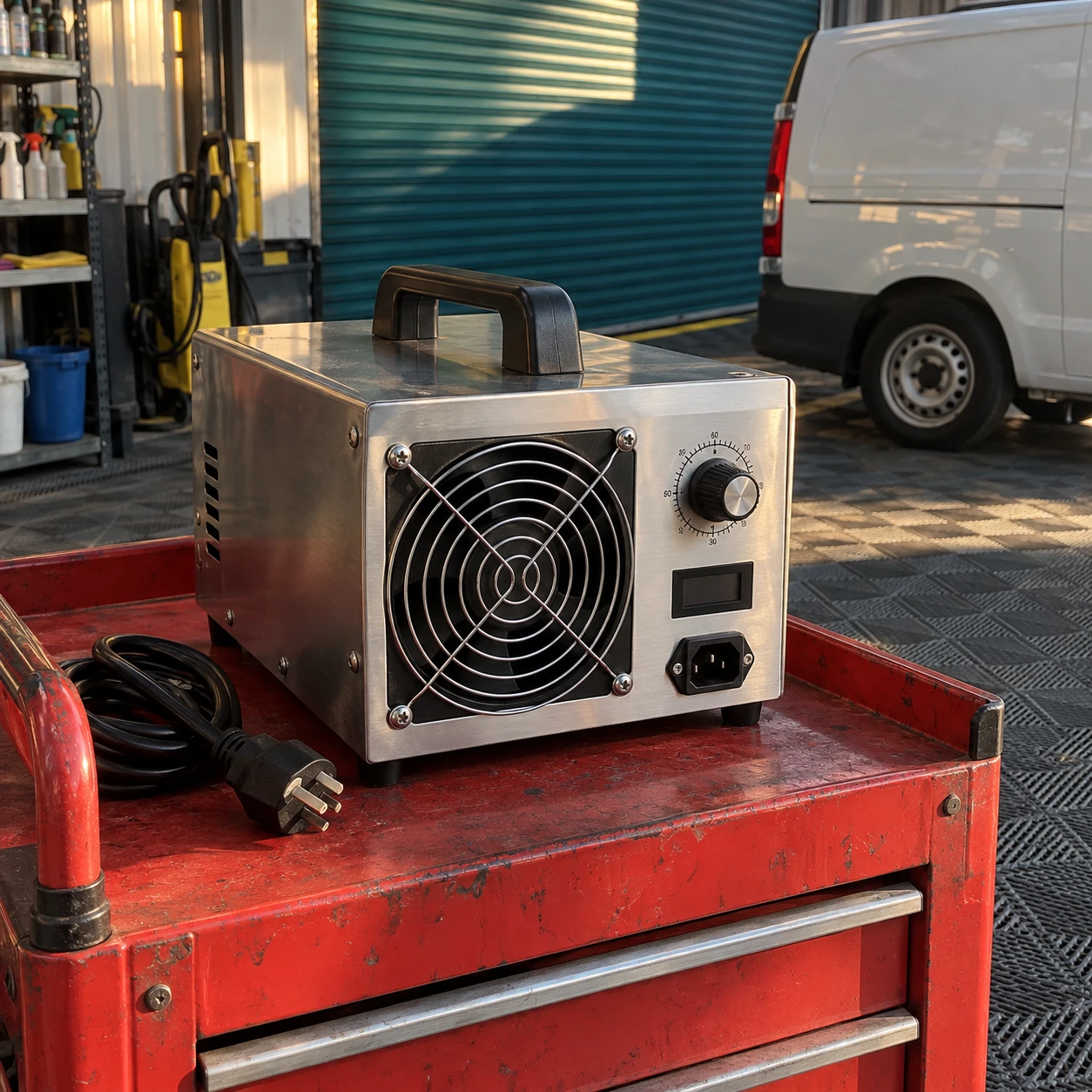
Ozone Generators
auto ozone generator
| Intended equipment use | Professional vehicle reconditioning in an access-controlled, unoccupied treatment area |
|---|---|
| Portable production options | 3.5, 7 or 10 g/h nominal generator configurations |
| External L × W × H (mm) | 460 × 310 × 310; gas-output enclosure option 650 × 350 × 250 |
| Construction | Carry-handle metal enclosure; protected fan opening; replaceable service components |
| Discharge arrangement | Fan-assisted outlet or a dedicated compatible gas connection, according to the unit |
| Power supply | Mains-operated configurations matched to destination voltage and frequency |
| Control options | Output adjustment, timer and operating-hours indication |
| Site equipment | Ozone measurement, controlled ventilation and access management specified separately |
Sizes are external enclosure dimensions, excluding leads and clearances. A gas-output unit needs an appropriate delivery assembly; its outlet must not be treated as a complete vehicle-treatment system.
Portable equipment and control options can be customized for the vehicle type and the reconditioning business's controlled-use procedure.
For vehicle reconditioning businesses, an auto ozone generator is a portable treatment tool considered after the source of an odour has been investigated and the interior cleaned. Its purchase should fit a controlled workshop process. It is not an air freshener for use with a driver or passengers inside.
A recurring smell usually has a source
Wet underlay, a contaminated cabin filter, trapped food and smoke residues need different remedial work. A vehicle that smells acceptable briefly but deteriorates again has not necessarily received an inadequate treatment cycle. The underlying material may still be wet or contaminated.
Inspect the complaint, remove the source where possible and complete the appropriate cleaning and drying first. An ozone machine should not be sold as a way to avoid lifting affected trim, repairing a water leak or replacing material that cannot be restored.
Make treatment part of a controlled job
- Accept the vehicle with a defined objective. Record the reported problem and the condition of relevant interior materials. Avoid promising complete removal before assessing the cause.
- Assign responsibility for the restricted area. Trained staff need to control entry and protect adjacent occupied areas. The vehicle remains out of service during treatment and subsequent clearance.
- Release it on verified conditions. Ventilation and suitable measurement support the return-to-use decision. An elapsed timer or a change in smell alone does not establish clearance.
- Record the handover. Note the work completed, unresolved source problems and any limitations the customer needs to know.
Select for workshop handling
A carry handle, stable feet, a protected grille and a replaceable intake filter can matter more in daily work than an oversized maximum rating. Equipment moves between bays and storage, where loose cables and dirty air can create avoidable maintenance problems. A suitable storage position keeps the unit dry and the connection points protected.
Check the power supply at the intended bay. A mains-powered machine should not be confused with a small accessory plugged into a vehicle socket. Where a hose-delivery arrangement is required, specify the compatible connection and its complete system scope instead of improvising an adapter.
Capacity does not set the appointment length
Vehicle volume is only one part of the assessment. Interior materials, contamination, ventilation and the approved method influence the job. A higher-output machine does not justify a universal short cycle or a fixed collection time for every car. Plan appointments around the full controlled process, including cleaning, drying and verified release.
For multi-site procurement, keep the equipment instructions, replacement parts and operator records consistent. shengtongJH can coordinate a suitable equipment package against those requirements. Buyers serving California should also review the specific California eligibility requirements before ordering.
Portable equipment and control options can be customized for the vehicle type and the reconditioning business's controlled-use procedure.