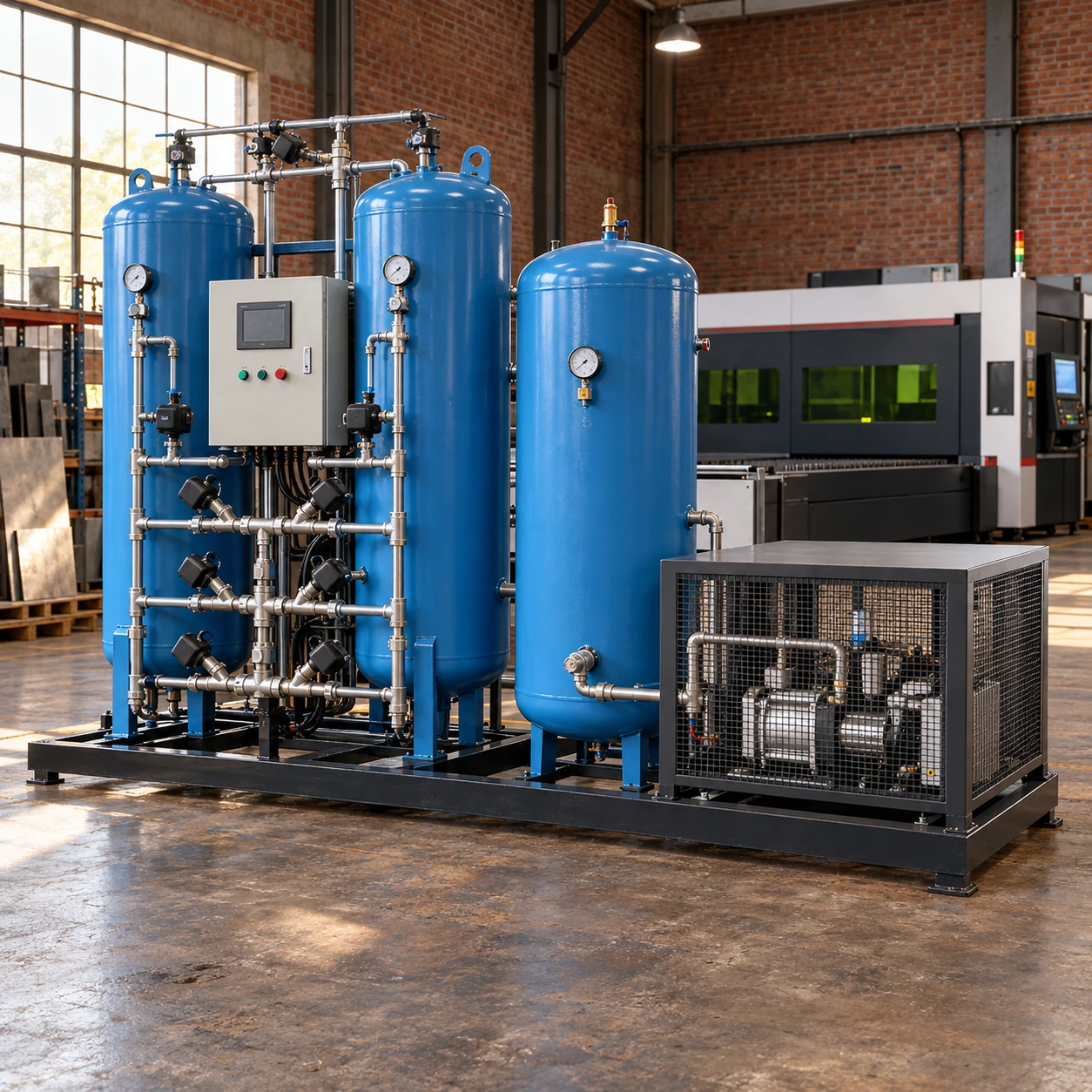
Nitrogen Generators
nitrogen generator for laser cutting
| Generation method | PSA nitrogen generation with application-specific purification |
|---|---|
| Gas-quality selection | 99.9%, 99.99% or 99.999% duties, subject to the cutting-machine specification |
| Generator external W × D × H (mm) | 775 × 840 × 2015; 1400 × 840 × 2015; 1421 × 970 × 2015 |
| Supply arrangement | Generator, buffer receiver, compatible booster and selected storage package |
| Assist-gas pressure | Established at the cutter inlet under flow; booster and regulation selected accordingly |
| Demand basis | Peak nozzle demand, simultaneous cutters and refill time between cutting periods |
| Gas monitoring | Residual oxygen, delivery pressure and required moisture/contaminant checks |
| Controls and backup | Quality diversion, low-pressure alarm and planned backup-source interface options |
The dimensions cover the generator section only. Booster, storage vessels, compressor and access routes require a separate installation envelope; a purity selection alone does not establish cut quality.
The laser-cutting gas package can be customized for the cutter specification, materials, shift pattern and required continuity of supply.
A nitrogen generator for laser cutting must deliver the cutter's specified assist gas at the required pressure while the nozzle is flowing. The generator, booster, storage and distribution line form one supply chain. Sizing only from a daily gas total can leave the machine short during a demanding cut.
Start with the cutter's gas schedule
Nitrogen assist gas helps limit oxidation and clear molten material from the cut. The required quality, pressure and flow depend on the machine and the cutting process. Obtain the equipment manufacturer's gas requirements for the intended materials and thicknesses before selecting the supply package.
Distinguish assist gas from any separate purge requirement. These connections can have different pressure and cleanliness requirements. Combining them in a single consumption estimate can hide the condition each connection must receive.
Production rate
The generator must replace gas consumed over the operating period at the selected purity. Use realistic cutting time and material mix; a peak machine rating alone can lead to excessive installed capacity.
Booster throughput
The booster must accept the available inlet gas and deliver at its specified discharge condition. Its throughput and operating pattern must agree with both the generator and the storage arrangement.
Usable reserve
Storage can supply a short peak and allow production between cuts. Its useful reserve depends on the pressure range the cutter can use. A large vessel does not solve a sustained shortfall over the whole shift.
Check pressure at the consuming machine
A pressure reading near the storage outlet can look satisfactory while a restrictive regulator, small line or loaded filter causes a drop at the cutter. Assess delivery under representative flow and identify the acceptable losses through the complete path.
Compressed-gas vessels, boosters and associated protection must be suitable for their intended pressure and local installation requirements. Specify a coordinated assembly rather than adapting low-pressure components to a higher-pressure duty.
Protect production when supply conditions change
Quality monitoring and a defined off-spec response help prevent unsuitable gas from being sent to a critical cut. Decide whether the system should inhibit supply, signal the cutter or change to a compatible backup source. Include the required contacts and commissioning responsibility in the purchase scope.
A useful enquiry includes the cutter model, its gas schedule, material and thickness range, simultaneous demand and working hours. shengtongJH can coordinate the generator and supporting equipment around these inputs. The broader nitrogen generator systems page compares central, modular and backup arrangements when several users share the supply.
The laser-cutting gas package can be customized for the cutter specification, materials, shift pattern and required continuity of supply.