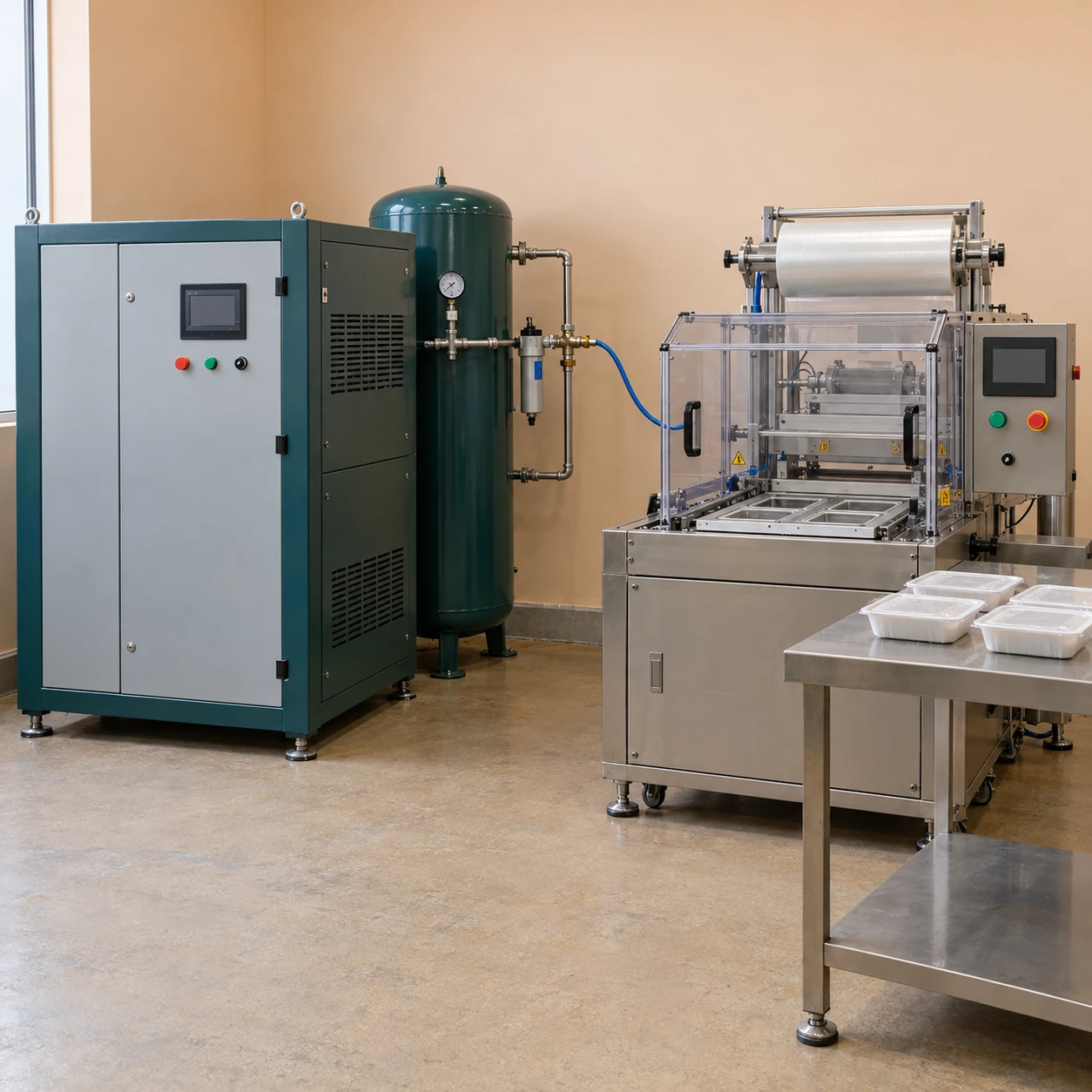
Nitrogen Generators
nitrogen generator for food packaging
| Separation technology | PSA nitrogen generation; membrane options where the gas specification permits |
|---|---|
| Generator external W × D × H (mm) | 775 × 840 × 2015; 1400 × 840 × 2015; 1400 × 970 × 2015 |
| Gas selection | Nitrogen supply or nitrogen feeding a separately specified blending system |
| Capacity basis | Gas use per pack, packs per cycle and maximum sustained line speed |
| Pressure control | Regulated delivery at the packaging-machine connection |
| Storage | Product receiver sized for flushing bursts and generator recovery |
| Quality monitoring | Generator oxygen analysis and separate package-atmosphere testing |
| Process interface | Gas-ready signal, off-specification isolation and line-stop coordination options |
| Final delivery | Compatible food-contact gas piping and application-specific point-of-use treatment |
The listed external sizes cover different generator configurations. Receiver volume, blending equipment and the complete installation footprint depend on the packing duty.
The nitrogen generation and delivery arrangement can be customized for the product, packaging machine and production pattern.
A nitrogen generator for food packaging supplies gas to the packing process. Successful modified-atmosphere packaging also depends on the food, gas recipe, packaging machine, film and seal. The generator must deliver the required gas quality and flow while the line is actually cycling.
Start with the pack atmosphere, then specify the generator
Different foods require different atmosphere strategies. Nitrogen may displace air and provide a relatively inert filling gas, while another recipe may need carbon dioxide or a controlled oxygen content. Do not replace a validated mixture with pure nitrogen simply because a generator is available.
Set the required gas composition with the product and packaging process in mind. This includes the food's respiration or spoilage behaviour, the package material and the intended storage conditions. Gas flushing does not replace hygiene, temperature control or the validation of shelf life.
Separate three measurements that answer different questions
- Gas at the generator: establishes whether the supply meets its oxygen specification under the selected operating conditions.
- Gas at the machine: checks what reaches the line after storage, regulation and distribution.
- Gas inside the sealed pack: assesses the result of flushing, product loading, headspace and sealing.
A high-purity supply can still leave excessive oxygen inside a pack when the flushing arrangement is ineffective. Conversely, changing the generator setting will not correct a leaking seal or a film that is unsuitable for the desired atmosphere.
Size around the flushing pulse
A machine can draw gas quickly during a short part of its cycle. Several heads or lines operating together can create a peak well above the average hourly consumption. Use the machine's gas requirement at the actual pack size and cycle rate, including permitted start-up or changeover losses.
A product receiver can smooth these bursts and reduce pressure variation at the machine. Its usable storage depends on the allowed pressure range; physical vessel volume alone does not describe the available gas. The generator must still replenish the buffer during sustained production.
Make gas availability part of line control
Define what happens during start-up, a quality alarm or a supply interruption. A gas-ready signal can prevent the machine from accepting unsuitable gas, but its logic must be agreed with the packaging-equipment supplier. After service, verify the gas path and package result before returning to normal production.
shengtongJH can assemble a procurement scope from the food type, package format, gas recipe, line speed and available compressed air. Broader tank and beverage processing duties are covered under nitrogen generator for food and beverage.
The nitrogen generation and delivery arrangement can be customized for the product, packaging machine and production pattern.