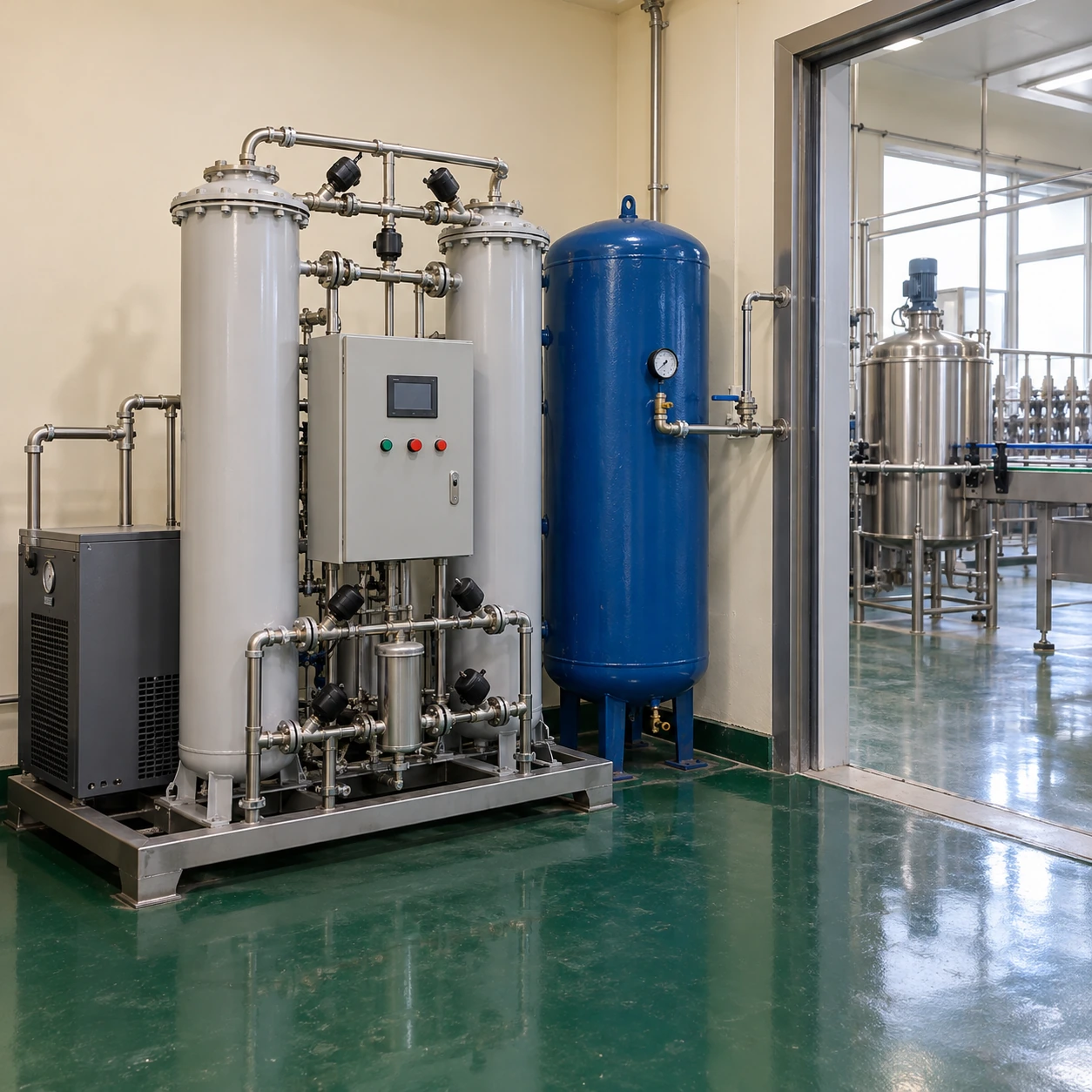
Nitrogen Generators
nitrogen generator for food and beverage
| Generation method | PSA or membrane separation, selected for the required oxygen limit and demand |
|---|---|
| PSA external W × D × H (mm) | 775 × 840 × 2015; 1400 × 840 × 2015; 1400 × 970 × 2015 |
| Membrane external W × D × H (mm) | 560 × 285 × 1150; 820 × 772 × 2090 |
| Process connections | Tank blanketing, product transfer, sparging or filling interfaces |
| Gas quality | Residual oxygen and contaminant limits defined for the intended food-contact use |
| Delivery | Regulation and buffering matched to the process operating pressure and peak demand |
| Air preparation | Drying, filtration and oil control matched to the separation equipment |
| Monitoring and control | Oxygen analysis, pressure indication and off-specification gas isolation options |
| Distribution | Compatible piping and point-of-use treatment selected for the process hygiene requirements |
Dimensions apply to generator enclosures in different configurations. Compressors, gas storage, sanitary interfaces and installation clearances are selected separately.
The nitrogen supply package can be customized for the food or beverage process, contact requirements and production schedule.
Nitrogen can reduce unwanted contact with oxygen during food and beverage processing. A suitable supply connects the generator to a defined process: protecting tank headspace, displacing air during transfer or supplying a filling operation. The gas specification and delivery arrangement need to follow the product and process, including any direct food contact.
Match the delivery method to the product
Tank headspace
Blanketing supplies gas above the liquid as tank contents change. The control arrangement needs to work with the vessel's pressure and venting limits. A generator outlet must not be connected directly to a tank without suitable pressure control and protection.
Transfer and filling
Empty pipe sections, containers and filling steps can introduce oxygen after an earlier processing stage. Coordinate gas delivery with the actual sequence so that protection is maintained where the product is exposed.
Sparging
Passing nitrogen through a liquid can help reduce dissolved oxygen in suitable processes. Contact time, gas dispersion and the liquid's properties affect the result. Excessive gas treatment may disturb foam, aroma or the desired product character.
A purity percentage is only part of food-contact quality
Residual oxygen describes one part of the gas composition. It does not demonstrate control of oil, moisture, particles or microbiological contamination. Review the air intake location, compressor and treatment train, generator, storage and final delivery components as one chain.
Define the required quality evidence and sampling location for the intended use. A good reading at the generator does not establish the condition of gas leaving an unmaintained distribution line. Point-of-use treatment may be appropriate, but it must be selected and maintained for the actual hygiene requirement.
Follow the production schedule when sizing the supply
A tank drawdown, a batch transfer and a filling run may create very different demand patterns. Add the operations that can occur together rather than multiplying a monthly average. A buffer can help meet short peaks; it needs enough recovery time between them.
Place generation and compressor equipment where heat, maintenance activity and exhaust can be managed without compromising production hygiene. Nitrogen releases also require suitable ventilation and an assessment of oxygen-depletion risk in enclosed areas.
shengtongJH can coordinate equipment selection around the process flow, gas specification and existing utilities. Where the principal task is sealed-package gas flushing, the food packaging page addresses pack atmosphere, sealing and peak flushing demand in more detail.
The nitrogen supply package can be customized for the food or beverage process, contact requirements and production schedule.