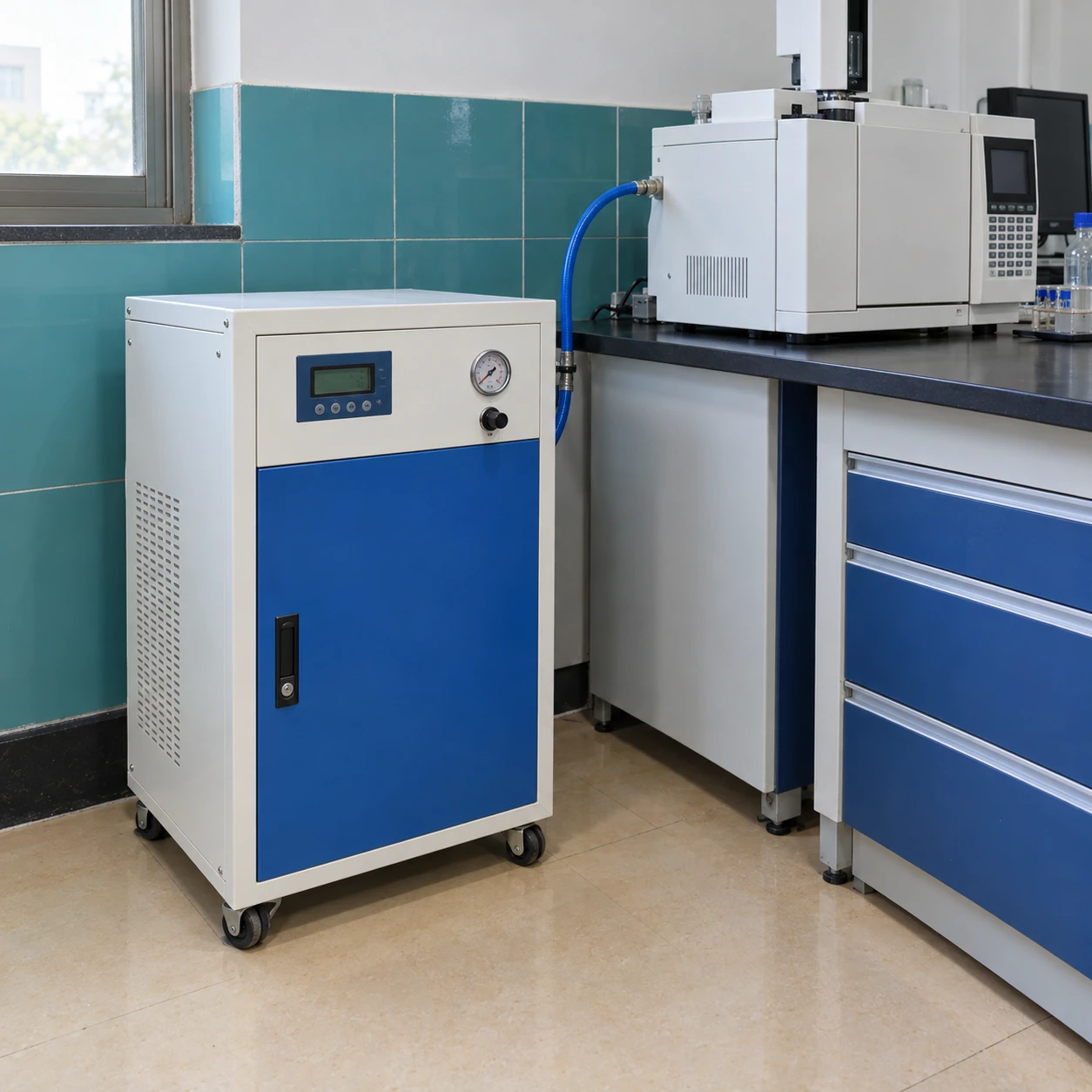
Nitrogen Generators
laboratory nitrogen generator
| Application arrangements | Low-flow high-purity gas; higher-flow instrument source gas |
|---|---|
| Low-flow selections | Up to 0.6 L/min or 5 L/min configurations, with the required gas-quality specification |
| Higher-flow selection | Up to 35 L/min class; purity and pressure depend on the selected configuration and flow |
| Bench unit W × D × H (mm) | 380 × 540 × 256 |
| Floor unit W × D × H (mm) | 449 × 406.5 × 1235; 570 × 710 × 650 |
| Air source | External conditioned air or integrated compressor |
| Delivery pressure options | Up to 5.5 bar or 8 bar configurations, selected against the instrument requirement |
| Gas-quality definition | Residual oxygen, moisture and relevant trace contaminants specified for the application |
| Electrical and service | Destination mains version; accessible filters, ventilation and service connections |
The low-flow and higher-flow figures describe different configurations. Maximum flow, pressure and purity must be confirmed together; the sizes exclude tubing and service clearances.
The laboratory gas package can be customized to the instrument specification, installation location and required continuity of operation.
A laboratory nitrogen generator should be selected from the analytical instrument's gas specification. A low-flow application requiring very low oxygen and trace contaminants is different from a higher-flow source-gas duty. The same nitrogen label does not make two generators interchangeable.
Begin with the instrument connection
Identify the gas function before requesting a generator: carrier gas, detector support, nebulisation, drying or sample preparation can impose different conditions. The instrument's site-preparation document should define the required supply at each connection.
Where several instruments are proposed, establish which operate simultaneously and whether their gas requirements are compatible. Adding their nominal flows is not sufficient if one requires a different purity, pressure or trace-contaminant specification.
Match quality as well as quantity
A high-flow generator intended for an instrument source may not meet a trace-analysis requirement. Conversely, an excellent low-flow purity specification does not make a small unit suitable for a much larger gas demand. Treat both conditions as part of one selection.
Residual oxygen is only one aspect of analytical gas quality. Moisture, hydrocarbons and other contaminants may affect a method or an instrument. The purchase specification should identify those limits and the relevant documentation instead of relying on a broad analytical-grade description.
Decide where the compressor belongs
An integrated compressor reduces dependence on a separate air connection but adds heat, sound and maintenance activity near the instrument. An external-air configuration can move that equipment elsewhere, provided the incoming air remains suitable at the generator.
Do not close a ventilated cabinet tightly beneath a bench or place its warm exhaust against the instrument intake. Allow room for filter replacement and access to the gas and power connections. The equipment footprint and its usable installation envelope are different.
Protect the analytical schedule
Startup and recovery following a service interruption may take time. Plan instrument work around the approved readiness indication and any method-specific requirements. For long unattended runs, determine how a gas-supply fault will be reported and how the instrument should respond.
Delivery tubing, fittings and local regulators also affect the condition at the instrument. Keep the installation compatible with the gas specification and follow the instrument and generator instructions for commissioning and maintenance.
Provide the instrument model and gas requirements with the enquiry. shengtongJH can coordinate an equipment configuration without claiming automatic compatibility with every analyser. If installation space is the main constraint, compare the trade-offs on small nitrogen generator.
The laboratory gas package can be customized to the instrument specification, installation location and required continuity of operation.