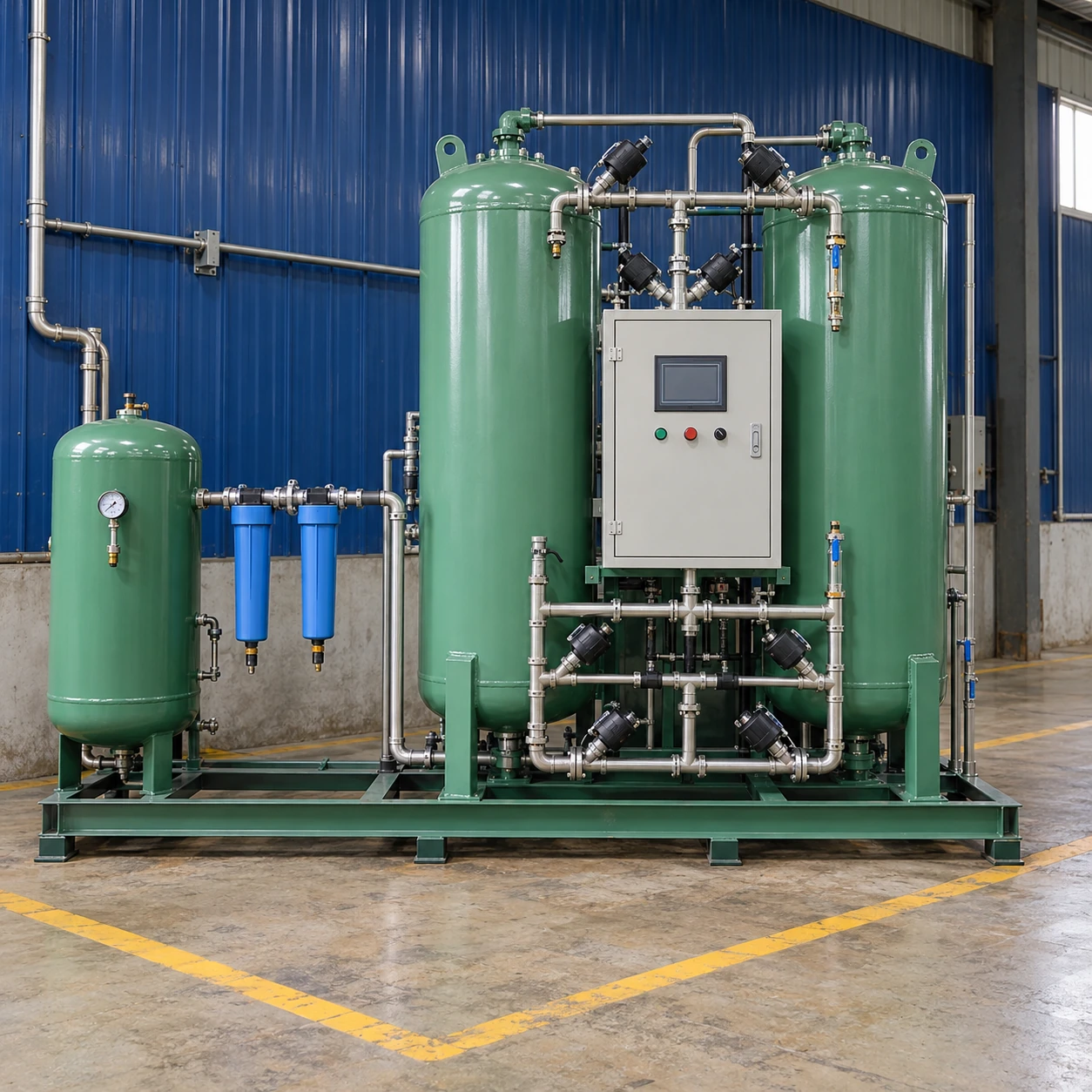
Nitrogen Generators
industrial nitrogen generator
| Generator arrangements | PSA twin-bed or modular membrane installation |
|---|---|
| Purity selections | PSA duties at 99%, 99.9%, 99.99% or 99.999%; membrane selected where its range suits the process |
| PSA external W × D × H (mm) | 775 × 840 × 2015; 1400 × 970 × 2015; 1421 × 970 × 2015 |
| Membrane external W × D × H (mm) | 820 × 772 × 2090; 820 × 1470 × 2090 |
| Feed-air requirements | Conditioned compressed air with pressure, temperature and quality limits defined for the selected unit |
| Storage and distribution | Receiver capacity and line pressure loss matched to the load profile |
| Plant controls | Demand-based operation, gas-quality monitoring, fault output and remote status options |
| Continuity options | Isolated modules, planned backup connection and maintenance access |
Generator dimensions exclude supporting plant. Capacity is selected at the required purity and actual feed-air conditions; the largest flow and highest purity are not assumed to occur together.
The industrial nitrogen installation can be customized for the process requirements, shift pattern, plant environment and continuity plan.
An industrial nitrogen generator serves a production duty that may run across several shifts and share utilities with other equipment. Selection must address the actual operating environment, changing gas demand and the consequence of an interruption. A cabinet rating is only one part of that assessment.
Use the production profile to set capacity
A steady process blanket, an intermittent purge and several machines starting together create different demands. Record the normal draw, the short peaks and the time available to replenish storage. The information is more useful than a single daily total when choosing the generator and receiver.
Consider foreseeable process changes without turning every possible future expansion into installed capacity today. Where future demand is uncertain, an expandable layout or provision for another module may be more practical than operating a large unit at a small fraction of its duty.
Plant air availability
A shared compressor system needs sufficient capacity after existing users and treatment losses are considered. Check pressure during the busy part of the production cycle. A quiet-period reading can conceal the shortage that appears when several machines run.
Installation environment
Hot, dusty or damp service areas can increase the burden on cooling and treatment equipment. Select the enclosure and air-preparation arrangement for the actual location, and keep heat-producing equipment from feeding its exhaust into another machine's intake.
Gas distribution
Long pipe runs, local regulators and final filters affect pressure at the consumer. Divide the network into sensible isolation sections so routine maintenance does not unnecessarily stop every user.
Choose the quality that protects the process
Different industrial duties need different residual oxygen and contaminant limits. An application requiring controlled moisture or hydrocarbon levels cannot be specified by nitrogen percentage alone. Agree how the delivered gas will be sampled and what condition will trigger an alarm or interruption.
Where the process is sensitive, retain records of the accepted operating condition. A change in gas quality can then be investigated alongside air treatment, control behaviour and downstream demand, rather than being dismissed as a change in the production material.
Plan a serviceable installation
The availability of filters, drain components, valves and analyser service can matter as much as the initial equipment cost. Provide access to those items and identify appropriate isolation arrangements. Maintenance work on pressure equipment must follow the equipment instructions and qualified site procedures.
Define the response to loss of power, air or gas quality. If the process cannot tolerate an interruption, determine what the backup source can support and how the changeover will be tested.
Compare operating cost on the same duty
Use the required purity, useful gas output and realistic working hours when comparing equipment. Include compressor energy, drying, maintenance and any backup supply. A saving quoted for a different plant or purity does not establish the result at your facility.
shengtongJH can coordinate equipment selection from that duty description. For the detailed connection scope, see nitrogen generator system.
The industrial nitrogen installation can be customized for the process requirements, shift pattern, plant environment and continuity plan.