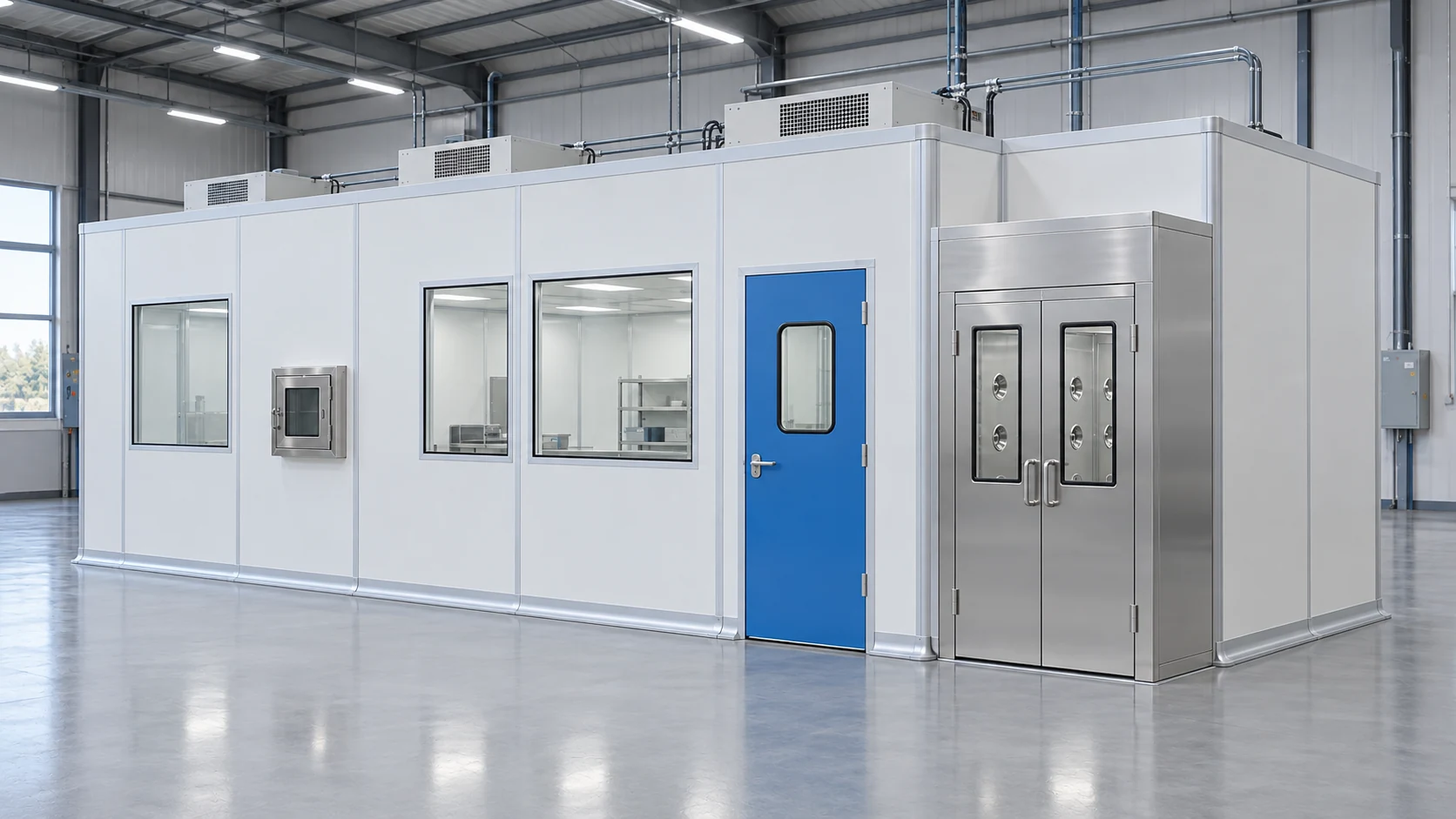
Keep particle control and thermal control coordinated
Filtered air circulation does not by itself establish a cooling capacity. The design needs equipment heat-release information, occupancy, operating hours and the required room temperature and humidity range. Include start-up and idle conditions where they differ from normal production.
Identify process exhaust early. Replacement air may create a conditioning requirement that is much larger than expected from the enclosure size. Also identify where the return air can travel without conflicting with equipment or the host building.
Avoid selecting cooling equipment from an assumed air-change number. Air quantity, cooling duty, humidity control and pressure relationships are connected but separate calculations. A coordinated mechanical design should explain how each requirement is met and how the system will be operated.
Configuration decisions
| Decision | What to define |
|---|---|
| Process heat | Request sensible and latent heat information at realistic operating loads. |
| People and lighting | Record occupancy patterns and installed lighting loads. |
| Outside or makeup air | Identify exhaust replacement and inlet design conditions. |
| Control range | Define acceptable temperature and humidity ranges and monitoring locations. |
Can room volume determine cooling capacity?
Volume is one input, but it does not capture equipment heat, moisture, external conditions or exhaust makeup. These inputs must be assessed before specifying a capacity.